Copy Trading Risk Management:
Limits and Review
Copy trading risk management means defining what each follower account may take on, measuring exposure before and after a copied instruction, and specifying what to do when a limit is approached or exceeded. The source trader's chosen lot and stop are inputs, not the follower's final risk. A follower can have another balance, instrument contract, currency, open position, broker rule or fill.
Publisher disclosure: TradeCopier publishes this guide about its own product. The worksheet below uses fictional account values and operator-selected limits to explain a review method; it is not a TradeCopier test, a recommended allocation, a broker guarantee or evidence of investment returns. Product pages and primary references were checked on September 23, 2026. The FCA's copy-trading explanation describes how a signal can become an order, while ESMA's supervisory briefing addresses copy-trading services and their client-facing obligations. Regulatory treatment depends on the actual service and jurisdiction; this guide does not determine it.
Separate the source decision from follower exposure
Copying a trade does not copy the source account's financial situation. The copier receives an eligible source event, applies a configured route and sizing rule, requests a destination action, and then depends on the follower broker's response. A submitted request is not necessarily a filled order. MetaTrader 5 distinguishes an order, execution deal and resulting position; retain each when reconciling a route.
Start with a risk record for every follower. Include its account currency and equity, broker and symbol, contract and volume rules, existing positions, pending instructions and the selected copying rule. A source and follower may use different symbol names yet still require verification of the underlying contract. MetaQuotes' symbol properties distinguish contract size, tick value, minimum volume, maximum volume and volume step. For the copy-specific sizing calculation, use the separate risk-percentage guide.
Write a limit hierarchy before sending more instructions
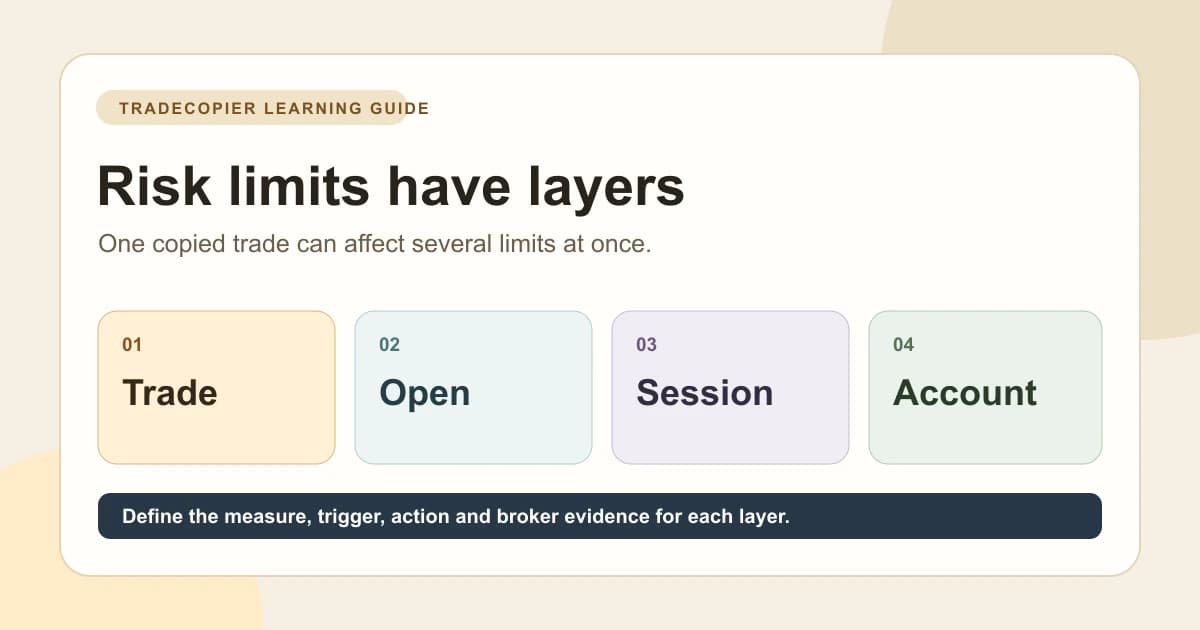
| Layer | Measure to define | Decision to record |
|---|---|---|
| One trade | Modeled cash downside at the planned follower stop, with costs and quantity step | Accept, resize or skip when no valid quantity fits |
| One strategy or source | Combined exposure from open and contingent orders linked to that strategy | Check the strategy's own ceiling and overlapping symbols |
| All open exposure | Additional downside from current marks to planned stops, including eligible pending orders and cost reserve | Check the account's concurrent exposure ceiling |
| Session, week and month | Loss already measured in each defined period plus additional planned downside | Apply the tightest remaining headroom; define time zone and reset |
| Account state | Equity, margin, connectivity, broker permissions and any configured drawdown trigger | Pause and reconcile if the state is unavailable or outside policy |
Choose whether a period loss measure uses realized P&L, floating P&L, fees, deposits and withdrawals, or a stated combination. Record the period start, timezone and reset behavior. Balance and equity are different account properties; silently switching between them can change the result. A daily limit, an open-exposure ceiling and a drawdown trigger are separate rules, even when all three are expressed in dollars or percentages.
Count open, pending and shared exposure
For a planned stop, estimate each position's additional loss from its current mark to that stop in the follower account currency, plus modeled remaining costs. Pending orders may become open while another position remains active, so count plausible simultaneous exposure under the declared scenario. If two strategies both buy the same underlying instrument, labeling them different sources does not make the combined exposure diversified. FINRA's concentration-risk discussion explains why overlapping exposures can amplify losses.
Do not add unrelated units directly: convert pips, points or ticks through the verified contract value and account currency first. Use the portfolio exposure calculator for an arithmetic cross-check, then compare its assumptions with the actual copying route. If a stop is absent, an instrument value is unknown, or an open/pending state cannot be reconciled, label the proposed exposure unavailable. Do not treat unavailable as zero.
Worked worksheet: a copied trade meets two limits
Assume a fictional follower began its current day, week and month at $20,000 equity with no cash flows. Its operator-selected review ceilings are $300 for the day, $600 for the week and $1,000 for the month. Assume the chosen mark-to-market rule has measured $80 of loss so far in each period. The remaining period headroom is therefore $220, $520 and $920 respectively. The account also has a separate $250 ceiling for additional open-and-contingent downside, and source strategy A has a $150 ceiling. None of these numbers is a recommended percentage or a published TradeCopier default.
| Window | Chosen ceiling | Loss measured so far | Remaining headroom |
|---|---|---|---|
| Current day | $300 | $80 | $220 |
| Current week | $600 | $80 | $520 |
| Current month | $1,000 | $80 | $920 |
In this fictional ledger, A's line amounts already include its own estimated costs; the separately shown $20 reserve belongs to B and counts in account totals, not strategy A's subtotal. This allocation rule is part of the example, not a universal accounting method.
| Item | Additional modeled downside | Strategy A subtotal |
|---|---|---|
| A: open position | $70 | $70 |
| A: contingent pending order | $40 | $110 |
| B: open position | $50 | $110 |
| B: modeled cost reserve | $20 | $110 |
| Current combined downside | $180 | $110 |
| Proposed new A trade including its cost reserve | $45 | $155 |
The proposed trade would lift combined modeled downside to $225. It remains below the separate $250 open-exposure ceiling but exceeds the day's $220 remaining headroom by $5. It also lifts strategy A to $155, above its $150 ceiling. The proposed instruction therefore fails two checks, despite passing the open-exposure check. If an independently verified quantity adjustment reduces the new modeled downside to $35, combined downside becomes $215 and strategy A becomes $145; that passes the stated arithmetic checks. The operator must still confirm broker-valid sizing and account state before acting.
This worksheet is an estimate. A further $30 adverse difference in total fills would turn the $80 already measured plus $215 planned into $325, overshooting the fictional $300 daily ceiling by $25. The U.S. SEC's stop-order bulletin explains that a stop price is not a guaranteed execution price for the products it discusses. Broker execution and connection outcomes must be checked for the actual instrument and venue.
Reopen and rebalance only after reconciliation
Write down each daily, weekly and monthly reset boundary in one timezone; a broker's trading day and the operator's calendar week need not turn over together. At a daily reset, the weekly and monthly measured losses still carry forward under this example policy. Open positions, contingent orders and unresolved fills do not disappear because a counter resets. Recompute all overlapping windows before allowing another instruction.
A strategy budget may be changed after a review, but moving unused capacity from strategy B to A is a policy change, not evidence that A has become safer. Record the old and new ceilings, who approved them, when they apply and how shared symbol exposure is treated. If A's limit is breached or its broker state is uncertain, pause new A instructions until positions and pending orders are reconciled; do not shift the same exposure to another label merely to pass a strategy check. Any reopened route must still pass the account and period limits.
Define the action after a trigger or uncertain result
A risk plan should say whether a threshold blocks only new copies, sends a close request, does both, or calls for human review. A close request is another instruction, not evidence that the broker closed every position. Confirm the final order, deals, open positions and remaining pending orders before resuming the route. TradeCopier's equity-protection page describes configurable daily-loss and drawdown controls, but those controls do not guarantee a maximum realized loss or a particular prop-firm outcome. Confirm the current behavior for your platform, account and connection.
Record a decision as unavailable when a broker connection is down, the follower's latest position cannot be read, a fill is partial, or the source and follower disagree. Do not repeatedly send a copy to clear an unknown status; reconcile first. The activity-log page describes available copier events, which should be checked against the follower broker's own record.
Review the source strategy without inventing a safe threshold
Past returns, win rate and a single maximum drawdown number do not establish the next trade's risk or the quality of a provider. Examine sample size, payoff distribution, costs, leverage, overlapping positions, missing periods and whether the record can be independently reconciled. Stress the same limit worksheet with wider stops, correlated losses, gaps and a disconnected follower. A past simulation, selected success story or attractive average cannot establish future profitability.
Keep a dated review row for each route: source and follower aliases, period rule and timezone, account values, strategy, symbol, order/position identifiers, current and contingent downside, fees and conversions, proposed instruction, each remaining limit, decision, broker result and any discrepancy. Repeat the review after changing a rule, account, symbol or connection. Copying can reduce manual order entry, but it does not choose a profitable strategy or remove market and execution risk.
Primary references
- FCA: how copy-trading instructions can become orders
- ESMA: copy-trading supervisory briefing
- MetaQuotes: account equity and balance properties
- MetaQuotes: instrument and quantity properties
- MetaTrader 5: order, deal and position concepts
- Investor.gov: stop order and stop-limit order distinctions
References and linked TradeCopier product pages were checked on September 23, 2026. Check the current broker, platform, product and jurisdiction for a real account.
Quick answers
Frequently Asked Questions
Find answers to the most common questions about this topic.
Is copy trading safe if I set a stop loss?
A stop is a planned exit condition, not a guaranteed fill or maximum loss. The follower can have a different price, contract, quantity or broker outcome, so review the actual position and all account-level limits.
How do I set a daily copy trading loss limit?
Define the account, starting value, timezone, reset, whether realized and floating P&L and fees count, the action after a trigger, and how the broker outcome will be verified. No universal percentage applies to every account.
Should pending copied orders count toward open risk?
Count them in a declared scenario when they could activate while existing positions remain open. Confirm the destination order state and avoid treating a pending instruction as a filled position.
Do multiple copied strategies diversify risk?
Not automatically. Strategies can hold correlated or overlapping positions. Compare combined instrument exposure and loss scenarios across all source routes feeding the follower.
Does TradeCopier guarantee that a threshold prevents a breach?
No. A configured rule can trigger a copying pause or close request, but gaps, slippage, connection failures and broker rejection can cause a different realized result. Reconcile the follower broker record.