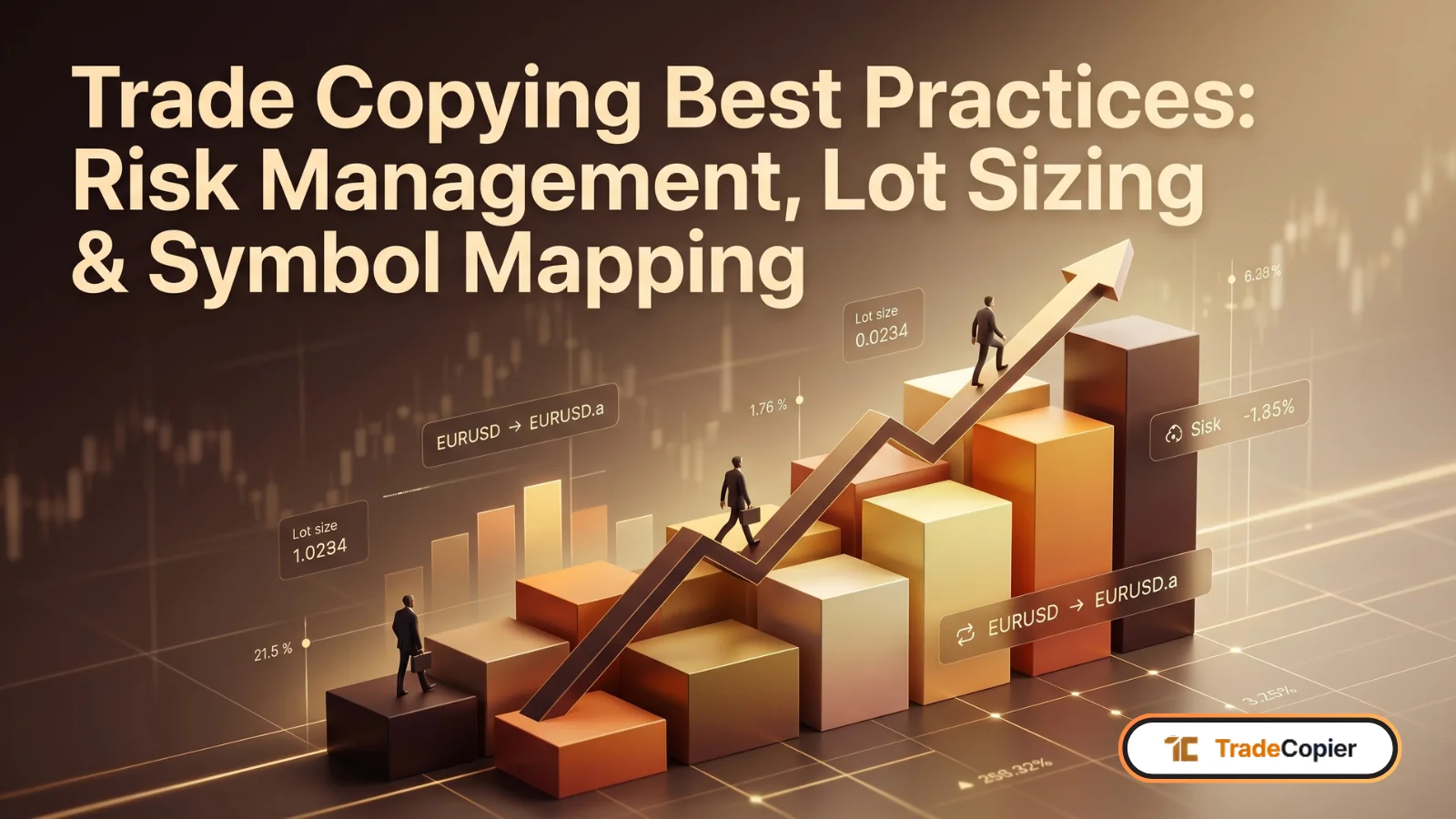
Trade Copying Best Practices:
Risk Management, Lot Sizing & Symbol Mapping
Why Trade Copying Requires More Than Just Fast Execution
Trade copying has become a core operational tool for traders, signal providers, account managers, and brokers managing multiple accounts simultaneously. But while speed is important, execution alone does not guarantee consistency.
The real difference between a stable copy trading setup and an unstable one often comes down to operational structure.
That is where Trade Copying Best Practices become essential.
Without proper:
- risk management,
- lot sizing configuration,
- and symbol mapping,
even profitable strategies can become difficult to scale across multiple accounts.
A well-configured trade copier should not simply duplicate trades. It should help maintain consistency, account protection, and execution accuracy across different trading environments.
Why Risk Management Is the Foundation of Copy Trading
One of the biggest mistakes traders make is assuming every connected account should mirror identical lot sizes and exposure levels.
In reality, account conditions often vary significantly.
Differences may include:
- Account balance
- Broker leverage
- Risk tolerance
- Trading objectives
- Prop firm rules
- Capital allocation structures
This is why risk management copy trading is not optional. It is the foundation of sustainable multi-account execution.
Without proper controls, traders may experience:
- Uneven drawdowns
- Overleveraged positions
- Margin issues
- Inconsistent account growth
- Portfolio instability
Professional copy trading setups prioritize risk synchronization before execution scaling.
The Role of Lot Sizing in Multi-Account Stability
Lot sizing directly determines how much exposure each account carries during copied trades.
Improper lot configuration is one of the fastest ways to create performance inconsistencies between accounts.
For example:
- A master account may comfortably handle a 1.0 lot trade
- A smaller slave account may become overexposed with the same trade size
This is why lot sizing copy trading requires flexible scaling rules rather than fixed duplication.
Common Lot Sizing Methods
Professional trade copying setups often use:
Fixed Lot Sizing
Every copied trade executes with a predefined lot size.
Best suited for:
- Controlled environments
- Equal-risk structures
- Simple account setups
Balance-Based Scaling
Lot sizes adjust according to account balance differences.
This helps maintain:
- Proportional exposure
- Risk consistency
- Better capital alignment
Equity-Based Scaling
Trades scale dynamically based on real-time account equity.
This method is commonly used for:
- Funded accounts
- Managed portfolios
- Variable-risk environments
The goal is not simply copying trades. The goal is maintaining balanced risk exposure across all connected accounts.
Why Symbol Mapping Matters More Than Traders Expect
One of the most overlooked areas in trade copying is symbol compatibility.
Different brokers often use different naming conventions for the same trading instruments.
Examples include:
- EURUSD vs EURUSD.a
- XAUUSD vs GOLD
- US30 vs WS30
Without proper mapping, copied trades may:
- Fail to execute
- Execute incorrectly
- Trigger synchronization errors
- Open unintended positions
This is where symbol mapping trade copier functionality becomes critical.
A properly configured symbol mapping system ensures:
- Correct instrument recognition
- Consistent execution
- Cross-broker compatibility
- Reduced operational errors
For traders managing multiple brokers or prop firm accounts, symbol mapping is essential for maintaining execution reliability.
How TradeCopier.org Supports Better Trade Management
TradeCopier.org focuses on operational efficiency for both traders and brokers managing copy trading environments.
Rather than relying on basic duplication mechanics, the platform supports structured trade management through customizable execution controls.
Flexible Risk Management Settings
TradeCopier.org allows users to configure:
- Risk ratios
- Lot multipliers
- Fixed or proportional sizing
- Account-specific trade rules
- Exposure adjustments
This helps traders create more stable multi-account structures.
Advanced Lot Sizing Control
Managing multiple accounts often requires flexible exposure handling.
TradeCopier.org supports:
- Dynamic lot scaling
- Balance-based execution
- Equity-sensitive sizing
- Custom volume allocation
This helps maintain more controlled portfolio behavior across connected accounts.
Built-In Symbol Mapping Features
Cross-broker compatibility becomes easier when symbol recognition is properly configured.
TradeCopier.org helps reduce:
- Symbol mismatch errors
- Trade rejection issues
- Incorrect instrument execution
This is particularly valuable for:
- Broker environments
- Fund managers
- Prop traders
- Multi-platform operations
Centralized Multi-Account Oversight
Operational visibility becomes increasingly important as trade copying scales.
TradeCopier.org supports:
- Multi-account synchronization
- Centralized execution flow
- Streamlined account management
- Structured copy trading environments
For active traders and brokers, this creates more operational consistency.
Best Practices for Managing Risk Across Multiple Accounts
Strong copy trading setups rely on preparation, not just automation.
Here are several proven best practices traders use to improve account stability.
Keep Risk Proportional
Every account should not carry identical exposure.
Instead:
- Scale risk according to balance
- Match drawdown tolerance
- Maintain consistent exposure percentages
This helps preserve portfolio balance.
Avoid Overleveraging Smaller Accounts
Aggressive scaling often creates unnecessary margin pressure.
Professional setups prioritize:
- Sustainable lot sizes
- Controlled exposure
- Long-term survivability
Regularly Review Symbol Configuration
Broker symbol structures may change over time.
Traders should routinely verify:
- Instrument naming
- Symbol mapping rules
- Trade routing behavior
This helps prevent execution inconsistencies.
Test Before Going Fully Live
Every copy trading structure should be tested under real conditions before scaling.
Testing should include:
- Volatile market sessions
- Multiple asset classes
- Simultaneous trade execution
- Broker synchronization checks
This reduces unexpected operational problems later.
Monitor Execution Consistency
Even optimized systems require ongoing monitoring.
Traders should evaluate:
- Copy delays
- Slippage behavior
- Lot accuracy
- Account synchronization
Long-term consistency depends on continuous oversight.
Why Brokers and Professional Traders Prioritize Operational Structure
As copy trading continues expanding across retail and institutional environments, operational structure has become increasingly important.
Modern trading operations often involve:
- Multiple brokers
- Funded accounts
- Signal distribution
- Managed client portfolios
- Cross-server trade execution
In these environments, small configuration mistakes can scale into larger portfolio problems.
That is why professional traders focus heavily on:
- Risk controls
- Lot sizing accuracy
- Symbol mapping stability
- Execution consistency
rather than relying purely on strategy performance.
A profitable strategy without proper operational structure becomes difficult to scale effectively.
Final Thoughts
Successful copy trading depends on more than automation. Sustainable performance comes from operational consistency.
Proper:
- risk management,
- lot sizing configuration,
- and symbol mapping
help traders and brokers maintain more stable execution environments while scaling across multiple accounts.
As copy trading infrastructure continues evolving, the ability to control risk and maintain execution accuracy becomes increasingly valuable.
TradeCopier.org provides the tools needed to support structured, scalable, and controlled copy trading operations.
Start your copy trading journey at tradecopier.org
Quick answers
Frequently Asked Questions
Find answers to the most common questions about this topic.
Why is risk management important in copy trading?
Risk management helps maintain balanced exposure across connected accounts. Without it, traders may face inconsistent drawdowns and overleveraged positions.
What is lot sizing in copy trading?
Lot sizing determines how much trade volume is executed on slave accounts relative to the master account.
Why does symbol mapping matter?
Different brokers use different instrument names. Symbol mapping ensures trades execute correctly across varying broker environments.
What is the best way to scale risk across multiple accounts?
Balance-based or equity-based scaling is commonly used to maintain proportional exposure between accounts of different sizes.
Can improper symbol mapping cause trade failures?
Yes. Incorrect mapping can prevent trades from executing properly or lead to incorrect instrument selection.
How does TradeCopier.org support multi-account risk control?
TradeCopier.org provides customizable lot sizing, risk management settings, symbol mapping support, and centralized execution tools for structured copy trading management.