Swap Fees in Copy Trading:
Carry and Close/Reopen Costs
Avoiding a swap charge can still leave a copied trade with a worse net result. A close before a financing event, a different account type or a shorter holding period can change the charge. Each can also change transaction costs or market exposure. Copying an order does not make the source and follower's financing terms identical.
This guide examines financing economics using primary broker and platform documentation checked September 22, 2026. Broker examples identify the relevant entity; they are not recommendations or terms that apply worldwide. Every numerical trade below is hypothetical, and no example establishes TradeCopier savings, returns or automatic fee avoidance.
Carry starts with financing, but ends with a total result
A currency carry position seeks a financing advantage while retaining currency-price exposure. A retail account's booked credit or debit depends on its own terms; it is not simply the difference between two published policy rates. For general charge definitions and account recording, use the overnight-fee management guide. Here the question is narrower: does retaining, interrupting or changing that exposure improve the modeled net economics?
OANDA Corporation's US financing page describes separate long and short rates, administration adjustments and rates that can change daily. It also distinguishes indicative rates from the finalized amounts applied to positions. A screenshot taken before finalization is therefore a planning input, not proof of the booked amount.
For another entity-specific example, IG's Australian forex-funding explanation uses tom-next plus an administration fee. Tom-next concerns extending currency settlement; it should not be replaced with a simple subtraction of two central-bank policy rates. The broker's published formula and account schedule determine the applicable calculation.
Distinguish funded currency carry from a retail swap credit
The BIS explanation of currency carry trades describes borrowing in a lower-interest funding currency and buying a higher-yielding asset in a target currency. In a funded cash example, the investor owes principal and interest in the funding currency while holding an asset denominated in the target currency. Converting the proceeds back introduces exchange-rate risk alongside the asset's own risks.
Suppose, purely illustratively, funding costs 1% annually and the target asset yields 3% on a comparable basis. The quoted rate gap is two percentage points before costs; it is not a guaranteed two-percent investment return. A rising funding rate or falling target yield can narrow that gap, while appreciation of the funding currency can make repayment more expensive in target-currency terms. Leverage can amplify these pressures.
A retail leveraged currency position with a broker swap adjustment is a different contractual arrangement. Its financing ledger does not prove that the customer directly borrowed one currency and placed a deposit in another. Use the actual product terms rather than importing the cash-carry construction into every account.
Normalize the inputs for a fair comparison
The examples below use money per lot per accrual day. That is an explicit teaching convention, not a universal broker formula. MetaQuotes' symbol reference distinguishes swap modes, direction-specific values and daily multipliers. OANDA's US worked examples instead illustrate annual-rate arithmetic and account-currency conversion. Normalize your actual provider's units before comparing amounts, and never apply a multi-day multiplier twice.
A worked financing ledger for two copied accounts
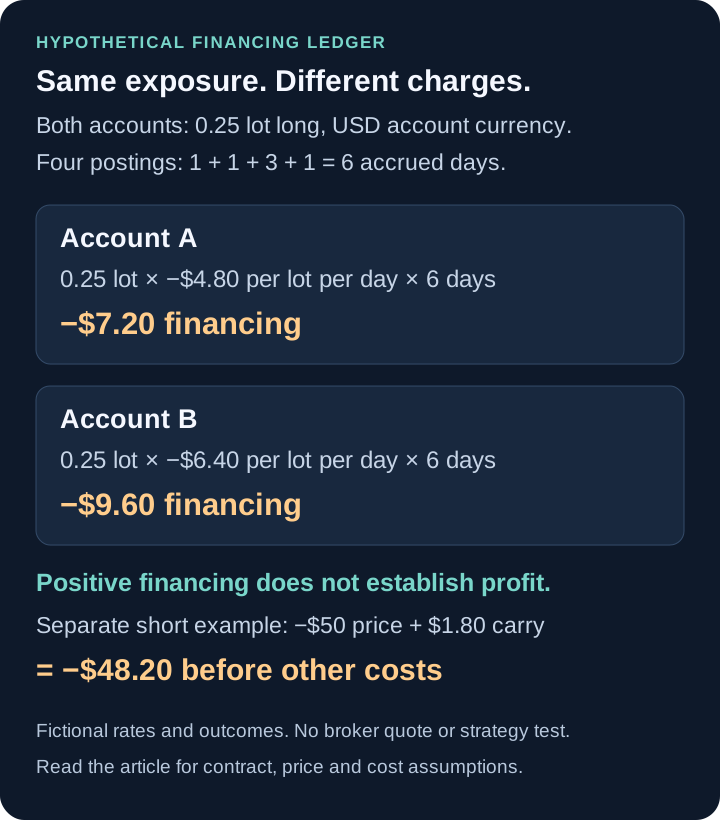
Assume a fictional linear EUR/USD contract where one lot represents 100,000 EUR. Account A and account B both hold a long position of 0.25 lot, or 25,000 EUR, and both report in USD. Their invented financing rates are already normalized to USD per lot per accrual day and include the assumed financing administration component: A is −$4.80 and B is −$6.40. No further currency conversion is needed.
The following four hypothetical posting events represent six accrual days in total. They are not weekday rules or a broker calendar. Quantity and rates remain constant solely to isolate the cost difference. Negative amounts are debits.
| Posting event | Accrual days | Account A, USD | Account B, USD |
|---|---|---|---|
| 1 | 1 | −1.20 | −1.60 |
| 2 | 1 | −1.20 | −1.60 |
| 3 | 3 | −3.60 | −4.80 |
| 4 | 1 | −1.20 | −1.60 |
| Total | 6 | −7.20 | −9.60 |
For event 3, A's calculation is 0.25 × −$4.80 × 3 = −$3.60. Across all events, B pays $2.40 more financing despite the equal position size. This does not identify which account is cheaper overall: entry and exit fills, commissions, other charges and account eligibility remain outside the table.
If quantity or the finalized rate changes, split the ledger into the applicable postings instead of multiplying the starting figure by the whole holding period. Preserve the raw quoted value and its units beside the normalized result. A missing statement entry remains unobserved; it should not become an assumed zero.
A positive carry credit can coexist with a loss
Now consider a separate, counterfactual short position in account A. Suppose its fictional short rate is +$1.20 per lot per accrual day. At 0.25 lot over six accrual days, financing contributes +$1.80. This is an alternative direction, not a claim that the earlier long position also earns that credit.
If EUR/USD rises from an assumed 1.1000 entry to a 1.1020 exit, the short position's price P&L is (1.1000 − 1.1020) × 25,000 = −$50. Adding $1.80 gives −$48.20 before other charges. A positive swap line therefore cannot establish a profitable trade, and selecting a position only for its financing rate leaves the larger price exposure unaddressed.
Compare closing and reopening with the charge avoided
Closing before the applicable boundary may avoid that event's financing if the provider's rules and completed transaction actually support that result. Reopening adds another execution decision. A planned close that has not filled is not the same as a closed position.
For a cost-only illustration, suppose avoiding A's event 3 would save $3.60. Assume the additional close-and-reopen transactions cost $2.50 in combined spread effect, $1.20 commission and $0.80 adverse slippage: $4.50 in total. Those assumed transaction costs exceed the financing saved by $0.90, before any price change while out of the market.
This comparison assumes the same intended exposure resumes and treats the cost components as separate. When using actual fill-to-fill P&L, do not subtract spread or slippage again if those price effects are already included. Time outside the market also changes the position's outcome; it is not a known fee that can always be estimated in advance.
Separate a fee saving from a strategy change
A useful comparison states what remains equal. If the holding scenario keeps 0.25 lot but the alternative reopens only 0.10 lot, its lower financing partly reflects smaller exposure. If it reopens in the opposite direction, the price outcome is a different trade. Calling either difference a software fee saving would confuse a changed decision with a changed charge.
Keep three amounts separate in a planning worksheet: the financing difference, additional transaction costs and the price effect of changed exposure. The first two can be estimated from stated assumptions; the third depends on the prices actually encountered. For historical review, use the completed account records. A hypothetical “would have reopened here” price is not an observed fill.
Test more than one holding scenario. A one-event comparison may favor a different cost structure from a multi-event position, especially when rates, quantity or eligibility change. Report each scenario's assumptions instead of presenting one invented example as evidence that an account, broker or copying setup is consistently cheaper.
Read swap-free account terms as a complete fee schedule
Swap-free does not necessarily mean cost-free holding. The IC Markets Australian swap-free account page states that holding fees can apply and that ordinary account spreads and commissions remain. It also states that rates and holding periods can change. Check the current entity, eligibility rules, instrument, grace period, charge currency and weekend treatment instead of transferring terms from another broker or jurisdiction.
Compare the amount for the intended holding scenario after any applicable grace period, not just the first overnight event. A fixed holding fee can produce a different result from a direction-specific financing credit or debit. Losing a potential credit also belongs in the comparison. A different account can change the contractual service and trading conditions, so a single fee line is insufficient for selecting it.
Keep a financing review that can be reproduced
| Input | Check |
|---|---|
| Account terms | Broker entity, account type, exact instrument and source URL with check date |
| Position | Direction, quantity and verified contract size for each account |
| Rate meaning | Quoted value, unit, formula, administration inclusion and indicative/final status |
| Accrual | Applicable days or multiplier without duplicating an adjustment already included |
| Currency | Financing currency, account currency and documented conversion convention |
| Alternatives | Additional execution costs, holding fees, lost credits and changed exposure |
Download the blank financing-ledger CSV and use one row per account and posting. Its eight blank rows start as not_recorded; estimated and observed amounts are separate fields, and a blank amount does not mean zero. Record aliases and evidence references, not account credentials. Keep estimates separate from booked observations and explain a discrepancy before attributing it to the copier.
For the operational steps alongside this cost comparison, use the separate copy-trading rollover checklist for dates, time zones, holidays and source-to-follower operational checks. No universal cutoff or tripling day is assumed here. The useful outcome is a documented total-cost comparison under stated conditions, not a promise that overnight fees or trading losses can be eliminated.
Quick answers
Frequently Asked Questions
Find answers to the most common questions about this topic.
Can a trade copier remove broker swap fees?
Copying an order does not override the broker's financing schedule. Each account's instrument, direction, quantity and terms determine its charge or credit. Confirm any account-specific arrangement with the provider.
Why can a follower pay more swap than the source?
Accounts can use different rates, contract sizes, quantities, accrual rules or currency conversions. Compare normalized amounts for the same exposure and posting period before assigning a cause.
Does positive swap mean a carry trade is profitable?
No. Financing is one component. An adverse price move and other charges can exceed a credit, as the fictional short-position example shows.
Is closing and reopening always cheaper than paying swap?
No. Additional spread effects, commission, slippage and time out of the market can outweigh the avoided charge. Compare incremental costs under explicit assumptions and verify that the intended close actually filled.
Are swap-free accounts free to hold overnight?
Not necessarily. Applicable terms may include holding or administration fees, grace periods, eligibility conditions and normal transaction costs. Review the exact broker entity and account schedule.
Should I multiply every Wednesday swap value by three?
No. The applicable schedule depends on the instrument and account, and a displayed amount may already include a multi-day adjustment. Record whether your input is a one-day rate or a finalized posting.
How should I compare financing between different accounts?
Normalize the same intended exposure, direction, accrual period and reporting currency using each provider's documented calculation. Keep financing differences separate from transaction costs and any change in the trade itself. An unequal position size is not evidence of a better financing rate.
Does the sample ledger use current broker rates?
No. Its rates, positions and prices are invented to show the arithmetic. It reports no customer outcomes, broker ranking, TradeCopier fee savings or investment return.