Copy Trading During Rollovers:
Cutoffs, Calendars and Account Checks
Copy trading around rollover requires a separate cutoff and position check for every connected account. A source account closing before its broker's daily boundary does not prove that a follower closed before its own. Record the applicable rule, the date and timezone, the destination fills and any financing adjustment before deciding that the accounts match.
This guide concerns operational records around daily financing and contract changes. It contains hypothetical examples, not measured TradeCopier performance or a universal trading schedule. For charge calculations and account terms, use the separate overnight financing and swap-fee guide.
First identify which rollover event you mean
An OTC forex financing cutoff and an expiring futures contract are different events. A broker may assess financing when an eligible position remains open across a stated boundary. A futures roll instead changes the contract held: the old expiry is offset and another contract is opened. A chart switching its displayed front month does not, by itself, establish either account transaction.
CME's contract-roll explanation distinguishes offsetting, rolling and settlement. Use the exact contract's rules rather than assigning one quarterly date to every index, currency or commodity. For a dated CFD, check the broker's expiration and adjustment terms separately; the shared word “rollover” is not a specification.
Build one dated rule record per destination
For each source and follower, record the broker entity, account type, exact symbol and contract, event type, rule source and date checked. Then record the local cutoff, its timezone and its UTC equivalent for the actual date. Server time, the device clock and the broker's published reference clock may differ.
OANDA Corporation's financing page, for example, describes its daily boundary at 5 p.m. Eastern Time and explains that instruments and holidays can affect the financing period. That is one provider's account context, not a global copier setting. A familiar Wednesday convention must not replace the current rule for a different instrument or broker.
In MetaTrader 5, symbol properties distinguish swap mode, long/short values, daily swap ratios, contract dates and trading permissions. Preserve the applicable specification with your review. A financing boundary, a daily trading break and a broker's contract-liquidation deadline belong in different fields even when two happen near each other.
Convert the clock and the calendar date together
Suppose an invented account rule uses 17:00 at UTC−05:00 on January 13, 2026. Its UTC boundary is January 13 at 22:00Z. A display at UTC+01:00 reads January 13 at 23:00; a display at UTC+05:30 reads January 14 at 03:30. These are the same instant under the stated offsets, despite different calendar dates.
The example deliberately supplies fixed offsets. For a real named timezone, resolve its offset for the event date, including any daylight-saving change. Do not carry last month's UTC conversion forward without checking it. Keep the original provider wording and the converted timestamp so another reviewer can reproduce the calculation.
Check both trading availability and financing-date rules around holidays. A market holiday in a relevant currency or jurisdiction can affect the schedule even when your own local workday looks ordinary. A calendar reminder is a prompt to verify the rule, not evidence that an order will execute before a deadline.
Work through a source-and-follower cutoff timeline
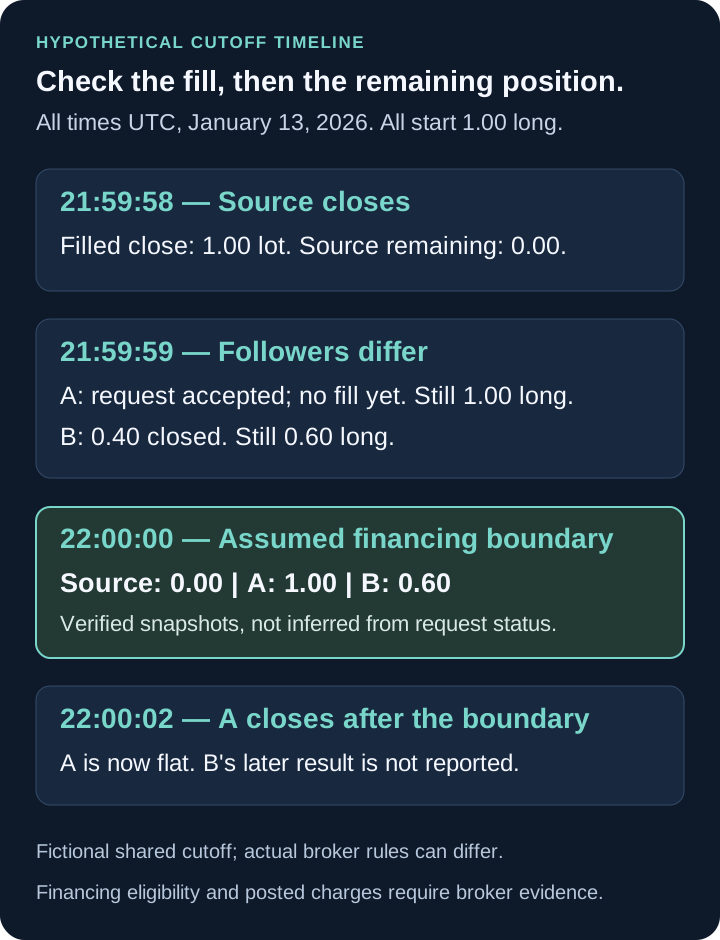
Consider a fictional source and two followers, each starting long 1.00 lot of a matching instrument. For this example only, all three use the same January 13, 2026, 22:00:00Z observation boundary. Position snapshots are assumed complete at the stated times; no manual trades or other orders occur. The times are invented and do not measure routing latency.
| UTC on January 13 | Observed record | What it establishes |
|---|---|---|
| 21:59:58 | Source close fills 1.00 lot; source position becomes zero | The source is flat before the boundary |
| 21:59:59 | Follower A close request is accepted; no fill yet | Acceptance alone does not close its position |
| 21:59:59 | Follower B close fills 0.40 lot; position snapshot shows 0.60 remaining | Only part of B's original exposure has closed |
| 22:00:00 | Boundary snapshots: source 0.00, A 1.00, B 0.60 lot | The accounts have different exposure at the cutoff |
| 22:00:02 | Follower A close fills 1.00 lot; position becomes zero | A closes after the boundary; B's later outcome remains unreported |
The table does not determine a financing amount. Apply each actual account's eligibility, rate and posting rules to its own records. A later zero position does not rewrite the earlier boundary snapshot. For B, do not label the remainder canceled or rejected without a corresponding record.
MetaQuotes documents that a successful OrderSend return is not itself proof of execution. Keep submission, acceptance, partial fills and final exposure separate. If a response is missing, reconcile destination history before considering a retry; an uncertain close should not become an unintended new position.
Reconcile the event before comparing charges
Use a worksheet for each account and event date. Start with the rule, then the exposure, then the account-statement entry. This sequence avoids explaining a charge with the source account's history when the follower actually held a different quantity.
| Check | Evidence to retain | Leave unresolved when |
|---|---|---|
| 1. Account and instrument | Alias, broker entity, account type, symbol and contract month | The destination instrument is ambiguous |
| 2. Event definition | Financing cutoff, trading break, expiry or planned contract roll | Different events are being treated as one |
| 3. Clock and date | Provider timezone, dated offset and UTC boundary | A timestamp lacks a usable timezone |
| 4. Calendar rule | Applicable holiday notice and dated specification | The current account rule is unavailable |
| 5. Intended action | Source event, configuration and destination request identifiers | The requested change cannot be reconstructed |
| 6. Destination exposure | Linked fills, pending quantity and boundary position | Partial or missing records prevent reconciliation |
| 7. Posted adjustment | Statement entry, currency, date and provider explanation | The entry cannot be matched to its rule |
| 8. Review decision | Reviewer, remaining question, action owner and closure evidence | A mismatch has merely been dismissed |
Download the blank eight-check rollover review. Every row starts as not_run. Record aliases and redacted evidence references, never passwords or tokens. Missing evidence stays unavailable; a blank amount is not a zero charge. The file is a manual worksheet, not a broker import or a TradeCopier export format.
When a statement adjustment appears later, distinguish the posting timestamp from the event or holding period it describes. Keep the entry identifier and ask the provider which rule produced it if that relationship is unclear. Do not move a fill timestamp to make a charge look consistent, and do not overwrite an earlier unresolved review when new evidence arrives; add the resolution and its date.
Handle an expiring futures contract as two exposures
For futures, identify the old and new contract explicitly. Consult the CME expiration calendar for the relevant product, then check exchange specifications and the broker's own earlier deadlines or holding restrictions. Do not substitute a chart's automatic roll date for these checks.
In a hypothetical roll from two old-month contracts into two later-month contracts, record both legs for each follower. If the old position closes but the new order is rejected, the follower is flat. If the new order fills while the old close remains unresolved, exposure may exist in both months. A source completing both legs does not settle either follower outcome. Verify contract identifiers, cumulative fills and remaining positions before calling the roll complete.
Observe spreads and execution in fixed windows
To investigate rollover conditions, declare the sampling plan before collecting observations. One hypothetical design uses three equal two-minute windows relative to the verified cutoff: six to four minutes before, one minute before to one minute after, and four to six minutes after. Include each window's start and exclude its end. Use the same scheduled quote-sampling interval and record missed samples; no new order is required just to observe quotes.
For every sample, retain the destination's exact instrument, quantity unit, bid, ask, quote timestamp and receipt timestamp. Spread is ask minus bid for that same quote. Record quote age only when the timestamps are comparable; otherwise label freshness unavailable. Do not compare a stale price with another account's fresh quote.
For actual eligible order attempts, retain requested and filled quantity, native status, unresolved remainder and separately defined submission-to-response and submission-to-fill intervals. Timing needs compatible clocks, declared endpoints and valid/missing counts. Compare window populations with the same selection rules and retain rejections or missing outcomes.
A wider spread alone does not measure available depth, executable size or the cause of a delayed fill. This protocol supplies no observations and establishes neither a rollover effect nor TradeCopier performance. Different order sizes, account rules and market events can confound a comparison.
Download the separate blank quote-and-execution observation CSV. It starts with six unobserved rows labeled before, around or after; add a row for every planned sample, including missing observations. Set the real window boundaries and sampling interval before collection. Keep quote, receipt, response and first-fill timestamps separate, and record the clock basis before calculating intervals. This manual schema is not an automatic feed or a TradeCopier export.
Choose operational actions from verified behavior
A plan should identify who monitors the event, which supported actions are permitted and how unresolved records are escalated. Pausing new copying is different from canceling working orders, closing positions or disabling connection-dependent protection. Confirm those distinctions in current product and broker documentation before relying on a schedule.
This article does not establish that TradeCopier automatically detects every cutoff, holiday or expiry, changes contract mappings, pauses a route or closes positions. Do not invent a universal 24-hour or 48-hour exclusion window. After an event, reconcile each destination and retain any exception; the absence of a dashboard alert is not proof that the account followed the intended sequence.
Quick answers
Frequently Asked Questions
Find answers to the most common questions about this topic.
Does rollover always mean an expiring futures contract?
No. In OTC forex, it can refer to an overnight financing boundary. A futures roll moves exposure between contracts, while a dated CFD can have its own broker adjustment rules. Identify the event before applying a calendar or account check.
Do all copied accounts have the same rollover time?
Do not assume so. Verify the broker entity, instrument, account type and event rule for every source and follower, then convert each dated cutoff to a common timezone.
Is triple swap always charged on Wednesday?
No universal weekday applies to every instrument and account. Some FX schedules commonly use a multi-day Wednesday adjustment, but holidays and instrument-specific rules can change the period. Check the current provider schedule.
If my source closed before cutoff, did my followers avoid overnight financing?
Not necessarily. Review each follower's fills and position at its own boundary, then apply its financing terms. A submitted or accepted close request is not proof that the position was already closed.
Why can my calendar show a different rollover date?
The same instant can fall on different dates in different timezones. Preserve the provider's reference timezone, resolve its offset for the actual date and record the equivalent UTC timestamp.
Does changing the contract on a chart roll a live futures position?
A displayed contract change does not establish that the old position closed or the new one opened. Reconcile actual orders, fills and positions in both contracts for each account.
Will pausing copying cancel pending orders or close positions?
Those are separate actions. Check documented product behavior and the broker's current account state; do not infer a cancellation or close from a paused route.
Does the rollover worksheet calculate my broker's charge?
No. It records rule, timing, exposure and statement evidence. It contains no live rates, account connection, completed tests or guaranteed financing outcome.