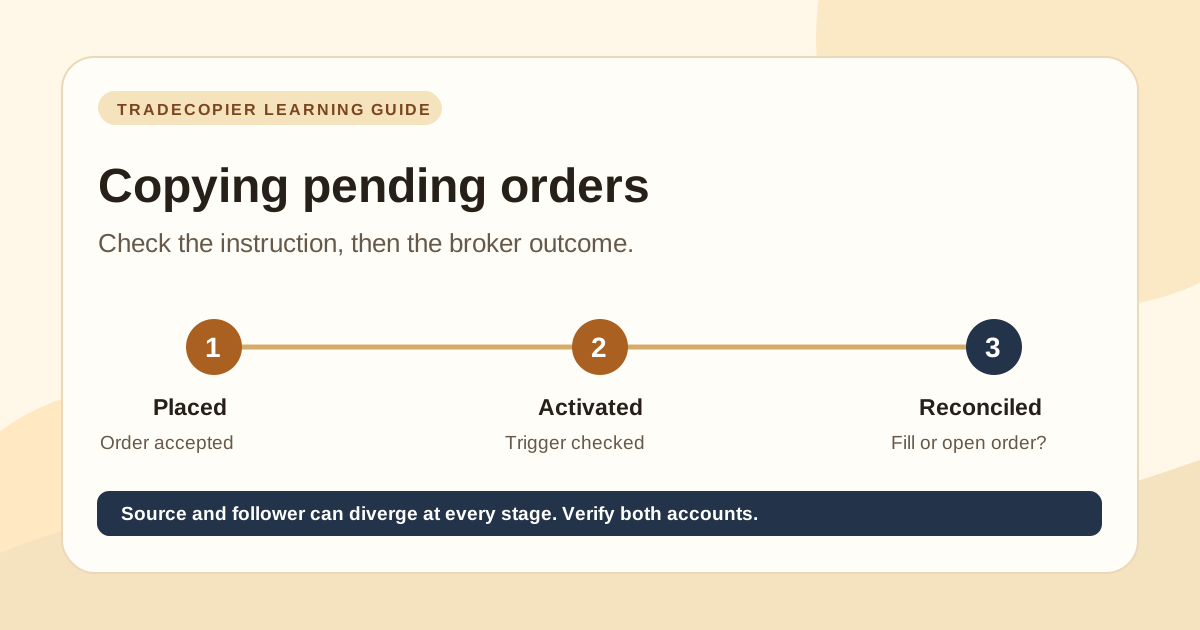
Copying Pending Orders:
Amendments, States and Fills
A copied pending order is an instruction awaiting a condition, not a completed trade. The source and follower can accept similar instructions yet later reach different states or fills. Before using a live account, verify the exact platform route, order type, symbol, quantity, trigger price, lifetime and cancellation behavior on both sides.
Publisher disclosure: TradeCopier publishes this guide about its own product. The example below is fictional and demonstrates a review method, not a product test or customer result. A listed platform or configuration control does not establish support for every pending-order type, broker, account mode or source-to-follower direction. Confirm the current route with TradeCopier support and test it on an appropriate demo setup.
Identify the order type before you copy it
A limit order, stop order and stop-limit order encode different instructions. MetaQuotes lists distinct MT5 pending-order types and states, including placed, partly filled, filled, canceled, rejected and expired. Its stop-limit type places a limit order after the stop price is reached; it does not promise a fill at the stop price. The stop-limit order guide compares trigger and limit behavior with an original scenario.
| Instruction | Question for the follower | Outcome to check |
|---|---|---|
| Limit | Is the side and limit price valid for the destination symbol? | Accepted, rejected, partly filled, filled, canceled or expired |
| Stop | Which quote and price condition triggers it on the destination? | Whether it activated and the actual execution price |
| Stop-limit | Are both trigger and subsequent limit prices supported and mapped? | Whether a limit order appeared and whether any quantity filled |
Do not translate a stop-limit into a plain stop or limit merely because the destination lacks the same field. That changes the instruction. cTrader's order documentation also distinguishes order types and partial execution; match the exact semantics for the two accounts rather than relying on a shared label.
Work through a fictional source and follower
Assume a source places a EUR/USD buy stop at 1.10500 for 0.20 lot. A proposed follower rule uses a 0.50 quantity multiplier, so the planned destination request is 0.10 lot. For this arithmetic example only, both symbols represent 100,000 EUR per lot and accept 0.01-lot increments. The proposed quantities therefore represent 20,000 EUR and 10,000 EUR respectively. These assumptions are not current broker specifications or evidence that TradeCopier supports this particular route.
Before submission, check the real follower's contract size, minimum, maximum, step, symbol suffix and trading permissions. MetaQuotes exposes these as separate symbol properties. If the follower contract differs, half the source lot count need not mean half the economic exposure. A margin or stop-distance check needs its own instrument and account-currency calculation.
| Stage | Source account | Follower question |
|---|---|---|
| Creation | Buy-stop request accepted, still pending | Was a matching type accepted, with the intended symbol, 0.10 lot, trigger and expiry? |
| Before activation | Order remains pending or is modified | Did a source edit reach the follower, and what state was confirmed? |
| Activation | Trigger condition occurs; execution may follow | Did the destination trigger too, and did it fill, partly fill, reject or remain pending? |
| Resolution | Order is filled, canceled or expired | What order, deals and resulting position remain on the follower? |
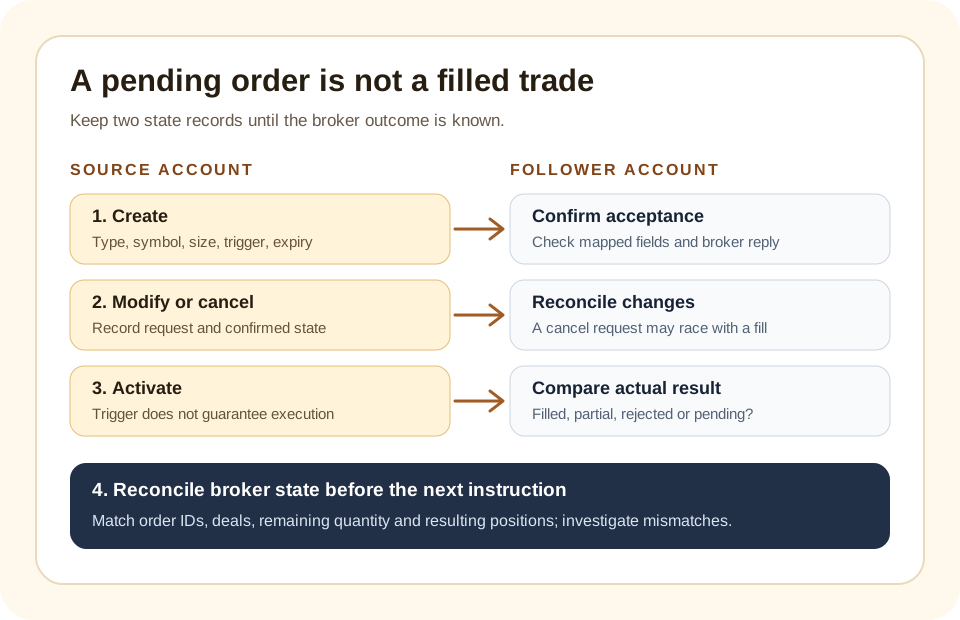
MetaQuotes warns that a successful OrderSend return does not prove execution. Retain the returned code, order reference, subsequent deals and final position state. A copied-order notification is not a substitute for the follower broker's record.
Test the failure cases that a green status can miss
- Cancellation race: The source cancel request may arrive while the follower order is activating. Record when each request was accepted and whether any destination quantity already filled. Do not assume a cancel request reversed an execution.
- Partial fill: If only part of an order fills, compare filled and remaining quantities separately. MT5 exposes initial and current order volume and a partly filled state. A repeated copy of the full original size can create unintended exposure.
- Expiry mismatch: Good-till-canceled, day and specified-time orders have different lifetimes. Record the original timezone and the destination broker's session and expiration rules; do not treat similarly named expiry settings as equivalent.
- Price or symbol mismatch: A follower may use another suffix, tick size, minimum stop distance or quote. Check the exact mapped contract and price precision before accepting a copied trigger. Reject an unsupported translation instead of silently changing the trading intent.
- Disconnected or uncertain state: If the source or follower reconnects, reconcile open orders, deals and positions before retrying. Re-sending an uncertain request can produce a duplicate order.
These are review scenarios, not claims that TradeCopier automatically cancels, retries, resizes or recovers every pending instruction. The available behavior must be verified for the connection and product version in use.
Reconcile an amendment against the order that is still live
An edit request does not erase the old pending order. MetaQuotes' OrderModify reference separates a successful basic request check from the trade server's result. MT5 order properties include a request-to-modify state, current and initial volume, expiration and final order state. A source-side confirmation is not a follower-side confirmation.
The following entirely fictional sequence assumes a compatible linear instrument, a buy limit whose 0.30-lot unfilled remainder may stay working after a partial fill, and an agreed 0.50 follower quantity for a 1.00-lot source request. Prices and times are teaching inputs, not market records or a measured TradeCopier route. The source and follower start with buy limits at 1.1000 expiring at 15:00Z. At 14:00:02Z the source's price and expiry change to 1.0990 and 15:30Z, while the follower's amendment outcome is missing. A later broker snapshot in this scripted case still shows its old 1.1000 order. At 14:00:03Z that follower order fills 0.20 at 1.0998, leaving 0.30 working; at 14:00:04Z the follower amendment is explicitly rejected.
| Time | Source state | Follower broker evidence | Decision |
|---|---|---|---|
| 14:00:00 | 1.00 pending at 1.1000; expires 15:00 | 0.50 pending at 1.1000; expires 15:00 | Both initial orders confirmed |
| 14:00:02 | Price 1.0990 and 15:30 expiry confirmed; 1.00 still pending | Amendment response absent; fresh order snapshot still shows 0.50 at 1.1000 and 15:00 | Follower change remains unconfirmed |
| 14:00:03 | No source deal in this example | 0.20 fills at 1.0998 under the old limit; 0.30 remains working | Record the deal and changed exposure before another request |
| 14:00:04 | 1.00 pending under amended terms | Amendment explicitly rejected; 0.30 remains at 1.1000, expiring 15:00 | Two accounts now have different order terms and positions |
Download the fictional amendment event ledger (CSV). Its follower arithmetic is 0.50 requested = 0.20 confirmed filled + 0.30 confirmed working at the final snapshot. The source has no fill in this script. The follower's rejected change did not undo its existing 0.20 deal. A missing response at 14:00:02 was unknown until the later broker records arrived; it was never evidence that an amendment had succeeded or failed.
Keep price, expiry, protection and quantity changes distinct
MetaQuotes documents MT5 pending-order changes to activation price, protection levels and expiry, but says the main order type and volume cannot be changed by that modify operation. A quantity change in that context requires a separate cancel-and-replace workflow; the cancellation and new placement are not one guaranteed atomic event. Another platform or broker may expose different editable fields. Check the exact native action before describing a copier translation.
For any expiry change, preserve the old expiration, proposed new expiration, time zone, server acceptance and the final live order. A request sent before the old deadline can still be rejected, arrive too late or race with a fill. If the old order expires while the new request is unresolved, do not invent a replacement order. Record the source and follower independently, including any deals already produced. A stop-loss or take-profit amendment is a protection question as well; inspect the actual destination order or position rather than assuming the displayed source level controls it.
Before changing quantity, calculate how much was already filled and how much remains working or unknown. Canceling a 0.50-lot order after 0.20 filled can at most resolve the remaining 0.30 in this script; it cannot cancel the executed deal. A replacement request for 0.50 without accounting for that deal could create 0.70 total exposure if it fills. This is a conditional arithmetic warning, not a claim that any specific connector retries or replaces orders automatically.
Pause when the two accounts no longer agree
Do not send another copy or retry an uncertain instruction merely to make a dashboard status look complete. First identify the last confirmed source order, follower order, every linked deal, remaining pending quantity and resulting position. A missing acknowledgment is an unknown outcome, not evidence that the broker received nothing.
Hold the affected route for review when the destination order type, trigger, expiry or symbol cannot be verified; when a cancellation is still pending; or when the source and follower show different filled quantities. Document which account owner can authorize a correction. Any cancellation, close or replacement is a new trading instruction with its own execution risk. Reconcile the broker records after that action before resuming copying.
Run a bounded demo acceptance check
- Record source and follower platform versions, broker servers, account modes, symbols, contract sizes, volume rules and trading permissions. Check the published platform list, then confirm the precise route.
- Choose one small, valid pending-order type and write down the expected source and follower fields before placing it. Record the rule version and any configured filters.
- Place the source order in demo. Compare the source acknowledgment with the follower request, broker response and pending-order snapshot. If the follower rejects it, preserve the reason instead of changing several settings at once.
- Modify and cancel separate test orders. Confirm each final broker state, including whether a cancellation was still pending or a partial fill had occurred.
- For an activation test, compare actual fills, remaining orders and resulting positions. A stop's trigger price is not a guaranteed execution price, and a stop-limit may remain unfilled.
- Review available copier events alongside both broker records. Record discrepancies and pause further testing until the final position and pending-order inventory are understood.
Use no universal order-count, slippage, win-rate or risk-percentage threshold from an unrelated article. Choose boundaries from your account, instrument, broker and strategy requirements, and document them before a live test. Pending-order copying can automate an instruction; it cannot guarantee matching fills, eliminate market risk or make an unverified strategy profitable.
Quick answers
Frequently Asked Questions
Find answers to the most common questions about this topic.
Does an accepted copied pending order mean the follower has a position?
No. Acceptance means an order may be waiting for its condition. Check the follower broker's order state, deals and resulting position before calling it executed.
Will a source and follower stop order fill at the same price?
Not necessarily. Trigger quotes, available liquidity, order rules, broker execution and timing can differ. Record each actual fill rather than treating the trigger price as a guaranteed fill.
What happens if the source cancels while the follower order activates?
The outcome depends on the confirmed sequence at the destination. Reconcile the follower's order, deals and position; a cancellation request cannot undo an already executed fill.
Can every TradeCopier connection copy every pending-order type?
This guide does not establish universal support. Confirm the exact source, destination, broker, account mode, order type and lifecycle action for the current connection, then test it in demo.
Is a stop-limit order the same as a stop order?
No. A stop-limit uses a stop condition to place a limit order. The resulting limit can remain unfilled; converting it to a plain stop changes the instruction.
Does a source pending-order amendment update the follower immediately?
No. Confirm the follower broker's order terms and server response separately. In the fictional ledger, the source edit succeeds while the follower's old order partly fills and its amendment is rejected.
Can I change the quantity of an MT5 pending order with OrderModify?
MetaQuotes documents price, protection and expiry changes for MT5 OrderModify, but not an in-place volume change. Quantity changes require a separately verified cancel-and-replace path, with any earlier fill and unresolved remainder reconciled first.