Prop Firm Daily Loss Rules and Drawdown:
Static vs Trailing
Prop firm drawdown rules do not use one universal percentage or calculation. A static floor stays at a fixed level under its stated rule. A trailing floor can move upward as a defined balance or equity high changes; it may recalculate at the end of the day or during the session. A daily loss limit is a separate rule with a program-specific amount, measurement basis, trading-day or session boundary, and breach or resumption behavior.
Publisher disclosure: TradeCopier publishes this educational guide about copy-trading workflows. Provider rules below were checked on September 24, 2026 against the linked official pages. Firms may change programs, stages and terms. Examples labeled hypothetical are original arithmetic, not account records, provider policy or TradeCopier testing. Verify the rules shown in your own current account before relying on them.
Static and trailing drawdown in plain language
A drawdown floor is the account value that a rule says must not be crossed. The word “trailing” is incomplete unless the rule also identifies what value it follows, when it updates and how a breach is measured.
| Rule detail | What to find in the current terms |
|---|---|
| Program and stage | Firm, product, evaluation phase, funded stage and account type |
| Reference value | Initial balance, starting-day balance, highest end-of-day balance, intraday high, or another stated value |
| Update cadence | Fixed, end-of-day recalculation, session rollover, or a continuous/intraday update |
| Breach measurement | Balance, equity, realized P&L, floating P&L, commissions, swaps, fees, and whether touching the floor counts |
| Reset or lock | Daily timezone, floor lock, account reset, payout, withdrawal, or phase change |
Under one explicitly simplified model, a static floor is starting reference − permitted loss amount. An end-of-day trailing floor is the higher of the starting reference or highest eligible end-of-day balance, minus the permitted loss amount. A provider may define different inputs, limits, update times, or breach tests. Do not apply either formula until it matches the account's current rule text.
Worked example: the same path, two different floors
Every amount in this example is fictional USD. Assume an initial balance of $50,000 and a $2,000 loss allowance. The static floor remains $48,000. For the simplified end-of-day trailing example, the floor for the next trading day is the highest end-of-day balance so far minus $2,000. The example compares hypothetical current equity with each established floor; it is not a provider rule or safe-loss buffer.
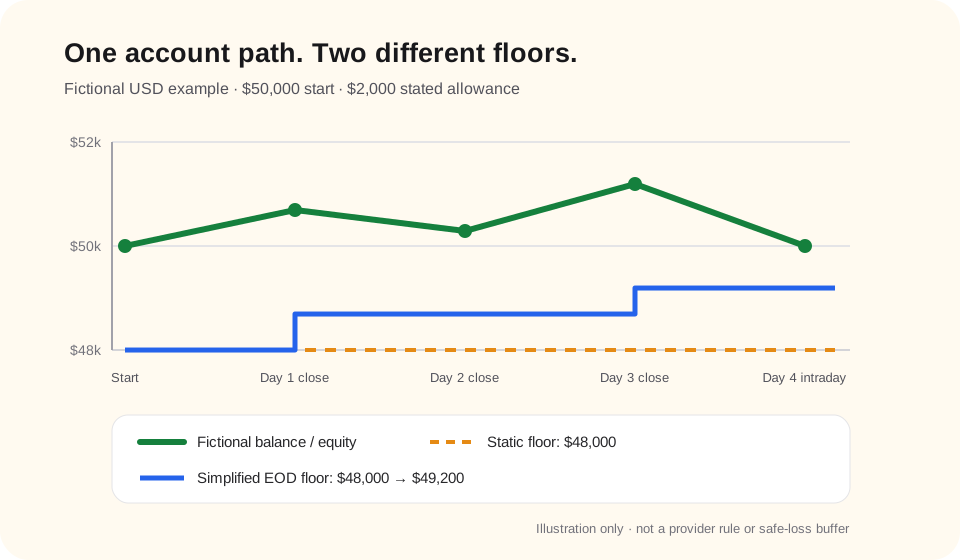
| Checkpoint | Current balance or equity | Static floor | EOD trailing floor in effect | Room to static floor | Room to EOD floor |
|---|---|---|---|---|---|
| Start | $50,000.00 | $48,000.00 | $48,000.00 | $2,000.00 | $2,000.00 |
| Day 1 close | $50,700.00 | $48,000.00 | $48,000.00 | $2,700.00 | $2,700.00 |
| Day 2 start, after Day 1 ratchet | $50,700.00 | $48,000.00 | $48,700.00 | $2,700.00 | $2,000.00 |
| Day 2 close | $50,300.00 | $48,000.00 | $48,700.00 | $2,300.00 | $1,600.00 |
| Day 3 start, after Day 2 close | $50,300.00 | $48,000.00 | $48,700.00 | $2,300.00 | $1,600.00 |
| Day 3 close | $51,200.00 | $48,000.00 | $48,700.00 | $3,200.00 | $2,500.00 |
| Day 4 start, after Day 3 ratchet | $51,200.00 | $48,000.00 | $49,200.00 | $3,200.00 | $2,000.00 |
| Day 4 intraday example | $50,000.00 equity | $48,000.00 | $49,200.00 | $2,000.00 | $800.00 |
Download the fictional drawdown ledger (CSV). The displayed end-of-day trail updates after the close: Day 1's $50,700 close makes the next day's floor $48,700; Day 3's $51,200 close makes the next day's floor $49,200. During the Day 4 example, current equity is $50,000, so the arithmetic difference is $800 to that established trailing floor and $2,000 to the static floor. Neither amount predicts future loss or says what any provider will permit.
Daily loss is a separate calculation
A daily threshold may reset each trading day while an overall drawdown floor continues across days. “Daily” does not automatically mean closed trades only, the trader's local midnight, or a percentage of the latest balance. Check the account's stated base, timezone and equity formula.
For example, FTMO's current CFD objectives page separates its 1-Step and 2-Step rules. On the 1-Step path, its daily loss amount is 3% of initial simulated capital, recalculated from the balance at 00:00 CE(S)T; its 2-Step path uses 5% of initial simulated capital and the balance at that same daily boundary. The page measures both against equity, which it defines using balance, open-position P&L, swaps and commissions. These are rules for those named FTMO CFD programs, not a general prop-firm percentage and not a description of FTMO Futures. See the current FTMO CFD Trading Objectives and its separate FTMO Futures rules.
Here is a separate fictional calculation using the published FTMO 1-Step formula, not a provider-issued example. Assume initial simulated capital of $100,000, a day-start balance of $102,000 at 00:00 CE(S)T, and closed trades that leave the balance at $99,500. Three percent of initial capital is $3,000, so the daily floor is $102,000 − $3,000 = $99,000. If current open P&L is −$400, swaps are −$60 and commissions are −$50, equity is $99,500 − $400 − $60 − $50 = $98,990. The balance remains $500 above the floor, while the hypothetical equity is $10 below it. The point is to compare the rule's stated equity basis with closed balance; the values do not come from a real account.
Download the fictional daily-loss calculation (CSV) with the stated initial capital, reset-time balance, closed balance, open P&L, swaps, commissions and resulting equity as separate fields.
| Program | Daily limit | Overall maximum loss | Measurement and timing from the official page |
|---|---|---|---|
| FTMO Challenge: 1-Step and FTMO Account (1-Step) | 3% of initial simulated capital; daily reference is the balance recorded at 00:00 CE(S)T | 10% of initial simulated capital; end-of-day trail based on the highest preceding day-boundary balance or initial capital, whichever is higher | Equity rule includes open-position P&L, swaps and commissions; daily and overall limits are recalculated at 00:00 CE(S)T. The page says a new account after reward withdrawal resets the overall limit. |
| FTMO Challenge: 2-Step, Verification and FTMO Account (2-Step) | 5% of initial simulated capital; daily reference is the balance recorded at 00:00 CE(S)T | Static 10% of initial simulated capital below the starting amount | Daily and overall breach tests use equity with open-position P&L, swaps and commissions. The static overall floor does not ratchet with profitable days. |
The named program, phase and page URL matter. The FTMO Futures page describes separate futures objectives, including end-of-day trailing drawdowns for particular futures account types. Do not copy a percentage, floor, reset time or breach consequence from the CFD page into a futures account. Reopen the exact provider rule for the account you actually have.
Reset boundaries can also refer to different kinds of controls. Topstep's June 30, 2026 help article describes the Daily Loss Limit as optional in the Trading Combine and Express Funded Account, and automatic in the Live Funded Account. Program exceptions matter: its Responsible Trading Program rules say new Trading Combines and XFAs in that program automatically receive a DLL, and its limited Topstep Labs offers differ by product. When a DLL triggers, Topstep describes a forced break for the rest of the session rather than an account-rule violation. The session runs from 5 PM CT to 3:10 PM CT, and the article says trading resumes at 5 PM CT in the next session. It does not say that the purchased DLL amount is recalculated at 5 PM CT, so this is a session and resume boundary, not a verified DLL-counter reset. On September 24, 2026, 5 PM CDT on September 24 and 00:00 CEST on September 25 identify the same instant; the distinction here is the providers' rule definitions and trigger behavior, not a claim that these boundaries always occur at different moments. Read Topstep's current Daily Loss Limit rules for the exact account and settings.
What current provider examples show about “trailing”
Topstep's current Maximum Loss Limit article says the standard Trading Combine limit ratchets with end-of-day balance and does not move down, while realized and unrealized P&L are monitored in real time during the session. It also describes different balance and payout behavior for Express Funded Accounts. In practice, the time the floor changes and the time a breach can occur are two separate questions. Read the current Topstep Maximum Loss Limit rules for the exact stage.
Topstep's Topstep Labs page publishes an example comparing a $25K static Trading Combine with standard end-of-day trailing: after the same stated gain-and-loss path, the page shows $1,500 of next-day room under the static example and $1,000 under EOD trailing. The page describes Labs offerings as limited, so treat this as a provider-published illustration and verify whether the specific offer is currently available. It is not a universal rule or a recommendation to select a program.
These examples show why labels alone are inadequate. An intraday high-water mark, an end-of-day closing-balance high and a fixed starting floor produce different calculations. A provider can also use equity for breach measurement even when a floor ratchets from balance. Ask what happens to the floor after a payout, account reset, phase change, withdrawal, or new trading day.
Read each follower account's rule before copying
When one source strategy is copied to more than one destination, inspect each destination separately. Starting balances, current equity, floating P&L, commissions, daily timezones and program stages can differ, even when the source instruction is the same. This is an operational implication of account-specific rules; it does not establish that any prop firm permits a particular copying arrangement.
- Write down the exact account and stage. Save the firm's program name, evaluation or funded phase, account type and current rules URL.
- Translate the rule into a dated formula. Record the reference balance, loss amount, calculation time and timezone, equity or balance measurement, and treatment of open P&L and charges.
- Check resets and locks. Note daily rollover, highest-water-mark behavior, payout or withdrawal changes, and any phase transition.
- Compare the copier route with the account terms. Technical connectivity does not prove that the provider permits copying or that a selected connector, broker and direction are compatible.
- Verify actual account state. A configured copier rule is not a prop firm's rule. Check destination orders, equity and positions in the provider's own records after relevant events.
TradeCopier describes configurable copying and account-level controls on its prop-firm workflow page and equity-protection page. Those controls do not alter an external provider's floor, establish permission, guarantee a closing fill or guarantee compliance. Confirm the exact settings and observed behavior for the selected account route.
Questions to answer before relying on a rule
| Record | Fill from current provider terms or account evidence |
|---|---|
| Provider, program, stage and account type | Exact names and date checked |
| Daily loss | Amount or percentage, base, reset time and timezone |
| Overall floor | Static, EOD trailing, intraday trailing, or another formula; starting value and ratchet reference |
| Breach basis | Balance or equity; open P&L, commissions, swaps and other costs |
| Reset, lock or payout | How the floor changes at each program event |
| Copying permission and route | Current provider permission plus tested broker, platform, direction and actions |
| Result evidence | Account statement or dashboard, order and position record, reviewer and timestamp |
Leave an item marked unknown when its rule or outcome is not established. Do not replace an unknown timezone with local time or an inaccessible balance with zero. This guide explains how to read examples; it does not determine eligibility, recommend a prop firm, set a safe buffer, calculate your account's live limit, or promise that copying will stay within a rule.
Quick answers
Frequently Asked Questions
Find answers to the most common questions about this topic.
What is the difference between static and trailing drawdown?
A static floor stays fixed under the stated rule. A trailing floor can rise as a specified account reference reaches new highs; it may update at the end of the day or intraday. Check the provider’s exact reference value, update time and breach measurement.
Does an end-of-day trailing limit move during the trading day?
The floor in an end-of-day model is recalculated from a qualifying close for a later period, but the account may still be checked against that established floor in real time. Topstep’s current Trading Combine article distinguishes its end-of-day update from real-time monitoring of realized and unrealized P&L.
Do prop firms all use the same daily loss percentage?
No. FTMO’s current CFD rules alone distinguish 3% of initial simulated capital for its named 1-Step programs from 5% for its named 2-Step programs. Other providers and programs can use different bases, times and measurement rules.
Can open trades count toward a daily loss limit?
They can where the current rule measures equity or includes open-position P&L. FTMO’s named CFD daily-loss rules measure equity and include open-position P&L, swaps and commissions. Confirm the same details for your own provider and program.
Does a daily limit always reset at midnight in my timezone?
No. Use the exact boundary and behavior stated for the program. FTMO’s named CFD examples use 00:00 CE(S)T as the daily reference. Topstep’s June 30, 2026 article describes its session as 5 PM CT to 3:10 PM CT and says trading resumes at 5 PM CT after a DLL trigger; it does not say the purchased DLL amount recalculates then. The article describes the DLL as optional in the Trading Combine and Express Funded Account and automatic in the Live Funded Account, while the separate Responsible Trading Program automatically adds it to new Trading Combines and XFAs. The clock labels 5 PM CDT September 24 and 00:00 CEST September 25 coincide, so this comparison is not evidence of different reset instants. Record the exact program, timezone, account setting and applicable trading-day boundary.
Can a trade copier keep my account under a prop-firm drawdown limit?
A copier setting does not redefine an external firm’s rule or guarantee that orders close before a floor is crossed. Check provider permission, the exact route, configured settings and the destination account’s actual order and position records.
Does the same drawdown rule apply to a firm’s CFD and futures accounts?
Not necessarily. FTMO publishes separate CFD and Futures rule pages, with distinct objectives and account types. Use the rules for the exact product and stage on your account.
What happens to a trailing floor after a payout?
The answer depends on the provider and stage. Topstep’s current article describes a specific Express Funded Account payout behavior, and FTMO describes a reset when a new account is provided after a reward withdrawal. Check the current rule for your account.