
Drawdown Attribution in Copy Trading:
Equity, Flows and Costs
Drawdown attribution explains an observed peak-to-trough decline using the same time interval, valuation basis and currency for every contribution. In copy trading, that means reconciling source-linked positions, manual trades, charges and unexplained differences against the follower account's actual records. It does not prove why a strategy lost money or predict when it will recover.
This guide uses official sources checked September 22, 2026 and an original hypothetical ledger. It covers historical accounting, not a TradeCopier reporting feature, automated exit promise or provider-specific account-breach calculation.
Choose the curve before measuring its drawdown
Balance and equity answer different questions. MetaTrader 5's trading-report documentation distinguishes balance from equity, which includes currently open positions. A closed-trade balance curve can miss a large floating loss. Record which series you use, its valuation times, included charges and treatment of credit or other adjustments.
For a positive-valued series V, the running high-water mark H is its highest observed value so far. Current drawdown in money is H − V; percentage drawdown is (H − V) ÷ H × 100. Maximum drawdown selects the largest decline over the stated history. The peak must precede the trough. The largest money decline and largest percentage decline need not occur in the same episode.
Daily closing snapshots can miss an intraday trough. Describe the result as maximum observed drawdown at that frequency, not the worst loss that occurred between snapshots. A series starting mid-history also has an incomplete high-water mark. With nonpositive reference equity, do not force the usual percentage formula into a meaningful risk score.
Remove external flows under an explicit convention
A deposit increases account equity without being trading profit; a withdrawal is not automatically a trading loss. For a single reporting currency, the accounting identity over an interval is: trading and valuation result = ending equity − starting equity − net external inflows. Deposits are positive flows and withdrawals negative.
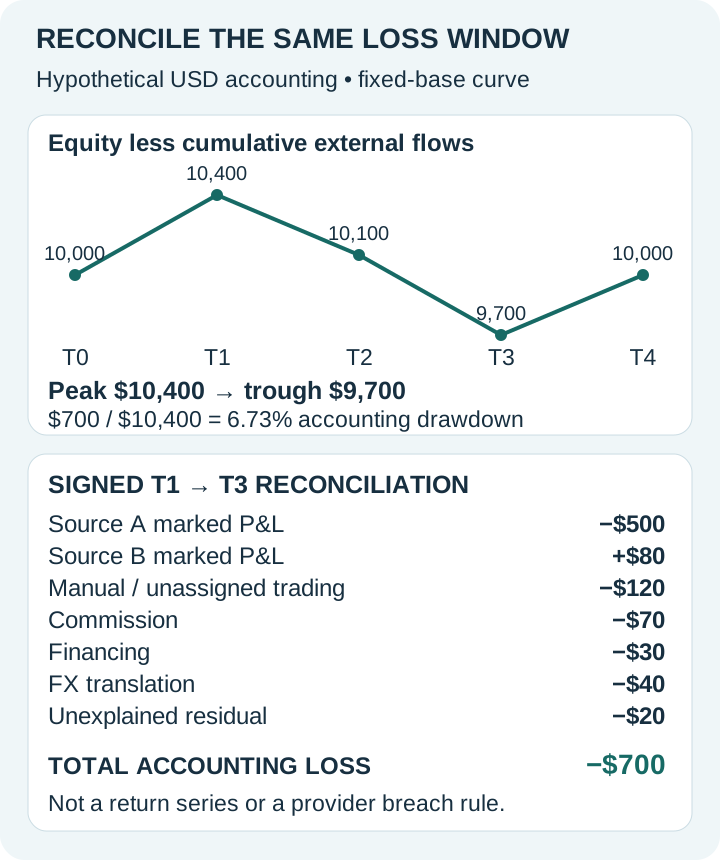
For the example below, define a fixed-base accounting curve as equity minus cumulative signed external flows since T0. This preserves cumulative dollar gains and losses on an initial $10,000 base. It does not normalize returns for changing invested capital: money added later can change subsequent position sizes and dollar P&L.
For performance comparisons, a time-weighted return index is a different construction. The GIPS Standards Handbook explains external-flow treatment, valuations around flows and geometric linking of subperiod returns. Applying those principles requires the relevant valuations and a consistent policy. Our simple dollar adjustment is not a time-weighted return, a claim of GIPS compliance or a substitute for a broker's drawdown rule.
A deposit can hide an accounting loss
Every amount below is fictional USD. T0–T4 are ordered review snapshots, not market observations. Flows are recorded when reflected in each equity value; no unrecorded flow is assumed.
| Snapshot | Account equity | External flow | Cumulative flow | Adjusted curve | Drawdown from adjusted high |
|---|---|---|---|---|---|
| T0 | $10,000 | $0 | $0 | $10,000 | $0 |
| T1: peak | $10,400 | $0 | $0 | $10,400 | $0 |
| T2 | $12,100 | +$2,000 | +$2,000 | $10,100 | $300 |
| T3: trough | $11,700 | $0 | +$2,000 | $9,700 | $700 |
| T4 | $11,500 | −$500 | +$1,500 | $10,000 | $400 |
The selected decline is T1 to T3: $11,700 − $10,400 − $2,000 = −$700. The adjusted peak-to-trough drop is $700 ÷ $10,400 = 6.73%. Label that percentage as a decline in this accounting curve, not an investment return or account-rule breach.
T4 improves the adjusted curve by $300 even though actual equity falls after the withdrawal. It remains $400 below the adjusted peak. A higher raw balance after a deposit does not establish recovery; recovery must use the same curve and convention as the original drawdown.
Reconcile contributions over the portfolio's interval
Freeze the portfolio's T1–T3 interval before selecting strategy contributions. Use positions actually held in the follower account. A source account's return percentage cannot be applied directly when follower size, fills, instruments or holding times differ.
| Component | Signed contribution | Meaning |
|---|---|---|
| Source A positions | −$500 | Realized price P&L plus change in floating P&L |
| Source B positions | +$80 | Same basis; offsets part of the decline |
| Manual or unattributed trades | −$120 | Known trade result without a verified source assignment |
| Commission | −$70 | Booked charges excluded from the trade rows above |
| Financing | −$30 | Booked net financing, also excluded above |
| Currency translation | −$40 | Separate translation effect under the stated policy |
| Unexplained residual | −$20 | Difference still requiring evidence |
| Total | −$700 | Matches flow-adjusted equity change |
The trade rows use realized price P&L during the interval plus ending floating P&L minus starting floating P&L. A position opened before T1 contributes only its change during T1–T3, not its entire lifetime result. Closing a position transfers value between floating and realized components; counting the full close result without removing the opening floating value overstates attribution.
MetaQuotes deal properties distinguish deal, order and position identifiers, execution times, profit, commission, swap and fees. Preserve those records and map their meanings. If imported trade P&L is already net of charges, separate them consistently or omit duplicate cost rows. Spread and slippage already reflected in actual fill prices must not become additional deductions.
Here the identified components total −$680; −$700 minus −$680 leaves −$20 unexplained. That residual is an accounting difference, not evidence of copier failure. Investigate missing charges, timestamp mismatch, stale valuations, rounding and conversion policies. Do not force it into a strategy row to make the report look complete.
Add comparable contributions, not individual maximum drawdowns
Two accounts can reach their own worst drawdowns on different dates. Adding those maxima combines different intervals and denominators; it does not reconstruct the combined portfolio's maximum drawdown. First align account equity snapshots in one reporting currency, remove internal transfers between included accounts, then find the combined curve's peak and trough.
Define the portfolio boundary before classifying transfers. Moving $500 from one included account to another is an outflow for the first account and an inflow for the second, but no external flow for their combined portfolio. If the destination is outside the included set, that same transfer is external to the measured portfolio. Retain both transfer references and check timing; mismatched posting times can create a temporary false loss.
A source or master account is a label for copied-trade provenance, not automatically another asset you own. Do not add its reported losses to the follower's losses. Include source-account equity only if that account genuinely belongs within the defined portfolio, and count its own positions separately from the follower's.
Account totals and source totals are two views of the same money. Use an account-by-source breakdown and sum either dimension once. Adding both views would double-count. Retain manual trading and unassigned positions as explicit categories.
For loss-share reporting, define contribution to the $700 loss as minus signed contribution divided by $700. Source A represents 71.43%; Source B represents −11.43%, an offset. Negative shares and shares above 100% can occur when gains offset losses. These are accounting proportions, not causal blame or automatic reasons to stop copying a source.
Convert values with a documented rate direction, timestamp and pricing source. Separate local-currency trading effects from translation only if the decomposition reconciles to the reporting-currency total. Do not add a translation estimate when it is already embedded in converted P&L.
VaR describes a loss quantile, not a drawdown ceiling
Value at Risk specifies a loss quantile for a confidence level and horizon under a model. A hypothetical one-day 95% VaR of $400 is not a promise that tomorrow's loss cannot exceed $400. Model-based exceedance probability is not a timetable for losses, and the model itself can be wrong.
The Basel framework's backtesting discussion explicitly considers losses exceeding model VaR. It concerns bank risk models; it supplies a statistical distinction here, not a retail trading rule. Confidence and horizon must accompany a VaR figure; changing either changes the question.
Observed drawdown depends on the sequence of equity values and the intervening peak. A one-day loss quantile does not describe the worst cumulative peak-to-trough path or the size of losses beyond that quantile. This accounting guide does not compare VaR estimation methods or derive expected shortfall.
Keep an auditable drawdown ledger
Download the blank drawdown-ledger CSV and record the curve definition, included accounts, reporting currency, valuation frequency, peak/trough timestamps, signed external flows, contribution basis and evidence references. Its five snapshot rows describe a valuation timeline; seven contribution rows describe one selected peak-to-trough interval. All numeric cells start blank and rows are marked not_recorded. These are unobserved placeholders, not account results or automatic calculations. Record drawdown amounts as positive loss magnitudes; record contributions as signed gains or losses. Use aliases and redacted references, never credentials.
Keep missing valuations blank with a reason; do not replace them with zero or silently interpolate a trough. State how many expected snapshots are available. Record when each account was valued, not only when the export was downloaded. Combining one current mark with another account's stale mark can manufacture a portfolio peak or trough that never existed simultaneously. Preserve raw statements, floating-position marks and revisions so another reviewer can reproduce the result. After corrections, recalculate the entire curve because its peak or trough may move.
Attribution identifies recorded contributions and unresolved differences. Decisions about sizing or copying require separate judgment about exposure and execution. This worksheet cannot guarantee recovery, limit future losses or establish that a particular source caused an unexplained drawdown.
Quick answers
Frequently Asked Questions
Find answers to the most common questions about this topic.
What is drawdown attribution in copy trading?
It reconciles an observed portfolio peak-to-trough decline to recorded position results, costs, currency effects and unexplained differences over the same interval. It explains accounting contributions, not a guaranteed cause or future recovery.
Should drawdown use balance or equity?
Choose and disclose the series. Equity includes currently open positions, so a balance-only curve can miss floating losses. Keep valuation frequency and cash-flow treatment consistent and do not confuse your calculation with a provider's account rules.
Does a deposit remove a drawdown?
A deposit increases equity without being trading profit. The example subtracts cumulative external flows to build a fixed-base accounting curve. Performance comparisons can instead require a properly constructed return index; neither convention automatically matches account-breach rules.
How is the example's $700 drawdown calculated?
The adjusted curve peaks at $10,400 and reaches $9,700, a $700 decline or 6.73% of that adjusted peak. Equivalently, ending equity $11,700 minus starting equity $10,400 minus the $2,000 deposit equals a $700 accounting loss.
Can individual account maximum drawdowns be added?
No. Their peaks and troughs can occur on different dates. Align account values in one reporting currency, remove transfers internal to the included portfolio, find its common interval, and add contributions measured over that interval.
Why can a drawdown contribution be negative?
When reporting shares of a positive total loss, a profitable component offsets losses and has a negative loss share. In the example, Source B's $80 gain offsets 11.43% of the $700 loss. Keep the sign rather than forcing every component to look harmful.
What should an unexplained attribution residual mean?
It is the difference between the flow-adjusted equity change and identified contributions. Preserve it explicitly and investigate records, timing, valuations, costs and conversions. It does not by itself identify a source, broker or copier fault.
Is Value at Risk a maximum possible drawdown?
No. VaR is a model-based loss quantile for a stated horizon and confidence level; losses can exceed it. Drawdown measures a peak-to-trough path, so a one-day VaR figure cannot serve as a ceiling on cumulative losses.