Fixed Lot vs Equity-Based vs Balance-Based Sizing
Fixed-lot, equity-based and balance-based sizing use different inputs to choose the next follower order's quantity. Fixed lot uses a selected quantity. Equity-based sizing responds to current account equity, which can reflect open gains or losses. Balance-based sizing, as a general comparison method, responds to account balance, which need not move with the same open-position change. None of these quantity rules by itself specifies cash loss at a planned stop or guarantees a trading outcome.
Publisher disclosure: TradeCopier publishes this guide about its own product. Its public configuration page documents fixed-lot, multiplier and equity-based lot modes. It does not document a separate balance-based mode or establish the exact formula used by every equity-based route. Balance-based sizing below is an educational comparison, not an instruction to find that setting in TradeCopier. The numbers are hypothetical arithmetic, not a product test, broker quote, customer outcome or recommended quantity. Sources and product pages were checked on September 23, 2026.
What each sizing basis reads
Fixed lot starts with a selected follower quantity. A 0.10-lot setting asks for 0.10 lot on an eligible instruction, subject to the destination instrument's minimum, maximum, step and other checks. Multiplier applies a factor to the source quantity: 0.20 source lot × 0.50 suggests 0.10 follower lot before validation. It follows source size, not a guaranteed cash-risk target.
Equity-based sizing uses follower equity as an input; an open gain or loss can change it before the position closes. Balance-based sizing, as a general method, uses account balance instead. The two may coincide when the relevant account values coincide, but they need not. The MetaQuotes account-property reference exposes ACCOUNT_BALANCE and ACCOUNT_EQUITY separately. Read both from the actual follower account at the calculation time, together with currency and any account-specific adjustments.
One hypothetical follower with an open loss
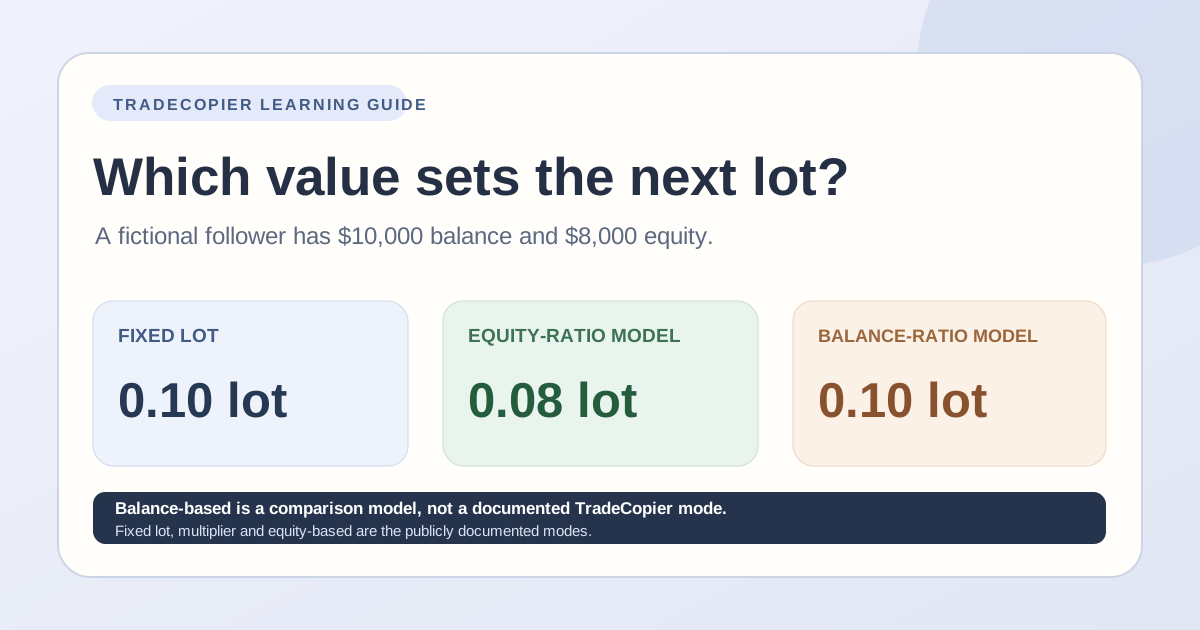
Assume a fictional source account has $20,000 balance and equity and sends a 0.20-lot instruction. A follower for the same assumed instrument and account currency has $10,000 balance but $8,000 equity after a $2,000 floating loss on an existing position. Assume no credit or other adjustment, and assume the destination accepts all four example quantities in 0.01-lot steps. This does not establish free margin, an acceptable live trade or TradeCopier's internal equity formula.
| Method | Illustrative rule | Calculated follower quantity |
|---|---|---|
| Fixed lot | Selected follower quantity | 0.10 lot |
| Multiplier | 0.20 source lot × 0.50 | 0.10 lot |
| Equity-ratio model | 0.20 source lot × ($8,000 follower equity ÷ $20,000 source equity) | 0.08 lot |
| Balance-ratio model | 0.20 source lot × ($10,000 follower balance ÷ $20,000 source balance) | 0.10 lot |
The last two rows are comparison models, not claims about TradeCopier's implementation. Here the floating loss changes the illustrative equity ratio to 0.08 lot while the balance ratio remains at 0.10 lot. If the $2,000 floating loss later becomes a $2,000 realized loss with no other changes or costs, the follower balance would also become $8,000 and this illustrative balance ratio would then produce 0.08 lot. The actual result depends on current account values, the selected product rule and broker validation.
Why an equal lot count does not establish equal risk
A lot is a quantity convention, not a cash-loss unit. The destination's contract size, tick size, losing-position tick value, account currency and volume rules affect what a given lot count means. MetaQuotes lists these as separate symbol properties, including minimum and maximum volume and volume step. Check the destination specification instead of transferring a source account's pip or point value by assumption.
Loss at a planned stop also depends on the follower entry, stop distance, costs and eventual execution. A sizing rule may suggest a quantity without receiving a stop. Even when a stop is present, its trigger price is not a guaranteed execution price; Investor.gov explains this distinction for securities stop orders. Check the broker rules for the instrument actually traded. For a worked cash-loss budget use the follower risk-percentage guide, and for an equal-lot contract comparison use risk per trade versus lot size. Neither guide turns an equity ratio into a fixed loss percentage.
Verify the selected mode on the follower route
- Record source and follower platform, broker, account, instrument, currency and direction. The platforms page calls for compatibility confirmation for the actual broker, account mode and instrument.
- In current product settings, identify whether the route uses fixed lot, multiplier or an available equity-based option. Record the setting value and any per-follower override. Do not select a supposed balance-based mode based on this comparison article.
- Read current follower balance, equity, available margin, contract size, tick values, minimum, maximum and volume step. Decide what should happen if calculated quantity is invalid or account data is unavailable. Do not round upward merely to force the broker minimum.
- In demo, predict the requested quantity for one eligible instruction. Compare the copier request with the destination order, fills and resulting position. Check broker records alongside available activity logs.
- Repeat after one controlled change, such as follower equity or destination instrument. If the observed quantity differs from the comparison model, do not present the model as the route's actual behavior.
When to pause and recalculate
Recalculate when follower balance or equity changes, a source quantity changes, an account is added, or a symbol maps to a different contract. A fixed quantity can become a larger share of a smaller account. A balance-based model can still use a higher balance while equity has fallen on an open position. Equity-based sizing responds to that account state but does not, by itself, test every existing position, available margin or planned stop. Use the separate copy-trading risk-management worksheet for account-wide and period limits.
If account values, contract specifications, selected mode or destination fills cannot be verified, label the sizing result unavailable. An unavailable calculation is neither zero exposure nor a passed check. No sizing mode guarantees profitability, a maximum realized loss or matching source and follower performance.
Primary references and scope
- TradeCopier: documented fixed-lot, multiplier and equity-based controls
- MetaQuotes: account balance, equity and currency properties
- MetaQuotes: instrument contract, tick and volume properties
- Investor.gov: stop trigger versus execution price for securities
Sources and linked product pages were checked on September 23, 2026. Confirm current settings and destination broker specifications before using a live route.
Quick answers
Frequently Asked Questions
Find answers to the most common questions about this topic.
What is the difference between fixed-lot and equity-based sizing?
Fixed lot requests a selected follower quantity. Equity-based sizing uses current follower equity as an input, so open gains or losses can change the calculated quantity. Neither method alone specifies cash loss at a stop.
Why can equity-based and balance-based calculations differ?
Equity can reflect open-position changes before they enter balance. In the hypothetical example, the follower has $10,000 balance but $8,000 equity after a $2,000 floating loss, producing different illustrative ratios.
Does TradeCopier offer a balance-based lot mode?
A separate balance-based mode is not documented on TradeCopier's public configuration page. That page documents fixed-lot, multiplier and equity-based modes. Confirm the current route settings in the signed-in product.
Do matching lot sizes mean source and follower have matching risk?
No. Contract size, tick value, account currency, entry, stop, costs, available margin and fills can differ. Check the follower instrument and broker result rather than comparing lot numbers alone.
Does equity-based sizing guarantee a chosen percentage loss?
No. An equity input can adjust order quantity, but a modeled loss at a stop also needs the follower entry, stop distance, contract value, currency, costs and valid volume. A stop price does not guarantee the eventual execution price.