
Partial Close and Scale-In Copy Trading:
A Position Risk Ledger
Adding to a copied position changes its quantity and entry cost; partially closing it realizes a result while leaving exposure open. Check those changes separately on every account. A source's profitable exit does not establish the follower's remaining quantity, entry price or protection.
This guide builds a hypothetical position ledger for additions and scale-outs. It explains the arithmetic and the records needed to investigate differences. It does not establish how TradeCopier handles a particular platform combination, allocation method or close request; those behaviors need current product documentation and route-specific testing.
Separate three decisions before changing a position
Write down the intended addition or reduction, the position it applies to, and the exposure permitted afterward. “Close 40%” is incomplete unless the denominator is clear: the original entry, the current source position or the current follower position can produce different quantities.
A scale-in adds exposure. Pyramiding usually describes adding while a position has moved favorably, but that favorable movement does not make the additional quantity free of risk. A scale-out reduces exposure through one or more exits. Neither action proves that the destination used the intended position or maintained the intended stop.
Before an addition, compare the whole resulting position with the account's stated loss budget. Before a reduction, specify the quantity expected to remain. Treat stop placement, position quantity and pending requests as separate observations; a calculated stop level is not evidence that the broker accepted protection at that level.
Calculate weighted entry after an addition
For a simple linear position, weighted entry equals the sum of each filled entry price multiplied by its quantity, divided by total entry quantity. MetaTrader 5's position-management documentation describes weighted entry for positions formed from multiple deals. Use confirmed fills, not the price or quantity originally requested.
Consider an invented long position measured in generic units. The account currency is USD, and each unit gains or loses $1 for each one-point price move. There are no commissions, financing charges or currency conversions in the example. These are teaching assumptions, not a specification for forex lots, futures contracts or another live instrument.
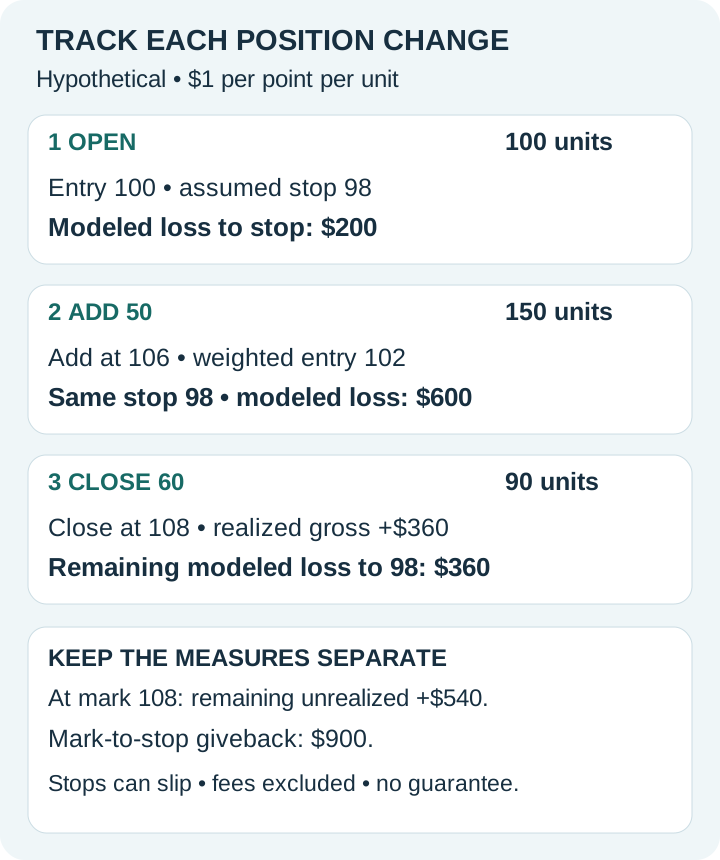
Buy 100 units at 100 and assume a stop fill at 98. The modeled loss from entry is 100 × (100 − 98) = $200. Then add 50 units at 106 without changing the assumed stop:
New weighted entry = [(100 × 100) + (50 × 106)] ÷ 150 = 102.
The resulting entry-to-stop loss is 150 × (102 − 98) = $600. The original units contribute $200 and the new units contribute $400. Quantity increased by 50%, but this particular modeled loss tripled. The new entry was farther from the unchanged stop.
Record that comparison before deciding whether an addition fits the account's budget. Margin availability and a profitable open position do not answer the same question as loss at a specified exit assumption. If the stop changes, recalculate using the confirmed new level and retain the old calculation for review.
Keep realized profit separate from remaining risk
Now close 60 of the 150 units at 108. This is a 40% reduction of the position immediately before that exit. The worksheet uses weighted-average allocation: the closed quantity and the remaining quantity both use the 102 entry basis.
| Completed event | Open units afterward | Entry basis | Cumulative gross realized P&L | Remaining entry-to-stop loss at 98 |
|---|---|---|---|---|
| Buy 100 at 100 | 100 | 100 | $0 | $200 |
| Add 50 at 106 | 150 | 102 | $0 | $600 |
| Close 60 at 108 | 90 | 102 | +$360 | $360 |
The partial exit realizes 60 × (108 − 102) = $360. The remaining 90 units have a modeled entry-to-stop loss of 90 × (102 − 98) = $360. If all remaining units actually fill at 98, their −$360 result offsets the earlier +$360: combined gross P&L is zero. If they instead fill at 97, the remaining result is −$450 and combined gross P&L is −$90. Costs can further change either outcome. These positive loss figures assume a long position with the stop below entry basis; use an explicitly signed P&L scenario for a different stop or direction.
There is another useful comparison. At an illustrative mark of 108, the remaining unrealized gain is 90 × (108 − 102) = $540. A move from that mark to a fill at 98 gives back $900 on the remaining units. Entry-to-stop loss ($360) and mark-to-stop giveback ($900) describe different starting points. Label both instead of calling either simply “risk.”
Weighted-average allocation is an explicit worksheet convention. A broker's selected tickets or other allocation rules can divide realized and unrealized amounts differently. Reconcile against native records; this example does not replace broker statements, tax accounting or the actual position-association rules.
Distinguish an intentional partial exit from a partial fill
A planned scale-out asks to reduce only part of an open position. A partial fill means an order has executed for only part of its requested quantity. Both can occur together: a planned 60-unit exit may initially fill 25 units. The strategy requested a partial exit, and that exit order remains only partly executed.
Keep separate columns for the strategy's intended remainder and the destination's observed remainder. Do not infer either from a button label. A dedicated partial-fill reconciliation guide addresses incomplete execution; this ledger focuses on the exposure and accounting after additions and reductions.
Check which position the reduction affects
cTrader's positions and deals guide distinguishes an execution deal from the open exposure and explains that an order can produce multiple deals. Its hedging accounts can hold multiple positions on a symbol; its netting accounts maintain a single net position for that symbol.
That distinction changes a reconciliation. In a hedging account, identify the particular position being reduced. In a netting account, another strategy or manual trade on the same symbol can affect the shared net position. The same total quantity across two accounts does not establish that the intended strategy's exposure was closed.
MetaTrader 5's accounting principles explain that an opposite-direction deal in netting can reduce, close or reverse exposure according to its size. Do not assume that every close-related command has that behavior: a position-specific partial-close operation has its own documented rules. Preserve the action type and destination position association.
Reconcile fills and rounding before comparing accounts
A submitted reduction is not a completed reduction. MQL5's PositionClosePartial reference explicitly separates a successful basic request check from successful execution. Its documented operation concerns hedging positions, with symbol and ticket variants; this is platform API documentation, not evidence of TradeCopier's implementation.
Record requested quantity, cumulative filled quantity, native status and the remaining open position. If an intended 60-unit reduction has only 25 units confirmed filled, do not enter 90 remaining merely because that was the plan. Keep the unresolved remainder visible until the destination records explain it.
Quantity constraints also matter. If a follower has 37 units, a proportional 40% reduction calculates to 14.8 units. With an assumed one-unit step, that is not an allowed increment. Closing 14 would leave 23; closing 15 would leave 22. These alternatives illustrate the discrepancy, not a recommendation or a claimed rounding policy.
MetaQuotes' symbol properties expose minimum, maximum and step constraints. Check the destination specification and the documented treatment of small residual positions. Record the calculated amount, the submitted amount and the actual fill separately.
Use a position ledger with reviewable evidence
Download the copy-trading position ledger worksheet. Its eight blank review rows start as not_run, with monetary fields empty. It is a manual template, not a product export. Keep hypothetical rows separate from observed account records. For each real addition or exit, preserve the account alias, instrument and unit, account model, source reference, destination position association, request and fill identifiers, timestamps and status.
Then reconcile the before/after quantity, weighted entry or ticket basis, confirmed stop, realized result and remaining modeled loss. Record the multiplier, currency, clock basis, costs and conversion assumptions. An unavailable fill or position snapshot is missing evidence, not zero exposure. Attach evidence references without including credentials or account secrets.
Before repeating an unclear close request, establish what the destination already executed and which action is still pending. Otherwise another reduction can change the intended remainder. The worksheet is a manual review aid; it does not send orders, implement retries or certify that a route supports every sequence.
A route test should retain its dated platform versions and account model, then demonstrate an addition, a deliberate reduction and the resulting destination records. Include what happens when an instruction remains unresolved. An arithmetic example cannot establish that stop association survives an addition, that repeated messages are handled safely or that a copier uses a particular allocation policy. Leave those results unverified until documented evidence exists.
A stop calculation is a scenario, not a guaranteed ceiling
The SEC's investor bulletin on stop orders explains, in its stock-order context, that the trigger price does not guarantee the execution price; a stop-limit also introduces a risk of no execution. Check the actual broker and instrument rules for a copied position.
Use additional fill-price scenarios when reviewing an addition or partial exit. Keep closed profit, current exposure and possible future execution separate. That makes a mismatch investigation answerable with quantities and records, without presenting a planned stop or an earlier winning exit as protection against every later loss.
Quick answers
Frequently Asked Questions
Find answers to the most common questions about this topic.
What changes when a copied position is scaled in?
The filled quantity and entry basis can change, and the loss modeled at a specified stop may increase. Recalculate the whole position from confirmed destination fills and verify the current stop rather than evaluating only the new addition.
How is weighted entry calculated after adding to a position?
Multiply each filled entry price by its quantity, add those amounts and divide by the combined quantity. In the hypothetical example, 100 units at 100 plus 50 at 106 produce 150 units with a weighted entry of 102.
Does closing 40% always leave identical exposure across accounts?
No. The percentage needs a defined starting quantity, and account sizes, volume steps, fills and position association may differ. A 40% reduction of 150 units is 60; 40% of 37 is 14.8, which may not be an allowed increment.
How do realized profit and remaining stop risk differ?
Realized profit comes from completed exits. Remaining modeled stop risk concerns still-open exposure under a stated fill assumption. In the weighted-average example, closing 60 units at 108 realizes $360 while the remaining 90 units still have $360 of entry-to-stop loss at 98, before costs.
Why is mark-to-stop giveback different from entry-to-stop loss?
They use different reference prices. With 90 units entered at 102, marked at 108 and hypothetically exited at 98, entry-to-stop loss is $360 while mark-to-stop giveback is $900. The latter includes giving back $540 of unrealized gain.
Why do hedging and netting matter for partial closes?
Hedging can maintain separate positions on one symbol, so the intended position must be identified. Netting combines symbol exposure, where an opposite deal may reduce, close or reverse the net position. The exact command and account rules determine the outcome.
Does a successful partial-close request prove the position was reduced?
No. A request check or acknowledgment must be distinguished from execution. Reconcile confirmed fill quantities, native status and the current destination position; retain unresolved or unavailable evidence rather than assuming the planned remainder.
Does this ledger verify TradeCopier's scale-in and partial-close behavior?
No. It is an educational calculation and manual review worksheet. Route-specific support, position mapping, rounding, stop handling and partial-fill behavior require current product documentation and tests on the relevant account configuration.