Reverse Copy Strategies:
Hedging Limits and Trading Costs
Reverse copying changes a trade's direction; it does not turn its net loss into an equal profit. Opposite positions can offset some price exposure, but spreads, commissions, financing and differences in execution remain. A losing source is therefore not evidence that an inverse account will make money.
This guide evaluates reverse copying as a proposed hedge and as a strategy test. The numbers are hypothetical, not TradeCopier results. They explain what to compare before treating an inverse position as protection, without establishing that a particular TradeCopier route supports the required actions.
Decide what the inverse position is supposed to achieve
A hedge seeks to reduce a specified exposure already held. A profit-seeking inverse strategy instead bets that the source's opposite direction will be favorable. These are different objectives: the first needs an exposure comparison, while the second needs evidence about returns after all relevant costs.
If you own a long position and add an equal short in the same linear instrument, the combined sensitivity to a common price move can approach zero while both positions remain open. If you hold only the short, however, you have taken a directional position. Calling it a reverse copy does not make it a hedge.
Write the objective before selecting a source. Identify the holding being protected, the risk factor, the intended hedge duration and the circumstances that end the hedge. A source changing instruments, size or holding period can change whether its inverted trades still serve that objective.
Follow one long and one reverse short through the same quotes
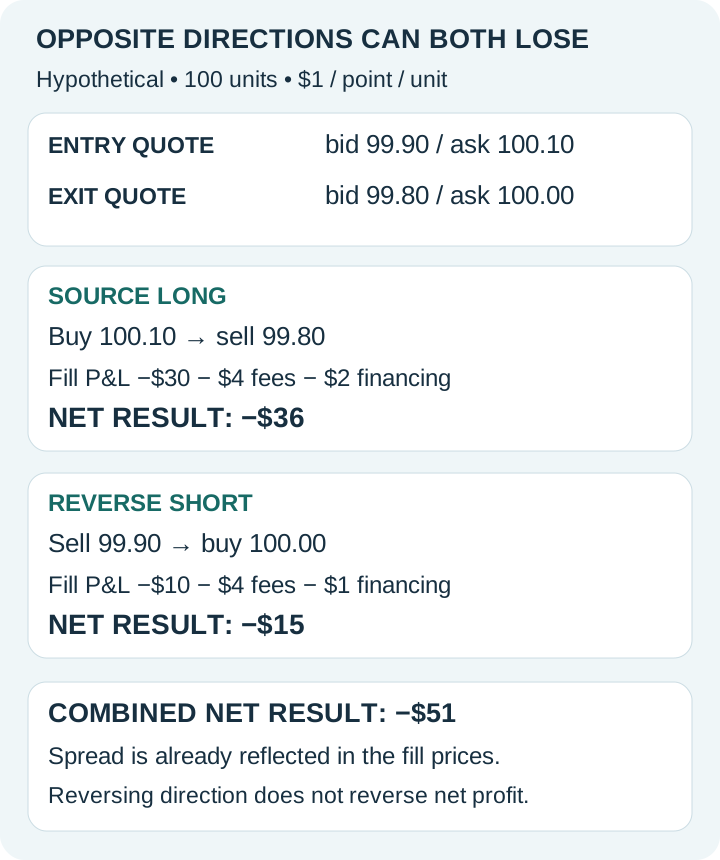
Consider two fictional accounts trading the same linear instrument. Each holds 100 units; one point of price movement is worth $1 per unit, in USD. Assume the same entry and exit instants, complete fills at the quoted sides, unchanged quantity and no currency conversion. Real accounts need not share any of those conditions.
At entry, the quote is bid 99.90 and ask 100.10. At exit, it is bid 99.80 and ask 100.00. The source buys at the entry ask and sells at the exit bid; the reverse account sells at the entry bid and buys back at the exit ask. MetaTrader 5's trading principles explain these buying and selling quote sides.
| Ledger item | Source long | Reverse short |
|---|---|---|
| Entry fill | Buy at 100.10 | Sell at 99.90 |
| Exit fill | Sell at 99.80 | Buy at 100.00 |
| Fill-based P&L before explicit charges | 100 × (99.80 − 100.10) = −$30 | 100 × (99.90 − 100.00) = −$10 |
| Total round-trip commission | −$4 | −$4 |
| Financing debit | −$2 | −$1 |
| Net P&L after these charges | −$36 | −$15 |
The midpoint fell from 100.00 to 99.90. A frictionless midpoint calculation would show −$10 for the long and +$10 for the short. Yet both quoted-side trades lose money. Their combined fill-based result is −$40, and their combined net result is −$51 after the example's $11 of additional charges.
The spread is already embedded in the entry and exit fills. Subtracting it again would double-count that cost. Likewise, these commission figures are totals for the entire round trip, not amounts to deduct twice. A real statement may organize charges differently; reconcile each item once.
Explain the gap before judging the source
For equal quantities, the same linear multiplier and matching entry/exit instants, the two fill-based results sum to minus the quantity times the multiplier times the entry spread plus the exit spread. Here that is −100 × 1 × (0.20 + 0.20) = −$40. Reversing direction does not reverse those spreads.
A source can lose because of trading costs despite a slightly favorable price signal. Its inverse can then lose from both direction and costs. Alternatively, a historical losing period may reflect an unusual market episode or an overfit selection rule. Choosing the worst source after inspecting the whole period does not provide an independent test of future inverse returns.
Financing is also not automatically an equal-and-opposite transfer between the two accounts. OANDA Corporation's financing explanation describes separate long and short rates, with administration fees and instrument-specific terms. Our two debits are invented examples, not its current rates. Use the actual account records, including credits, borrow charges or other applicable adjustments.
Separate directional offset from gross exposure
In the fictional pair, signed quantity is +100 − 100 = zero, while gross quantity is |100| + |−100| = 200 units. Zero signed quantity says something narrow about simultaneous sensitivity to the same price. It does not mean there are no positions, no charges or no account obligations.
Across separate accounts, do not assume that the gain in one automatically funds the other's margin requirement. If one position closes or liquidates first, the remaining position becomes directional. Record each account's exposure as well as the combined view, and identify who is responsible for a one-sided remainder.
Different instruments require more than matching their displayed lot counts. Contract multipliers, currencies, expiries and underlying exposures may differ. Basis risk arises when the proposed hedge and the holding do not move together as assumed. Equal dollar amounts in two related assets can still leave meaningful market sensitivity.
A separate exposure check illustrates a partial hedge: 100 long units and 70 short units of the same hypothetical instrument leave +30 signed units and 170 gross units. With the same $1 multiplier, a simultaneous one-point downward move contributes −$30 across the pair before trading costs. The residual is an intentional directional exposure only if that was the stated objective.
Compare this with reducing the original holding directly. Both choices can reduce price sensitivity, but they create different positions, costs and account requirements. Do not assume reverse copying is cheaper than closing part of a holding or using another hedge; that comparison needs the actual instruments and terms.
Keep beta, correlation and concentration distinct
Correlation describes the strength and direction of a linear relationship between return series. Beta describes sensitivity to a chosen benchmark, while concentration concerns how much exposure is tied to a position or shared risk factor. None is interchangeable with “percentage hedged.”
CME's sector-futures analysis explains why equal notional positions need not be market-neutral and discusses estimated sensitivities and unstable hedge ratios. Record the benchmark, return interval and estimation window before using an estimate. A beta of 0.7 is not a correlation requirement, and a high historical correlation is not a guarantee of future offset.
A reverse-copied account can remain concentrated in the same currency, sector or broker as the holding it was intended to protect. Assess those dependencies directly instead of counting the number of accounts as diversification.
Verify account behavior and directional protection
An opposite-side instruction does not always create a separate hedge position. cTrader's account-model documentation distinguishes hedging accounts, which can maintain multiple positions on one symbol, from netting accounts, where deals affect a single net position. The actual account model and existing exposure matter.
Stops and targets also require directional interpretation. A protective stop below a long entry cannot simply retain the same role when applied unchanged to a short. Specify whether protection is based on absolute prices, distance from the destination fill or a different rule, then verify which quote side triggers it and what the platform accepts.
Pending entries, partial exits, stop changes and disconnect recovery need their own documented mapping. This article does not verify TradeCopier's reverse-copy support on any particular route, its treatment of those actions or its account permissions. Retain dated platform, connector and broker evidence before relying on a specific configuration.
Use risk estimates without treating them as loss caps
Value at Risk, or VaR, summarizes a modeled loss threshold for a specified horizon and confidence level. It is not an order, a guarantee or a maximum possible loss. The Basel Framework's risk terminology distinguishes VaR from expected shortfall, which addresses losses beyond that threshold. Estimates depend on data and model assumptions.
A chosen 2% loss budget does not make VaR enforce a 2% ceiling. Nor does an ordinary stop guarantee its trigger price: the SEC's stop-order bulletin explains that execution can differ, in its stock-order context. Check the applicable instrument and broker rules. Detailed VaR methods and tail-loss estimation require separate analysis.
Record a comparison that another reviewer can reproduce
Use the reverse-copy comparison worksheet as a manual record, not a product export or backtest result. Its eight blank rows contain 32 fields, start with review_status set to not_run and leave numerical observations empty. Keep hypothetical calculations separate from observed records. Preserve paired account aliases, instruments, units, multipliers, timestamps, bid/ask quotes, actual entry/exit fills and quantities.
Record commission_round_trip and other_charges as positive costs to subtract; financing_signed is positive for a credit and negative for a debit. With every amount expressed on the same currency basis, net_pnl = fill_based_pnl − commission_round_trip + financing_signed − other_charges. Apply any required currency conversion consistently and retain its rate and timing. State whether spread is embedded in fill prices. Missing fills or fees remain unavailable; they are not zero-cost observations. Retain source and destination references without credentials.
Define the selection rule and evaluation period before comparing strategies, retain rejected or unmatched attempts, and distinguish simulated from observed execution. Judge a proposed hedge against its stated exposure objective and residual costs. Judge a proposed inverse strategy by independently evaluated net outcomes, not by negating the source's reported P&L.
Quick answers
Frequently Asked Questions
Find answers to the most common questions about this topic.
Does reverse copying a losing trader guarantee a profit?
No. Opposite direction does not invert spreads, fees or financing, and execution, quantity and exit rules can differ. A losing source may have lost mainly to costs or an unrepresentative period, so its inverse needs an independent evaluation.
Can a source trade and its reverse both lose money?
Yes. In the hypothetical example, a 100-unit long loses $30 and the reverse short loses $10 from quoted-side fills. Separate invented commissions and financing increase their net losses to $36 and $15.
Should spread be subtracted again from fill-based P&L?
No. When entry and exit prices are actual quoted-side fills, spread is already reflected in their difference. Deduct separate charges once and explain how the broker records them.
Is an opposite trade automatically a hedge?
No. A hedge must offset a specified exposure that is already held. A reverse short held alone is directional, and a position in a related instrument can leave basis risk even when its notional amount matches the holding.
Does zero signed quantity mean zero risk?
No. Equal long and short quantities can offset sensitivity to a common price while retaining gross exposure, charges and account obligations. If one side closes first, the remainder becomes directional.
Are beta and correlation the same measure?
No. Correlation describes a linear relationship between return series; beta describes sensitivity to a benchmark. Their estimates depend on data and method, and neither establishes a guaranteed hedge ratio.
Can Value at Risk cap a reverse-copy loss at 2%?
No. VaR is a modeled threshold tied to a horizon and confidence level, not a maximum possible loss or an execution control. A chosen loss budget does not prevent losses exceeding it.
Does this guide verify TradeCopier's reverse-copy behavior?
No. The guide explains hedge economics and a hypothetical comparison. Account permissions, netting behavior, reverse entries, stop and target mapping, partial exits and recovery require current documentation and dated evidence for the actual route.