Risk per Trade vs Lot Size in Copy Trading
Lot size is the quantity sent to a follower; risk per trade is the estimated amount that follower could lose under a stated exit scenario. The same displayed lot count can carry different cash exposure when the contract, tick value, account currency, entry, stop or transaction cost changes. A planned risk amount is an estimate, never a guaranteed maximum loss.
Publisher disclosure: TradeCopier publishes this guide about its own product. Its configuration page describes fixed-lot, multiplier and equity-based lot modes. None of those labels by itself establishes a cash-loss limit at a stop. The contracts and prices below are fictional arithmetic for learning, not a live TradeCopier route, broker specification, customer result or recommended risk percentage. Product and platform references were checked on September 23, 2026.
Separate position quantity from a loss estimate
| Number | What it answers | What it cannot answer alone |
|---|---|---|
| Lots or units | How much of the destination instrument is requested? | Cash loss if the price moves against the position |
| Notional exposure | What underlying contract value does that quantity represent? | Loss at a particular planned exit price |
| Margin | What collateral does the broker require under its current rules? | A ceiling on possible loss |
| Modeled loss at a stop | What would the price move and specified costs imply at an assumed fill? | The realized result after gaps, slippage, rejection or another fill |
For an MT5 symbol, MetaQuotes lists separate properties for contract size, tick size, losing-position tick value, minimum volume, maximum volume and volume step. A label such as “0.10 lot” is not enough to infer those fields across two destination instruments or brokers. The source account's contract rules do not replace the follower's current rules.
Compare equal lots on two hypothetical contracts
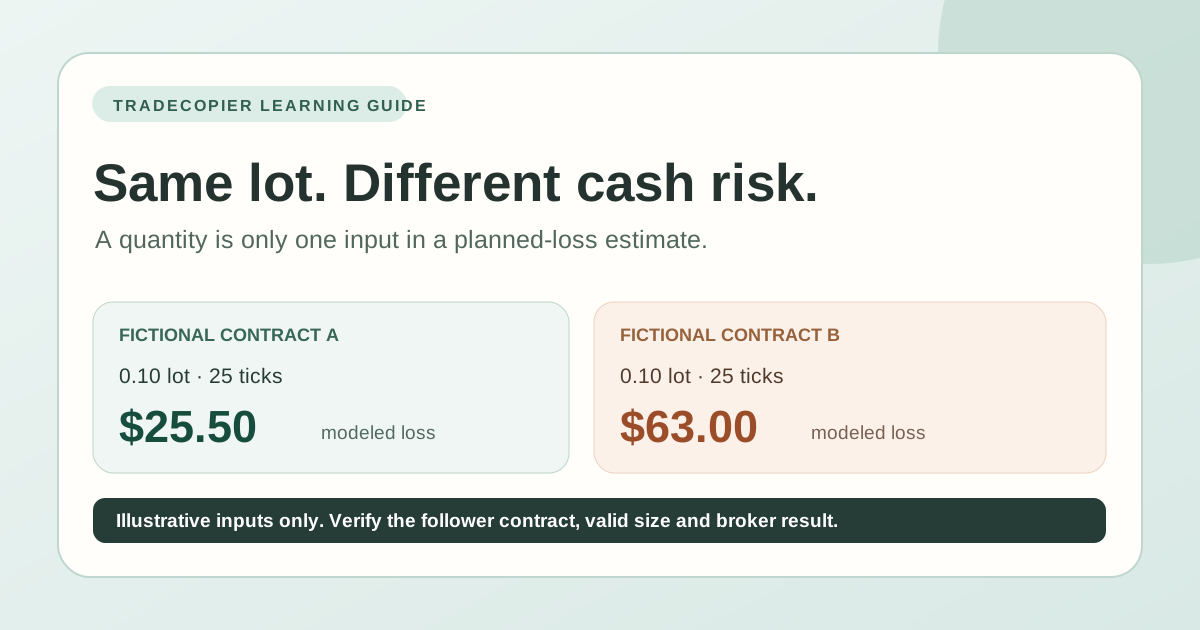
Assume two fictional follower contracts, A and B, each permitting 0.10 lot. Both planned stops are 25 ticks from their assumed entry fill. Contract A loses $10 per tick for 1.00 lot; B loses $25 per tick for 1.00 lot. For this example only, both charge $5 per 1.00 lot in modeled round-trip costs, scaled with quantity, and all values are already in the follower's USD account currency. The stop distance is measured from the executable entry side, so no second spread charge is added.
| Input or result | Contract A | Contract B |
|---|---|---|
| Follower quantity | 0.10 lot | 0.10 lot |
| Assumed tick loss for 1.00 lot | $10 | $25 |
| Planned adverse distance | 25 ticks | 25 ticks |
| Modeled price loss | 0.10 × 25 × $10 = $25.00 | 0.10 × 25 × $25 = $62.50 |
| Modeled transaction cost | 0.10 × $5 = $0.50 | 0.10 × $5 = $0.50 |
| Total modeled loss | $25.50 | $63.00 |
Equal 0.10-lot quantities have different estimated outcomes even with the same 25-tick stop. Here the calculation is valid lots × (ticks to planned stop × loss per tick for 1.00 lot + modeled costs per 1.00 lot). Do not use this simplified multiplication until the actual contract's tick value, calculation mode and currency conversion are verified. For MT5, OrderCalcProfit can estimate a specified order's profit or loss in account currency under current conditions; it still cannot predict a future fill or include every future cost.
Work backward from a chosen cash budget
Suppose the fictional follower has $5,000 in equity and independently selects $50 as the modeled loss budget for this example. That $50 is an arithmetic assumption, not advice that one percent is suitable for a particular trader. With the contract B assumptions above, one full lot models $625 of price loss plus $5 cost, or $630. An unrounded $50 ÷ $630 is about 0.07937 lot. If the actual permitted volume step were 0.01 lot and the minimum at most 0.07 lot, rounding down to 0.07 lot would model 0.07 × $630 = $44.10. Rounding to 0.08 lot would model $50.40 and exceed the chosen $50 amount.
If the destination minimum were instead 0.10 lot, there would be no eligible quantity under this particular $50 plan: its modeled loss would be $63.00. A broker minimum cannot safely be ignored or rounded upward just to force a copy. A different instrument, account currency, current quote, fee schedule or stop changes the answer. When an expected stop or monetary tick value is unavailable, this loss-at-stop calculation is unavailable; do not silently insert zero or invent a default distance.
Check what a copying rule actually changes
A fixed-lot rule can hold destination quantity constant while the follower's equity and cash risk change. A source-lot multiplier changes quantity with the source size. An equity-based lot rule can change quantity as an account value changes. None automatically converts a stated percentage into a stop-based loss budget. The separate follower risk-percentage guide compares those meanings and shows a forex-specific budget calculation. The sizing-mode comparison explains how fixed, equity-based and hypothetical balance-based quantities respond to floating P&L.
For the actual TradeCopier route, confirm which sizing controls exist for the precise source, follower, broker, instrument and connection. Do not infer a stop-risk feature from a field called “risk percentage” without checking its documented input and output. The supported-platform page requires route-specific confirmation; a cross-asset illustration does not certify copying stocks, crypto or every futures contract.
Recheck the number after the trade changes
The example's $44.10 estimate assumes contract B fills at the specified entry and stop distance. If the adverse fill is five ticks beyond the planned stop, the same 0.07 lot would model 0.07 × (30 × $25 + $5) = $52.85, already above the illustrative $50 budget. Broker fees could also change. Investor.gov explains for securities stop orders that a triggered stop does not guarantee an execution at its stated stop price; the exact mechanics for a follower's product and venue must be checked separately.
Copied orders can be rejected, partially filled or modified. A source stop can differ from the follower stop because of symbol mapping, minimum stop distance or broker rules. Look at the destination order, each fill, actual position and protective order before concluding that a planned quantity or stop was applied. If the result is uncertain, record it as uncertain and reconcile with the broker rather than retrying an unknown instruction.
Use a follower-side verification record
- Identify source and follower account aliases, broker servers, account currencies, exact symbols, contract sizes, tick sizes and monetary tick values. Record when each property was checked.
- Write down the copying mode and its current settings. Separate the source quantity, calculated destination quantity, broker-valid submitted quantity and actual filled quantity.
- For a planned stop, record expected entry, stop, distance, direction, assumed costs and any currency conversion rate and time. Estimate a cash result for the destination contract; compare any platform calculator with its underlying inputs.
- In demo, test one supported source action and inspect the follower broker's order, deals, position and stop. Compare modeled and actual cash outcomes only after the action is resolved.
- Repeat the check after changing symbol, lot step, account value, stop distance or rule version. Include open and pending positions when deciding whether one more copy fits an account-level plan.
Use the copy-trading risk-management worksheet for account and period limits beyond one trade. Quantity, estimated loss at a stop, combined exposure and realized account loss are different observations; keep them separate in the record.
Primary references and scope
- MetaQuotes: symbol contract, tick and volume properties
- MetaQuotes: current-condition profit and loss estimate
- Investor.gov: why securities stop orders can execute away from the stop price
These sources and linked TradeCopier product pages were reviewed on September 23, 2026. The example is a calculation template, not evidence of TradeCopier's realized order results or a profit forecast.
Quick answers
Frequently Asked Questions
Find answers to the most common questions about this topic.
Is lot size the same as risk per trade?
No. Lot size is an order quantity. Estimated cash risk at a planned stop also depends on the follower instrument's monetary tick or price-move value, stop distance, account currency and costs. Realized loss may differ from the estimate.
Can I use the same 0.10 lot on two copied instruments?
Only after checking the actual destination contracts and account limits. Two 0.10-lot positions can have different cash results for the same number of adverse ticks, and either quantity may be invalid under a broker's volume rules.
How do I convert a cash risk budget into lots?
Estimate loss per full tradable lot at the planned follower stop in the follower account currency, including stated costs; divide the selected budget by that value; then round down to a broker-valid step and verify the minimum. If required inputs are missing, the result is unavailable.
Does a stop order cap the loss at the calculated amount?
No. The stop and entry prices are assumptions for sizing. The actual broker fill can differ because of gaps, liquidity, slippage, rejection or other execution conditions.
Does TradeCopier automatically size every copy by stop-loss risk?
The public configuration page describes fixed-lot, multiplier and equity-based lot controls, not a universal stop-risk calculation for every route. Confirm the available setting and actual follower result for your specific connection.