Trade Copier Reverse Trading:
Copy Losing Trades Inverses
Introduction
Trade copier technology has evolved beyond simple trade duplication. One increasingly discussed strategy involves reversing trade direction instead of copying positions directly. This approach, commonly referred to as Trade Copier Reverse Trading, allows traders to mirror losing trades inversely in an attempt to capitalize on consistently underperforming strategies or unstable signal behavior.
This article explains how reverse copy trading works, why traders use inverse trade copier systems, and how controlled risk management becomes essential when implementing reverse execution models across multiple accounts. It also explores the operational considerations involved in reversing copied trades within structured multi-account trading environments.
1. Understanding Reverse Copy Trading Logic
1.1. What Is Trade Copier Reverse Trading?
Traditional trade copying duplicates positions from a master account to connected slave accounts using the same:
- Entry direction
- Lot size
- Stop loss
- Take profit
Reverse trading changes this logic entirely.
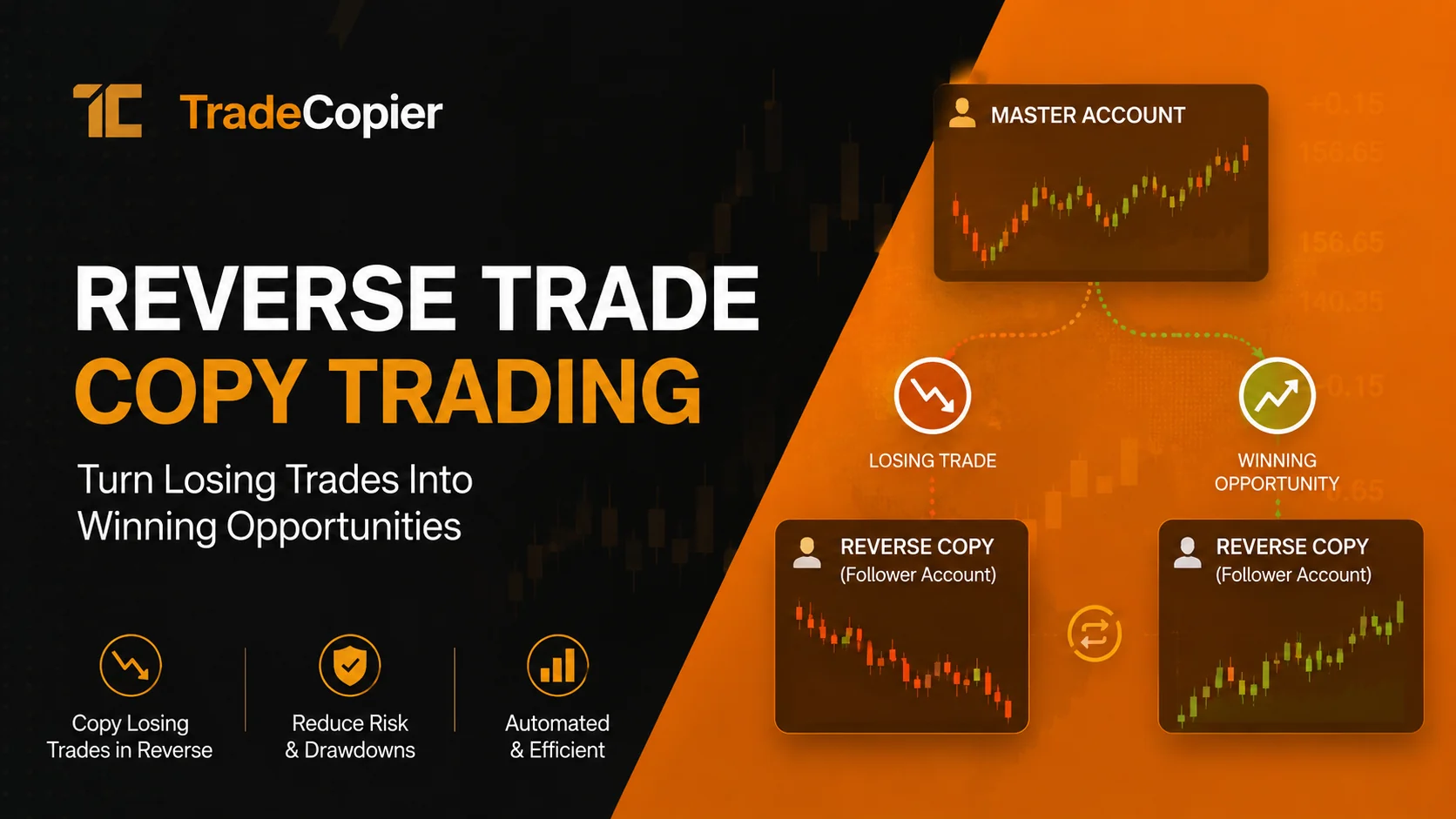
Instead of copying trades identically, an inverse trade copier executes the opposite direction of the source trade.
Example:
- Master account opens BUY EURUSD
- Slave account executes SELL EURUSD
This process allows traders to copy losing trades in reverse when the original strategy demonstrates prolonged inconsistency or statistically weak performance.
The objective is not random inversion. The objective is leveraging execution patterns where the source account consistently underperforms under specific market conditions.
1.2. Why Traders Use Reverse Copy Trading
Reverse trading is typically used in highly specialized situations.
Common use cases include:
- Counter-strategy testing
- Opposite trend execution
- Poor signal inversion analysis
- Hedge-style account structures
- Behavioral strategy exploitation
Some traders identify systems where:
- Entries consistently lag momentum
- Risk management remains weak
- Stop losses trigger frequently
- Market timing becomes unreliable
In these situations, reversing trades may theoretically produce improved outcomes under certain conditions.
Key Detail: Typical Reverse Trading Parameters
- Opposite directional execution
- Adjustable lot scaling
- Independent stop loss settings
- Risk percentage control
- Symbol-specific filtering
- Multi-account synchronization
Key Detail: Operational Logic Constraints
- Reverse execution requires precise synchronization
- Slippage affects inverse strategies significantly
- Volatile markets increase execution divergence
- Symbol mapping consistency becomes critical
- Risk scaling must remain controlled across accounts
Reverse trading should be approached as a structured execution methodology rather than a shortcut strategy.
2. Technical Structure Behind Inverse Trade Copying
2.1. Reverse Trade Execution Workflow
An inverse trade copier operates by intercepting source account trades and converting them into opposite-side positions before execution on destination accounts.
The operational process generally includes:
- Master account generates trade signal
- Copier reads execution details
- Trade direction is reversed
- Risk parameters are recalculated
- Inverse trade executes on connected accounts
For example:
- Original BUY becomes SELL
- Original SELL becomes BUY
Additional controls may include:
- Lot multiplier adjustments
- Independent stop loss settings
- Risk filters
- Symbol-specific execution rules
TradeCopier.org supports structured copy trading environments that help traders manage complex multi-account execution workflows with centralized trade handling capabilities.
Pro Tip: Reverse trading systems become highly sensitive to execution delays during volatile market conditions. Stable synchronization infrastructure is essential for maintaining consistency.
2.2. Why Risk Management Matters More in Reverse Trading
Reverse execution introduces additional complexity compared to traditional copy trading.
A normal trade copier attempts to replicate:
- Direction
- Timing
- Position size
Reverse trading introduces:
- Opposite directional exposure
- Different market behavior assumptions
- Increased sensitivity to volatility
- Greater slippage impact
Without structured controls, traders may face:
- Rapid drawdowns
- Synchronization drift
- Overexposure across accounts
- Inconsistent trade behavior
This is why professional reverse trading setups rely heavily on:
- Strict risk allocation
- Controlled lot sizing
- Maximum exposure limits
- Multi-account balancing
For larger operations managing multiple accounts simultaneously, risk control becomes more important than trade frequency.
3. Testing and Optimization of Reverse Copy Trading
3.1. Backtesting Reverse Execution Models
Reverse trading strategies should never be deployed without proper historical testing.
Backtesting helps traders evaluate:
- Win-rate inversion behavior
- Drawdown patterns
- Volatility sensitivity
- Slippage exposure
- Execution consistency
Testing environments should include:
- Trending market conditions
- Range-bound sessions
- High-impact news periods
- Different asset classes
The purpose is identifying whether poor signal behavior remains statistically consistent enough to justify reverse execution.
Common Optimization Variables
Professional traders often test:
- Fixed reverse lot sizes
- Dynamic risk scaling
- Symbol-specific inversion
- Session-based activation
- Volatility-adjusted filtering
These variables help refine operational stability.
Important: A losing strategy does not automatically become profitable when reversed. Market structure, spread behavior, and execution quality still affect outcomes significantly.
3.2. Managing Slippage and Synchronization
Reverse copy trading amplifies the importance of execution precision.
Even small delays can create:
- Entry discrepancies
- Poor inverse positioning
- Increased spread exposure
- Strategy drift across accounts
This becomes particularly problematic during:
- Scalping activity
- News events
- Low liquidity conditions
- Rapid directional moves
TradeCopier.org helps traders maintain more structured execution environments through:
- Centralized trade management
- Multi-account synchronization
- Risk control flexibility
- Stable trade distribution workflows
For reverse execution systems, infrastructure stability directly affects long-term consistency.
4. Visual Analysis / Results
4.1. Typical Reverse Trading Behavior
Reverse copy trading often behaves differently depending on market structure.
Trending Markets
If the source strategy repeatedly trades against trend momentum, inverse execution may perform better under directional conditions.
Range-Bound Markets
Some reversal systems may experience inconsistent behavior during sideways movement due to spread and false breakout activity.
Volatile Sessions
High volatility increases:
- Slippage probability
- Synchronization drift
- Execution inconsistency
This is why many traders combine reverse trading with:
- News filters
- Risk caps
- Volatility controls
4.2. Performance Comparison Scenarios
Conservative Reverse Setup
- Lower lot exposure
- Reduced volatility risk
- More stable portfolio behavior
Aggressive Reverse Setup
- Higher exposure
- Increased drawdown sensitivity
- Larger slippage impact
Filtered Reverse Setup
- Selective symbol execution
- Session-based activation
- Controlled risk exposure
Filtered environments often produce more stable long-term operational behavior compared to unrestricted inversion models.
Conclusion
Trade Copier Reverse Trading represents a specialized execution approach where copied trades are intentionally inverted rather than duplicated directly.
While the concept of attempting to copy losing trades in reverse may appear straightforward, successful implementation requires:
- Structured risk management
- Stable synchronization
- Careful backtesting
- Controlled lot sizing
- Reliable infrastructure
Reverse trading is not simply about opposing trades. It is about managing inverse exposure systematically across multiple connected accounts while maintaining operational consistency.
TradeCopier.org supports scalable copy trading environments designed to help traders and brokers manage advanced multi-account execution workflows with centralized control and structured risk handling.
Start your copy trading journey at tradecopier.org
Quick answers
Frequently Asked Questions
Find answers to the most common questions about this topic.
What is Trade Copier Reverse Trading?
It is a copy trading method where destination accounts execute the opposite direction of trades generated by the source account.
Why do traders reverse copied trades?
Some traders use reverse execution when analyzing strategies that consistently underperform or trade against broader market momentum.
What is an inverse trade copier?
An inverse trade copier automatically converts BUY trades into SELL trades and vice versa during trade replication.
Can reverse trading improve profitability?
Not necessarily. A losing strategy does not automatically become profitable when reversed. Proper testing and risk management remain essential.
What are the risks of reverse copy trading?
Major risks include: Slippage Execution delays Increased volatility exposure Synchronization inconsistencies Overleveraged inverse positions
How does TradeCopier.org support advanced copy trading workflows?
TradeCopier.org provides structured multi-account trade management, risk control flexibility, and centralized execution environments for scalable copy trading operations.