Trade Copier Risk Percentage:
Size Follower Trades
A trade copier risk percentage is meaningful only after you name the quantity it controls. A percentage of follower equity used to scale lots is different from a percentage of equity budgeted for the modeled loss between entry and stop. Neither setting guarantees the realized loss. Check the current copying mode, instrument specifications and actual follower account before describing a copied trade as “1% risk.”
Publisher disclosure: TradeCopier publishes this guide about its own product. The public configuration page describes equity-based lot sizing and per-account settings. It does not establish that every route calculates position size from a chosen stop-loss risk percentage. The numbers below are hypothetical arithmetic, not a TradeCopier execution test, a broker quote or a recommended risk level. Product and platform information was checked on September 23, 2026.
Three meanings of percentage risk in a copying workflow
| Method | What determines follower quantity | What it does not prove |
|---|---|---|
| Fixed lot or multiplier | A specified follower lot count or a multiple of the source lot | Equal cash exposure or equal percentage loss across accounts |
| Equity-based lot scaling | A rule that adjusts lot size using follower equity and its configured relationship to the source or reference size | A particular cash loss at the follower stop |
| Loss budget at a planned stop | Follower equity or balance × chosen percentage, divided by modeled loss per tradable unit | A guaranteed stop fill or a ceiling on realized loss |
For an equity-ratio example, a 0.40-lot source trade on a $10,000 account and a $5,000 follower might suggest 0.20 lot if a particular rule simply applies a 0.5 equity ratio. That arithmetic is not a statement of TradeCopier's internal formula. Even with the ratio, a different symbol, contract size, stop distance, currency, spread or fill can change the follower's cash loss. Compare the actual mode with the copy-lot ratio model before using it.
Calculate a hypothetical follower loss budget
First choose the account value and hypothetical percentage; do not import the source account's cash budget. Then specify the follower's expected entry and stop, monetary value of the price move in the follower account currency, expected transaction costs and valid quantity increments. MetaQuotes documents account balance and equity as separate properties, while its symbol properties include contract size, tick size, tick value, minimum volume, maximum volume and volume step. The destination account's current values matter.
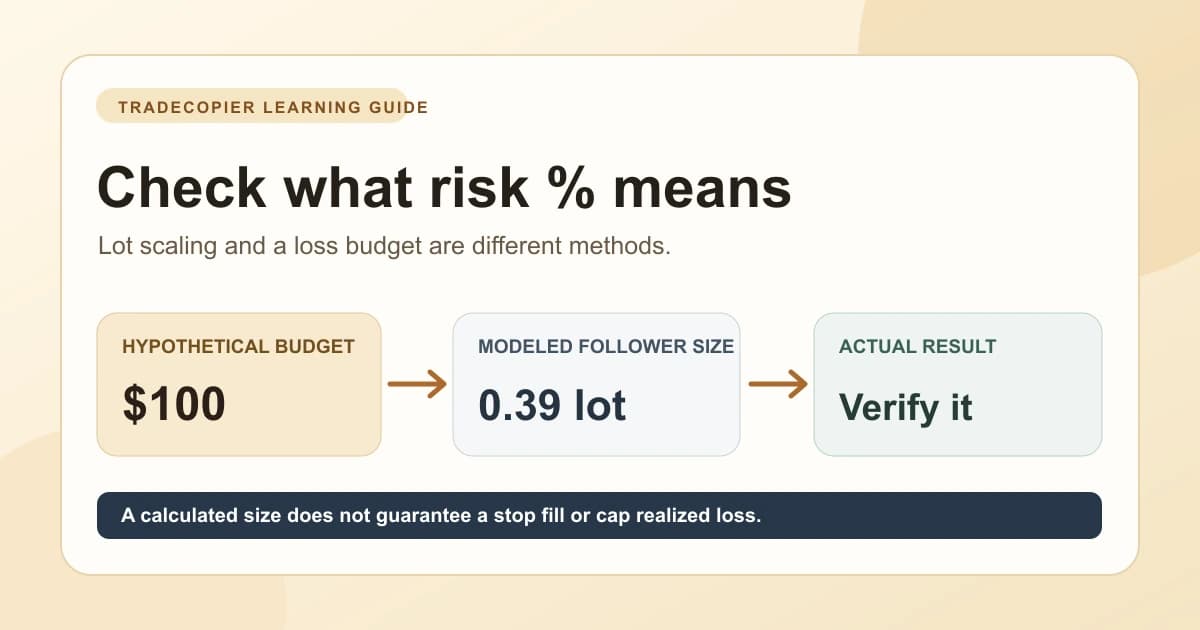
Hypothetical EUR/USD arithmetic: Assume a follower has $10,000 equity and chooses a 1% illustrative budget: $100. Assume its planned entry-to-stop distance is 25 pips, its loss value is $10 per pip for 1.00 lot in USD, and modeled round-trip commission is $5 per 1.00 lot. Assume the entry is the relevant executable side of the quote, so spread is already reflected and is not added a second time. Modeled loss per lot at the planned stop is (25 × $10) + $5 = $255. The unrounded size is approximately $100 / $255 = 0.392157 lot. With an assumed 0.01-lot step and 0.01-lot minimum, rounding down gives 0.39 lot and a modeled loss of 0.39 × $255 = $99.45.
These values describe one assumption set, not a live quote or a TradeCopier setting. If a destination account instead required a 1.00-lot minimum, that minimum would model $255 of loss and the example would call for no trade under the $100 budget. Rounding up to the broker minimum would break the chosen budget. The forex position-size calculator lets you inspect the cash assumptions and valid lot steps separately from any live copying workflow.
Recalculate for each follower and changed stop
The same 0.39-lot quantity with a 35-pip adverse move and the same $5-per-lot modeled commission would imply 0.39 × (($10 × 35) + $5) = $138.45. The extra 10 pips can represent a revised stop or unfavorable execution; neither is covered by the original $99.45 modeled amount. A different follower's account currency may also require conversion at a stated rate and time. For MT5, OrderCalcProfit can pre-evaluate a specified order's profit or loss in that account's currency under current conditions; it does not predict a future fill.
cTrader's risk-reward tool distinguishes a chosen balance or equity percentage, a stop-loss price and the resulting volume. That is cTrader tool behavior, not proof that TradeCopier uses that tool or applies the same sizing method to each copied route. For any platform, check whether the copier receives a stop, whether a follower stop is accepted, what happens when the source modifies it and how the final destination quantity is rounded.
Verify the copying mode and broker result
- Record the source and follower platform, broker, account currency, equity, account mode, symbol and current connection method. Confirm the precise direction on the supported-platform page or in the signed-in product.
- Record which sizing mode is actually available for that route, its setting values and whether it uses source lots, a fixed follower lot, an equity relationship or an explicit stop-based loss budget. Do not label an equity-lot mode as a loss-at-stop mode without confirming its calculation.
- Record the destination's contract size, tick or pip value in account currency, minimum, maximum and step. Decide what the route should do when the valid minimum exceeds the budget, when a stop is absent or when inputs cannot be verified.
- In demo, calculate the expected destination quantity before sending one eligible source instruction. Compare it with the requested quantity, broker acceptance, fills, final position and attached stop. Inspect available activity logs and the broker's own records rather than relying on a green copying status alone.
- Repeat after changing follower equity, stop distance, symbol or lot step one at a time. Preserve the rule version and observed outcomes. Pause the route for review if the resulting position or stop differs from the plan.
Some controls operate at the account level rather than per trade. TradeCopier's equity-protection page describes drawdown and daily-loss triggers, which are distinct from setting a new order's quantity. A trigger or close request cannot guarantee a realized-loss cap. MetaTrader's trading documentation explains that stop-related execution can differ from the specified level. Broker rules, gaps, slippage, unavailable connections and rejected instructions may change the outcome.
When a percentage cannot be calculated responsibly
Without a stop level, a valid instrument value, a currency conversion where needed or an eligible broker quantity, a finite loss-at-stop size is unavailable. Do not silently treat missing costs as zero, round upward to force a trade or claim that an account is protected because a percentage appears in a setting. A percentage can guide a modeled decision; it does not replace checking the destination order and resulting account exposure.
Primary references and scope
- MetaQuotes: account equity, balance and trading properties
- MetaQuotes: symbol contract, tick and volume properties
- MetaQuotes: pre-evaluating profit or loss in account currency
- cTrader: risk-reward calculation modes
- MetaTrader 5: trading and stop-order behavior
Sources and the linked TradeCopier product pages were checked on September 23, 2026. Recheck the current product route, platform documentation and broker specifications before relying on a live configuration.
Quick answers
Frequently Asked Questions
Find answers to the most common questions about this topic.
Does a 1% trade copier setting guarantee that I can lose only 1%?
No. The setting may describe a lot-scaling rule rather than loss at a stop, and even a stop-based calculation is only a model. Changed prices, gaps, slippage, costs and broker outcomes can make realized loss larger.
Is equity-based lot sizing the same as risk percentage at a stop?
No. Equity-based sizing adjusts the copied quantity using follower equity. Loss-at-stop sizing also needs the follower's entry, stop distance, instrument value, currency, costs and valid volume increment.
What if the broker minimum lot exceeds my modeled budget?
The example calls for no trade under that budget. Rounding up to the minimum would increase modeled loss beyond the selected amount; confirm the route's actual skip or rejection behavior.
Can I calculate a fixed loss percentage without a stop?
Not from a finite entry-to-stop distance. A copier may still use another lot-scaling mode, but it cannot infer a specific loss-at-stop budget when the stop or monetary instrument value is unavailable.
Do source and follower accounts have the same risk percentage?
Not automatically. Their equity, symbols, contracts, currencies, stop distances, valid lot steps and fills may differ. Calculate and verify the follower account separately.