Trade Copier Security:
Permissions, Access Reviews and Offboarding
Trade copier security starts with knowing who can access each account, which actions that access permits and how to remove it. A connection that cannot withdraw funds may still place unwanted trades. Review observation, trading, account administration and funding separately, then check what happens to open positions when a connection stops.
This is a general operating checklist published by TradeCopier, with primary documentation checked on September 22, 2026. It does not certify TradeCopier's implementation or establish its encryption, authentication, retention or recovery controls. Confirm the current connection method and account permissions for the route you intend to use.
Separate identity, permission and trading exposure
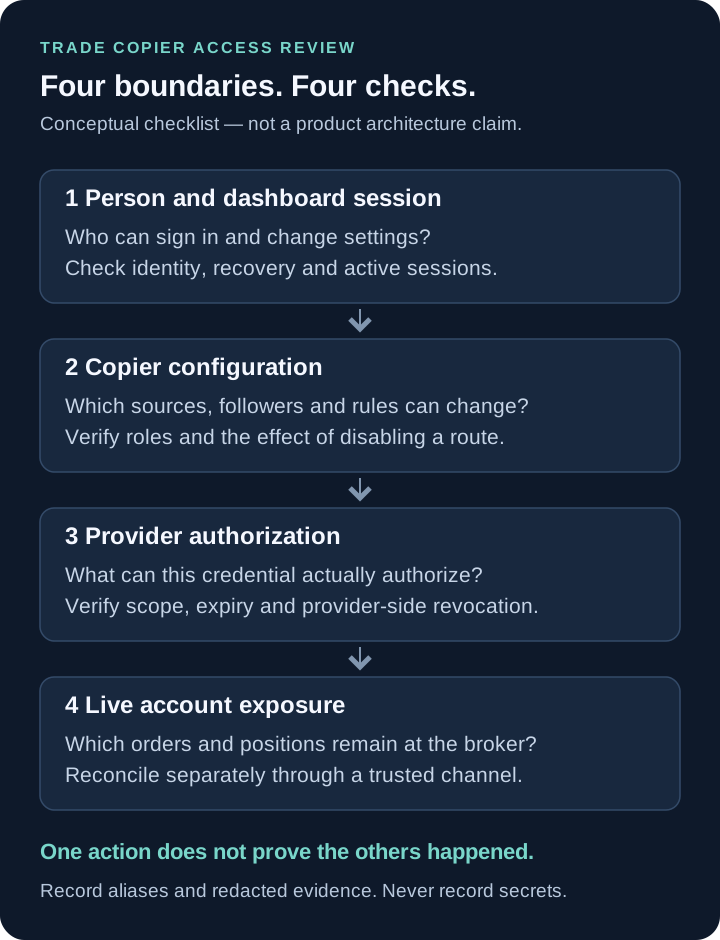
Logging in proves something about an identity; it does not automatically authorize every account action. OWASP's authorization guidance recommends limiting permissions to the required task and checking authorization for requests. Apply that distinction to a copier dashboard, platform connection and broker account independently.
A useful review has three records: the person or service allowed to connect, the actions that connection can perform, and the orders or positions already held at the broker. Changing the first two does not establish the state of the third. A revoked connection can leave an existing position open, so inspect the broker record instead of inferring exposure from a disconnected icon.
Check permissions against the actual connection
| Capability | Question to verify | Evidence to retain |
|---|---|---|
| Observation | Which balances, orders, positions and history can this identity read? | Documented scope and redacted permission screen |
| Trading | Can it submit, change or cancel instructions, including protective orders? | Provider documentation and authorized test outcome |
| Administration | Can it add accounts, change routes, grant access or replace credentials? | Role definition and current membership record |
| Funding | Is any deposit, withdrawal or transfer authority included, and through which service? | Broker funding permissions, checked separately |
Provider terms differ. MetaQuotes documents MT5 master and investor access: investor authorization permits viewing account information but not trading. The cTrader Open API authentication reference distinguishes accounts, which provides view-only access, from trading, which includes permitted trading operations. These examples do not establish which route a particular copier uses or whether a read-only source connection is supported.
Do not request withdrawal authority merely to reproduce order instructions. If a connection requests broader access than its stated purpose, resolve the exact requirement before approving it. A platform's “full access” label needs its documented scope; it is not a universal description of every broker or funding function.
Store credential references, not credential values, in the review
OWASP's secrets-management guidance treats creation, rotation, revocation and expiration as distinct lifecycle events. Use a controlled credential store suited to the connection, restrict who can retrieve secrets and document the issuing provider. Keep passwords, private keys and tokens out of source repositories, shared spreadsheets, screenshots and support transcripts.
A review row can contain an account alias, credential identifier, owner and storage reference. It should not contain the secret itself. Treat refresh tokens as credentials too: a browser logout is not evidence that an integration's refresh capability has ended. When replacing a credential, record both the new connection check and the old credential's revocation result. A successful new login alone does not prove the old access was removed.
Choose lifetime and rotation rules for the credential type and provider. Do not apply a blanket “change every 30 days” rule to every password, token and key. Suspected exposure calls for prompt provider-side containment, not waiting for the next scheduled review.
Review human access and sessions
For each dashboard, broker portal and recovery email account, inspect the available authentication and recovery options. OWASP's multifactor-authentication guidance covers both additional factors and the risks around their reset or replacement. Record which factors are actually enabled and who can recover access; do not turn an available feature into an assumed control.
Session controls need their own check. OWASP's session-management guidance distinguishes server-side invalidation from simply clearing a browser token. Establish what sign-out, password replacement, device removal and account removal invalidate. Do not assume that signing out of a dashboard also revokes broker credentials or an application's authorization.
Run an eight-check access review
Start before connecting an account, repeat after a personnel or route change, and choose a periodic review interval appropriate to the setup. A quarterly review is one possible operating schedule, not a universal requirement. The following checklist is an original review template; it contains no completed tests.
| Check | Record | Completion evidence |
|---|---|---|
| 1. Identity and purpose | Account alias, route, person or service owner | Owner confirms the current business purpose |
| 2. Permission scope | Read, trade, administration and funding capabilities | Provider scope and redacted configuration agree |
| 3. Credential lifecycle | Issuer, identifier, storage reference and expiry policy | Authorized custodian confirms handling |
| 4. Human recovery | Enabled factors and recovery authority | Current settings checked without recording recovery secrets |
| 5. Sessions and grants | Active devices, application grants and offboarding owner | Each access path has a documented removal method |
| 6. Event evidence | Available access, permission-change and trading records | Redacted sample includes source and timestamp |
| 7. Revocation check | Approved test method and provider confirmation | Old access rejected or otherwise confirmed revoked |
| 8. Broker state | Open orders, positions and responsibility after disconnect | Broker records reconciled by an authorized operator |
Download the blank eight-check access-review CSV. Every check begins as not_reviewed. Use aliases and redacted evidence references only; never enter credential values. Record unavailable evidence as unavailable rather than marking a check passed. The worksheet includes principal and reviewer aliases, permission scope, last-use time when available, a review decision, revocation evidence reference and closure time. Mark a removal decision closed only after its required checks are confirmed; record unresolved work with an owner and follow-up. Leave unknown timestamps blank; do not infer last use from a successful login today.
For example, a former analyst might retain a dashboard role while a separate automation token remains active. Removing the role completes only one access change. The reviewer still needs to identify the token's owner, determine whether its purpose continues, and record the applicable removal decision. This is a hypothetical example, not a reported customer incident.
Offboard without losing track of open trades
Before a planned removal, assign an authorized person to reconcile outstanding orders and positions. Document whether any protective behavior depends on the connection. Then remove the relevant dashboard role or session and revoke the platform or broker authorization using its supported procedure. Replace shared credentials when needed; deleting a saved row in the copier is not proof of provider-side revocation.
Confirm the removal through provider records and an authorized, non-trading access check where supported. If a check is unavailable, leave that result unresolved and seek provider confirmation. Reconcile broker exposure afterward. Neither “disconnected” nor “access denied” confirms that a pending order was canceled or a position was closed.
Respond to suspected exposure with a dated record
NIST SP 800-61 Revision 3 places incident preparation, detection, response and recovery within ongoing risk management. For a connected trading workflow, keep the provider's verified support channel available before it is needed.
If access appears compromised, promptly contact the relevant broker or platform through a trusted channel and use its containment process. An authorized operator should check pending orders and positions while the affected credentials, sessions or grants are addressed. Preserve a redacted event timeline without delaying containment to assemble a perfect archive. Do not assume that all positions should be closed automatically; the account owner and broker need to establish the actual exposure and permitted response.
OWASP's logging guidance identifies access tokens, passwords and primary secrets as data that should not be recorded directly in ordinary logs. Keep identifiers, event times, actions, outcomes and evidence locations instead. After access is restored, verify the intended permissions and account state before resuming the route. Record what was confirmed, what remains unknown and who owns the follow-up.
Quick answers
Frequently Asked Questions
Find answers to the most common questions about this topic.
Can a trade copier cause losses without withdrawal permission?
Trading authority can permit orders or position changes that create market losses even when withdrawal is unavailable. Verify funding permissions separately and do not treat their absence as a guarantee against loss.
Is a read-only account enough for copying trades?
A follower that executes orders needs the appropriate trading permission. Whether a source can be observed through read-only access depends on the actual connection. MT5 investor access and cTrader's accounts scope are provider examples, not proof of a copier's supported route.
Does dashboard two-factor authentication protect every API token?
Not automatically. Human login, existing sessions and platform or broker tokens are different access paths. Check which actions require another factor and how issued credentials are expired or revoked.
Does disconnecting a copier close my trades?
Do not infer that from a disconnected status. Check the broker's pending orders, open positions and protective instructions. Removing access and changing market exposure require separate confirmation.
How often should trading credentials be rotated?
Follow the credential type, provider policy and documented risk assessment instead of one universal interval. Handle suspected exposure promptly. Replacing a credential should include confirmation that the previous access is no longer valid.
What belongs in an access-review record?
Use account aliases, identities, permission scope, credential identifiers, review dates, decisions and redacted evidence references. Do not store passwords, private keys, tokens or recovery secrets in the worksheet.
How do I offboard someone who managed connected accounts?
Assign responsibility for open exposure, remove applicable roles and sessions, address platform or broker grants and shared credentials, then confirm revocation and reconcile broker records. One dashboard removal may not cover every access path.
Does this guide verify TradeCopier's security controls?
No. It provides a general review method and documented platform examples. Product-specific encryption, authentication, retention, recovery and access behavior require current implementation evidence for the connection in question.