What Is Copy Trading? Trade Copiers, Social Trading and Mirror Trading
Copy trading is a way to reproduce trading decisions from a source in another trading account. The source may be another trader, a published strategy or an account that you operate. The copying can be automatic, or a signal can require your approval before an order is sent. That distinction changes who makes the decision, what control you retain and which risks you need to review.
Publisher disclosure: TradeCopier publishes this educational guide and sells standalone trade copier software. The worked performance example below is fictional, not a customer record or a measured TradeCopier return. A copied strategy, broker execution and follower result need separate evidence.
The phrase is used for several different products. A broker's social-copy network lets you select another person's activity to follow. Standalone trade copier software commonly sends actions from one account to other connected accounts. Mirror trading usually follows a predefined strategy, while signal services may stop at an alert. MAM and PAMM are broker-specific managed-account structures rather than interchangeable names for ordinary copier software.
Investor.gov describes copy trading as copying other investors' trades on certain digital platforms. The UK Financial Conduct Authority explains that an automatically executed model can have a different regulatory character from a service where the client confirms every transaction. Product design and legal treatment vary by country, instrument and provider, so use the applicable provider documents and local rules for a real account.
Copy trading, social trading and a trade copier are not identical
Social trading is the broadest term. It can mean viewing other traders' ideas, statistics or discussions without copying anything. A social platform may also include an automatic copy feature, but the community layer and the execution feature are separate concepts.
Copy trading usually means selecting a person, portfolio or strategy and allowing some or all of its trading actions to be reproduced. Some services execute automatically. Others send a signal that the recipient accepts or rejects. The FCA notes that this manual-intervention distinction matters when assessing the service.
A trade copier, as the term is used in this guide, is execution software that routes actions from a designated source account to connected follower accounts using configured sizing, mapping and filtering rules. The person operating the setup may be distributing their own decisions across accounts rather than choosing a public trader to follow.
Mirror trading generally centers on a selected strategy or rule set instead of copying a person's discretionary activity trade by trade. The FCA describes mirror trading as implementing fixed strategies based on trading preferences. Provider terminology still varies, so confirm what the service actually does.
Six models compared by decision, account and execution
| Model | Who originates the decision? | How execution starts | Account and custody pattern | Common cost model | Typical controls | Risk to examine |
|---|---|---|---|---|---|---|
| Standalone trade copier | The designated source-account operator | Source account events are translated into instructions for connected followers | Each trading account remains at its broker or platform | Software subscription, hosting or account-based plan | Sizing, symbol mapping, filters, pause and account groups | Fill divergence, mapping errors, rejected orders and connection failure |
| Broker social copy | A selected trader or portfolio provider | The broker or network copies eligible activity automatically | The copying account is held with the participating broker or platform | Spreads, subscription, management or performance-linked charges may apply | Allocation, loss limits, stop-copy controls and provider selection | Provider incentives, strategy drift, concentration and different follower fills |
| Mirror trading | A selected strategy or rule set | Strategy signals trigger orders under the service's rules | Usually executed in the subscriber's brokerage account | Platform, strategy or brokerage charges vary | Strategy selection, allocation and stop conditions | Model opacity, market-regime change and differences between modeled and live execution |
| Signal service | A signal publisher, analyst or algorithm | The recipient confirms manually or uses a separate automation bridge | The recipient keeps their own brokerage account | Subscription plus normal trading costs | Manual confirmation, filters and independent sizing | Stale, incomplete or ambiguous signals and unverified track records |
| MAM or another managed-account label | An appointed manager under the provider's mandate | The provider's arrangement gives the manager discretion or an allocation interface; mechanics vary | Ownership, authority and custody follow the provider agreement | Management, performance and brokerage charges may apply | Mandate, allocation method and provider-defined limits | Manager authority, conflicts, allocation and termination terms |
| PAMM | An appointed money manager | In the retail-forex structure discussed by NFA, activity is conducted through a master account and allocated to customer subaccounts | Account, allocation and withdrawal terms follow the provider's arrangement | Management or performance fees plus trading costs may apply | Allocation share, manager selection and provider-defined exit rules | Manager loss, allocation fairness, fees and withdrawal restrictions |
MAM and PAMM labels are not standardized product guarantees. ASIC's managed-discretionary-account guidance notes that managed-account arrangements can use different terminology and structures. NFA's retail-forex PAMM notice discusses a master account, customer subaccounts, allocation and withdrawal concerns in that specific regulatory context. Read the actual provider agreement for account ownership, trading authority, allocation, fees, loss treatment and withdrawals. A table like this helps identify questions; it cannot determine the legal status of a specific service.
How automatic copy trading works
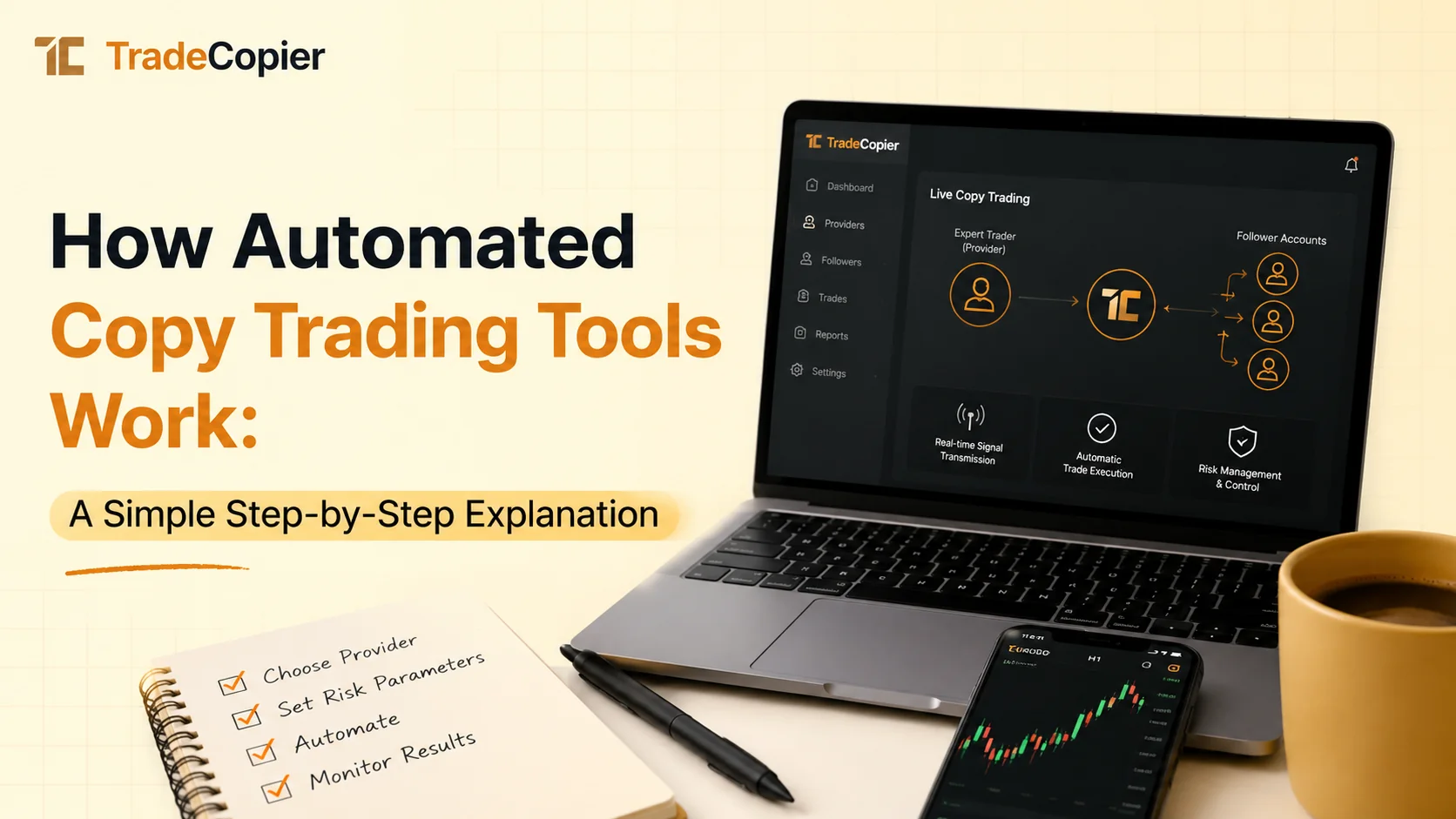
- A source event occurs: a person or strategy opens, changes or closes a position.
- The service detects an eligible event: the exact trigger may be an order, acknowledgement, fill or platform-specific update.
- Rules transform the instruction: the service applies sizing, symbol mapping, direction and filtering settings.
- The destination receives a request: the receiving broker or platform decides whether to accept it.
- The account receives its own outcome: the destination price, quantity, partial fill, rejection or timing can differ from the source.
- The operator reconciles the records: copier logs and broker order and position records are compared before an uncertain action is repeated.
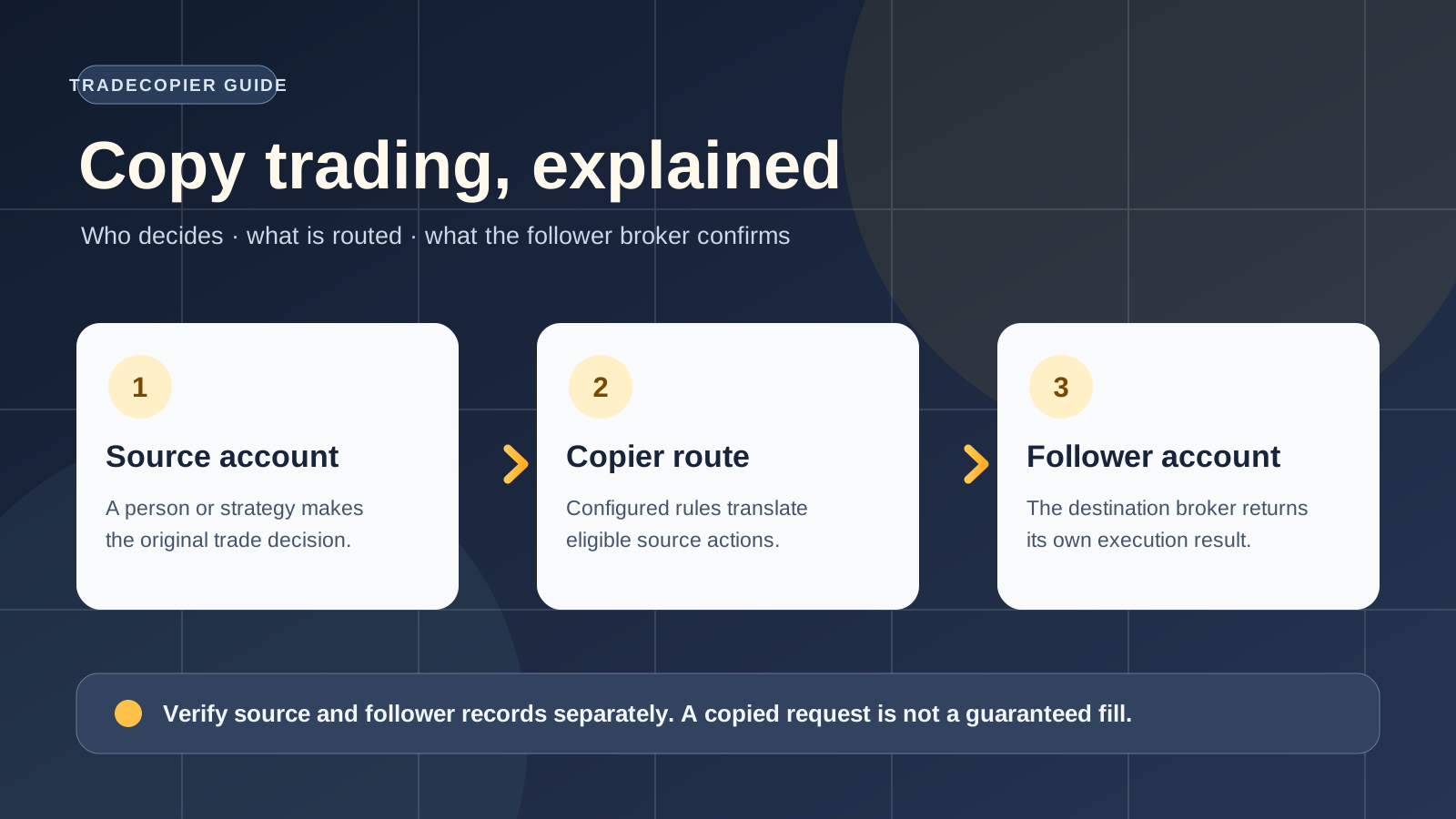
The source trade and the follower trade are separate executions. Copying does not guarantee the same price or result. For a detailed account-event sequence, read how automated trade copiers route source events and where copies can diverge.
MetaTrader's official Signals documentation illustrates one platform-specific implementation: a subscriber selects a provider and eligible operations are copied automatically under configured parameters. Its rules do not describe every social platform or standalone copier.
Choose the category before comparing brands
The most useful question from the former “best copy trading tool” guide is simple: are you following someone else's decisions, or distributing a strategy you operate to other permitted accounts?
- If you want to select a public trader or portfolio, investigate the broker or social-copy category.
- If you want to distribute actions from a designated source account to connected accounts, investigate standalone trade copier software.
- If you want ideas but intend to approve each order, investigate a manual signal or research service.
- If you are appointing a manager to trade under a mandate, investigate the broker's specific MAM, PAMM or managed-account documentation.
If standalone copier software is the right category, compare the verified product details that affect your own setup: review supported platforms and connection information, examine the available copying, control and monitoring features, and check current Free and paid plan limits. Treat those maintained product pages as the source for current compatibility and plan information rather than assuming that a general comparison article is current.
Then ask whether the arrangement is allowed for every account involved. A software connection does not establish broker, prop-firm or regulatory permission.
A due-diligence sequence for any copy-trading service
- Identify the decision maker. Record who chooses the instrument, direction, timing and size, and whether you must approve each order.
- Identify the account relationship. Confirm where the account and funds are held, what access the provider receives and how that access can be revoked.
- Read the complete cost schedule. Include subscription, management or performance fees, spreads, commissions, financing, conversion and withdrawal charges where relevant.
- Check the evidence behind performance displays. Separate live broker records from backtests, simulations and selected examples. Review the observation period, drawdown, open positions, deposits, withdrawals and trading costs.
- Check sizing and loss controls. Establish how quantities are calculated, rounded and capped, and what happens when a destination rejects the requested size.
- Test the lifecycle. Where a demo environment is available, observe an entry, modification, protective-order change, partial close and full close on every destination type you plan to use.
- Plan for divergence. Decide how you will detect a missed, delayed, rejected or duplicated action and which record is authoritative before attempting recovery.
- Review incentives and conflicts. Understand how the provider, copied trader, manager, broker and affiliate are paid.
The ESMA supervisory briefing on copy trading highlights areas such as marketing information, costs and charges, product governance, suitability or appropriateness, remuneration and the qualifications of copied traders. Those supervisory expectations are useful prompts for due diligence even though their legal application depends on the service and jurisdiction.
How can you verify a copy-trading performance screenshot?
A screenshot can show a selected number, but it cannot establish a complete account result on its own. A joint US investor alert documents the use of fake trading screenshots in scams; it does not assess any particular provider. Ask which account, currency, start and end timestamps, trades and open positions the number covers. Obtain the complete period statement or report through the account owner's authorized broker access, then compare it with the displayed claim. Do not request a trading password, API key or unredacted account number. If the account owner cannot provide enough verifiable evidence, mark the claim unverified rather than guessing a return.
ESMA's copy-trading supervisory briefing asks whether past-performance information gives a fair representation and clearly explains its calculation method; it also addresses the effects of charges. This is a supervisory question for firms in its scope, not a worldwide certification of any screenshot. FINRA's account-statement guidance tells readers to examine the complete statement, including activity and fees, rather than relying on its summary page.
- Freeze the exact sample. Save the claim's capture date, time window, account currency, whether the account was live or simulated, and whether losing deals and still-open positions are included. Retain canceled or unfilled requests in an operational-exception record, not as executed trades. A selected winning week is not a full strategy history.
- Reconcile cash movements. Record deposits, withdrawals, transfers and broker credits separately. A deposit raises the balance without being trading profit. MetaTrader 5 notes that payment history inside the terminal can omit operations made through the broker's other channels; use the broker's complete account record.
- Separate closed and open exposure. Collect both the closed result and a dated snapshot of every open position's floating result. MetaTrader 5's trading report distinguishes balance, equity, closed trades, swaps, commissions, deposits and withdrawals. An open loss can be absent from a closed-trade profit screenshot.
- Net the actual costs once. Identify commission, financing, fees and conversion charges and where each is already included in the reported result. A spread embedded in fill prices or a fee already deducted from broker equity must not be subtracted a second time. Account-external subscriptions belong in an additional all-in cost comparison.
- Check the method and the sample. Ask for the return formula, cash-flow treatment, valuation times, drawdown basis, complete observation period and any excluded accounts or trades. A cash-flow-adjusted dollar bridge is a useful consistency check, but a defensible percentage return needs the flow dates and an explicitly stated method.
Count the sample at the right level: one source decision copied into several follower accounts is still one source decision, even if it produces several broker deals. Record distinct source decisions, trading days, position overlap and instrument concentration. A high trade count can still represent a short or highly dependent sample. A single ending snapshot also cannot show the worst intervening equity decline; drawdown needs a dated series with cash flows and open positions handled consistently. The separate win-rate sample uncertainty guide explains why a small selected sample cannot establish a stable success rate, while the drawdown attribution guide treats account-value paths and flows in detail.
A fictional screenshot audit with deposits, fees and an open loss
Suppose a fictional promoter shows +$600 in closed trades. The same invented account begins with $10,000 equity and no open positions, receives a $5,000 deposit, pays out a $1,000 withdrawal, incurs $120 in broker charges and ends with a $300 mark-to-market loss on a position opened during the period. All amounts are USD; there are no broker credits, internal transfers, currency adjustments or other account movements in this simplified example. The broker charges are assumed to be deducted from the account exactly once. This is a teaching ledger, not a TradeCopier customer account or a verified trading result.
| Step | Amount | Running equity | Record to check |
|---|---|---|---|
| Opening equity | 10,000 | 10,000 | Opening broker snapshot |
| Deposit | +5,000 | 15,000 | Confirmed external cash-flow record |
| Withdrawal | −1,000 | 14,000 | Confirmed external cash-flow record |
| Closed trading result before listed broker charges | +600 | 14,600 | Complete deal history for the period |
| Broker charges not already in that result | −120 | 14,480 | Commission, financing and fee entries |
| Change in open-position mark during period | −300 | 14,180 | Opening and ending position/equity snapshots |
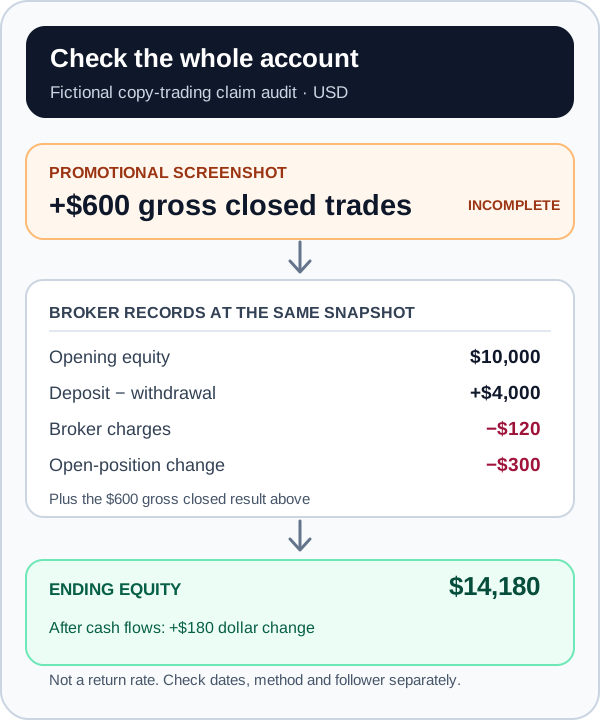
The bridge gives ending equity of $14,180. The raw increase from $10,000 is $4,180, but $4,000 of that comes from net external deposits. Under only the assumptions above, the snapshot's cash-flow-adjusted dollar change is $180 ($14,180 − $10,000 − $5,000 + $1,000). Neither $4,180 nor $180 is a justified percentage return without the timing and valuation method. The $300 open loss is provisional and can change before a position closes. CFA Institute's performance-reporting explanation distinguishes money-weighted and time-weighted methods because cash-flow timing changes the question a return figure answers.
Use the redacted performance-evidence checklist to retain the period, source of each number, unresolved gaps and reviewer decision. It begins with not_checked states and contains no personal or account data. The example is also available as a downloadable equity bridge; it is a static worked example, not a calculator. Replace fictional amounts only with verified records and recompute every running equity value and the external-flow adjustment yourself. Keep the original statements securely and redact personal names, account identifiers and credentials before sharing a review copy.
Why the copied trader's result is not the follower's result
Even an authentic source-account statement does not prove what a follower earned. Verify the follower's own entry and exit fills, quantity, open exposure, broker fees, financing, currency conversion and cash flows over the same stated interval. Match source instructions to follower requests and broker outcomes. Count actual filled quantity in the executed result; retain missed, rejected and unfilled remainders in separate coverage and exception counts. If only the source record is available, the follower result is unavailable.
Do not use a screenshot, a high win rate or a short selected period as a forecast. Judge any provider's evidence alongside strategy risk, account permissions and the actual controls you can use. A trade copier can route supported instructions; it does not independently verify a strategy's return or make the source and follower results identical.
What can make follower results differ from the source?
- Market movement: the available price can change before the destination order executes.
- Account settings: balance, leverage, sizing rules, minimum quantity and rounding can produce a different position.
- Instrument mismatch: symbols with similar names may have different contract sizes, currencies or trading sessions.
- Order handling: brokers and platforms may support order types, protection orders and partial fills differently.
- Costs: spreads, commissions, financing and currency conversion can vary by account.
- Connectivity: an unavailable source, copier, destination platform or broker can interrupt the sequence.
These differences mean a provider's history is not a promise of a follower's result. Copy trading also does not turn a risky strategy into a safer one. Set exposure from your own account constraints and monitor actual positions.
Where TradeCopier fits
TradeCopier is in the standalone, cloud-based trade copier category. It is designed to route a designated source account's actions to supported connected accounts with configurable sizing, symbol mapping, risk controls, activity logs and alerts. It is not a marketplace for selecting a public “expert trader” to follow.
Check supported platform and connection information for the exact account combination, copy configuration for sizing and filters, and current Free and paid plan limits. The permanent Free plan has account limits. Product access and technical compatibility do not establish permission to copy under a broker or prop firm's terms.
No copy-trading category guarantees profit, identical fills or protection from market loss. Start with the category and account relationship, verify the evidence and terms, and test the actual workflow before increasing exposure.
Primary references used for this guide
- Investor.gov: Copy Trading
- Financial Conduct Authority: Copy trading
- ESMA: Supervisory Briefing on Copy Trading
- MetaTrader 5 Help: Trading Signals and Copy Trading
- Australian Securities and Investments Commission: Managed discretionary accounts
- National Futures Association: Forex transactions in a PAMM program
- MetaTrader 5 Help: Trading Report and Deposits and Withdrawals
- FINRA: Reviewing brokerage account statements
- CFA Institute: Performance reporting and cash-flow methods
- Investor.gov: Joint alert on fake trading screenshots
Sources and product pages were checked on September 24, 2026. Recheck current provider terms, account permissions and local requirements before acting.
Quick answers
Frequently Asked Questions
Find answers to the most common questions about this topic.
What is copy trading?
Copy trading reproduces trading decisions from a source in another account. The source may be another trader, a strategy or an account you operate. Some services execute automatically, while others require you to confirm each signal.
Is copy trading the same as social trading?
No. Social trading can include discussion, statistics and shared ideas without automatic execution. A social platform may offer copy trading as one feature, but the community and copying functions are distinct.
What is the difference between copy trading and a trade copier?
Copy trading often describes following a selected trader or portfolio. A trade copier is execution software that routes actions from a designated source account to connected follower accounts under configured sizing, mapping and filtering rules.
How is mirror trading different from copy trading?
Mirror trading generally follows a selected strategy or rule set, while copy trading often follows a person or portfolio. Providers use the terms differently, so verify the actual decision source and execution process.
Are MAM and PAMM accounts the same as trade copier software?
No. MAM and PAMM usually describe broker-specific managed-account and allocation structures. Trade copier software routes instructions among connected accounts. Review the broker agreement for authority, ownership, fees, allocation and withdrawals.
Is a signal service the same as automatic copy trading?
No. A signal service can stop at an alert that you accept or reject. Automatic copy trading sends eligible instructions without requiring approval for each one. Some providers combine both modes, so check exactly what starts an order.
What should a beginner verify before copying trades?
Verify who makes each decision, where the account and funds are held, all fees, the evidence behind performance displays, sizing and loss controls, broker or prop-firm permission, and what happens after a rejection, partial fill or connection failure.
Will a copied trade get the same price and result as the source?
Not necessarily. Market movement, sizing, rounding, account settings, symbols, broker rules, costs and connection timing can all change the follower outcome. Reconcile the copier log with the destination broker record.
Can a screenshot prove a copy-trading strategy is profitable?
No. A selected screenshot cannot establish a complete account result. Compare the claim with an authorized broker record for the same account, currency and period, including cash flows, net charges and open positions; mark unavailable evidence as unverified.
Do deposits count as copy-trading profit?
No. A deposit increases account value but is an external cash flow, not trading profit. Separate confirmed deposits and withdrawals from the broker equity change before assessing the trading result.
Does closed-trade profit include an open loss?
Not necessarily. A closed-trade total may omit floating profit or loss on positions still open at the snapshot. Check both balance and equity, dated open-position records and whether charges were already included.
Can I use a copied trader’s return as my follower return?
No. The follower can have different fills, position sizes, fees, financing, currencies, cash flows and open exposure. Use the follower broker record and reconcile missed, rejected or partial actions over the same stated interval.
Does a large number of copied fills prove a strategy is reliable?
No. Several follower fills can come from one source decision, and trades in the same period or market may be dependent. Count distinct source decisions, trading days and overlapping exposure, and inspect a complete dated equity path before interpreting win rate or drawdown.