Swap and Overnight Fees in Copy Trading:
What Changes Across Accounts
Carrying a Trade Beyond the Day Changes the Cost
A trade does not necessarily end when the trading session closes. When a position remains open overnight, the broker may apply a swap fee or overnight charge to the account. For traders holding positions for several days, these costs can gradually become a meaningful part of overall trading expense.
The challenge becomes more important in copy trading. A master account may carry a position overnight, but connected follower accounts can have different balances, contract specifications, symbols, and broker conditions. As a result, the cost of carrying the same copied trade may not be identical across accounts. Understanding swap and overnight fees is therefore a genuine part of managing multi-account copy trading — not just a footnote to execution.
What Actually Happens When a Trade Is Carried Overnight?
Swap is a financing adjustment applied when a position remains open beyond the broker's daily rollover time. It reflects the interest rate differential between the two currencies (or the financing cost structure of the instrument) being traded, plus the broker's own markup.
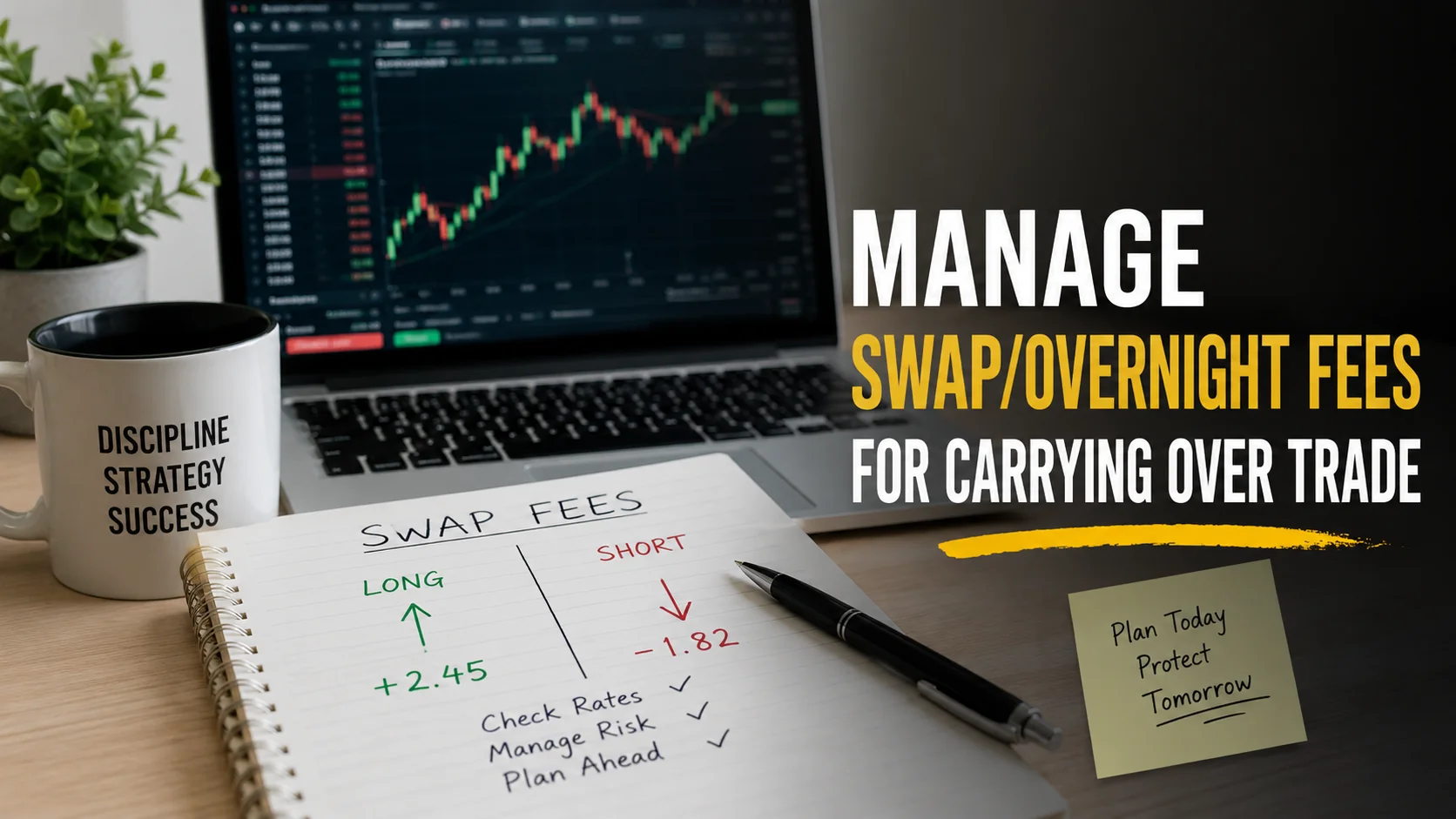
The amount depends on several factors: position direction, trading instrument, position size, number of nights held, the broker's swap rates, account currency, and contract specifications. A long and short position on the same instrument can have completely different swap costs — in some cases, one side may even receive a credit rather than incur a charge. This is why traders shouldn't treat overnight cost as a fixed, predictable expense.
How Swap Is Actually Calculated
A widely used general formula for forex swap is:
Swap = (Pip Value × Swap Rate × Number of Nights) / 10
Worked example: trading 1 standard lot (100,000 units) of EUR/USD long, with a pip value of $10 and a swap rate of -0.25 pips, held for one night:
Swap = (10 × 0.25 × 1) / 10 = $0.25 charged for that night.
Held for five nights at the same rate, that becomes $1.25 — small on its own, but it scales directly with lot size and holding period. A 5-lot position held for three weeks at the same per-lot rate would be $0.25 × 5 × 21 = $26.25, purely in financing cost, before any market movement is considered.
Note: exact swap rates, formulas, and rollover timing vary by broker, instrument, and account type — this formula illustrates the general mechanism, not a rate you should assume applies to any specific account. Always check your broker's current published swap rates.
Triple Swap Days: A Widely Used Industry Convention
Because forex trades settle on a T+2 basis, most brokers apply a triple swap charge on a specific weekday — commonly Wednesday for FX and metals — to account for the weekend when markets are closed. Holding a position through that day can mean three nights' worth of swap charged (or credited) at once, rather than one.
This is a broad industry convention, not a universal rule — the exact day and which instruments it applies to varies by broker, so confirm the specific rollover schedule with each broker involved in a copied position rather than assuming it matches across accounts.
Why Swap Fees Become More Complicated in Copy Trading
In a single trading account, monitoring swap is relatively straightforward. In a copy trading environment, it gets more complex because master and follower accounts may sit with different brokers, and those brokers can apply different swap rates to the same instrument.
Example: the same copied position, two different follower brokers
| Master account | Follower A | Follower B | |
|---|---|---|---|
| Broker | Broker X | Broker Y | Broker Z |
| Position | 1 lot EUR/USD long | 1 lot EUR/USD long (copied) | 1 lot EUR/USD long (copied) |
| Swap rate (long) | -0.25 pips | -0.40 pips | +0.10 pips |
| Cost per night | $0.25 | $0.40 | -$0.10 (credit) |
The trade itself is identical. The financing cost isn't — because copying replicates the position, not the broker's specific swap terms. Other differences that can appear include different contract specifications, rollover times, trading conditions, and account currencies.
Carry Trade Copying Needs More Than Position Synchronization
For strategies that intentionally hold positions for extended periods, carry trade copying requires particular attention to overnight financing. Some strategies specifically target swap positive pairs — instruments where the applicable financing can potentially support the strategy rather than increase its cost. However, a positive swap should never be treated as a guaranteed benefit: rates change, broker policies differ, and the underlying position can still lose money on price movement regardless of swap direction.
The Real Risk Is Often the Rollover, Not One Night
The biggest concern usually isn't the size of a single overnight charge — it's the cumulative effect. A position held for one night may incur a small adjustment; the same position held for several weeks can accumulate substantially larger financing costs, especially once triple-swap days are factored in. This rollover risk can affect net trading performance, long-term strategy costs, position-holding decisions, and the gap between master and follower results.
How TradeCopier.org Fits Into the Equation
TradeCopier.org is built around keeping trades synchronized across multiple connected accounts. Its cloud-based architecture allows automated trade replication without a local VPS, and its multi-account capabilities support more complex account structures. For overnight trading specifically, the practical advantage is operational consistency — traders can maintain their intended trade structure across accounts through automated copying, while separately monitoring the financing conditions applicable to each one.
It's worth being direct about the limitation here: a trade copier does not eliminate broker-imposed swap charges. Those charges are determined entirely by each account's broker and conditions. The copier's role is to automate and manage trade replication — not to equalize or offset financing costs across accounts.
Practical Ways to Manage Overnight Charges
There's no universal approach — the right method depends on strategy and holding period:
- Check swap rates before holding positions overnight, on every connected account, not just the master.
- Compare financing conditions across connected accounts before assuming they match.
- Identify instruments where overnight cost fits the strategy rather than working against it.
- Monitor positions approaching a rollover or triple-swap day.
- Account for swap explicitly when evaluating net performance, not just gross P&L.
- Periodically review whether a long-held position remains economically viable once financing costs are included.
A More Complete View of Copy Trading Costs
Trade execution is only one part of the economics of a copied position. A realistic assessment should also weigh spread, commission, slippage, swap fees, overnight charges, and broker-specific execution conditions together. A trade that looks profitable before financing costs may look meaningfully different once all applicable charges are included — this matters most for strategies that hold positions overnight or for several days.
Conclusion
Overnight trading introduces a cost that's easy to overlook when evaluating a copy trading strategy. Swap fees can accumulate over time, and differences between brokers mean the master account's financing experience may not match its followers' — even when the underlying trade is identical. The answer isn't to ignore these costs, but to check them explicitly across every connected account and build them into the overall risk-management process. This article is for general information only and isn't financial advice — trading involves risk of loss, and swap rates, rollover timing, and broker policies vary and can change, so always verify current terms directly with each broker.
Quick answers
Frequently Asked Questions
Find answers to the most common questions about this topic.
What are swap/overnight fees in copy trading?
Financing adjustments that may be charged or credited when a position remains open beyond a broker's daily rollover period — separate from, and in addition to, any spread or commission cost.
Are swap fees the same across brokers?
No. Brokers use different swap rates, rollover times, contract specifications, and trading conditions, which can create real broker swap differences even for the exact same copied trade.
Can a copied trade have different overnight charges on different follower accounts?
Yes — the position itself is copied, but each follower's broker sets its own swap rate, so the same trade can cost more, cost less, or even earn a credit depending on which account it lands on.
What is a triple swap day, and does it apply the same way everywhere?
Many brokers charge three nights' worth of swap on a specific weekday (commonly Wednesday for FX and metals) to account for the weekend settlement gap — but the exact day and applicable instruments vary by broker, so confirm this with each broker involved.
What are swap positive pairs?
Instruments where a particular position direction may receive a positive financing adjustment under a broker's swap conditions. Rates and eligibility change over time and shouldn't be assumed to persist.
Does TradeCopier.org remove overnight charges?
No. Swap and overnight charges are set entirely by each account's broker. TradeCopier.org automates and synchronizes trade replication across connected accounts — it doesn't offset or equalize financing costs between them.
How can traders reduce rollover risk?
Monitor swap rates on every connected account (not just the master), understand each broker's rollover and triple-swap schedule, factor financing into net performance calculations, and avoid holding positions longer than the strategy actually requires.