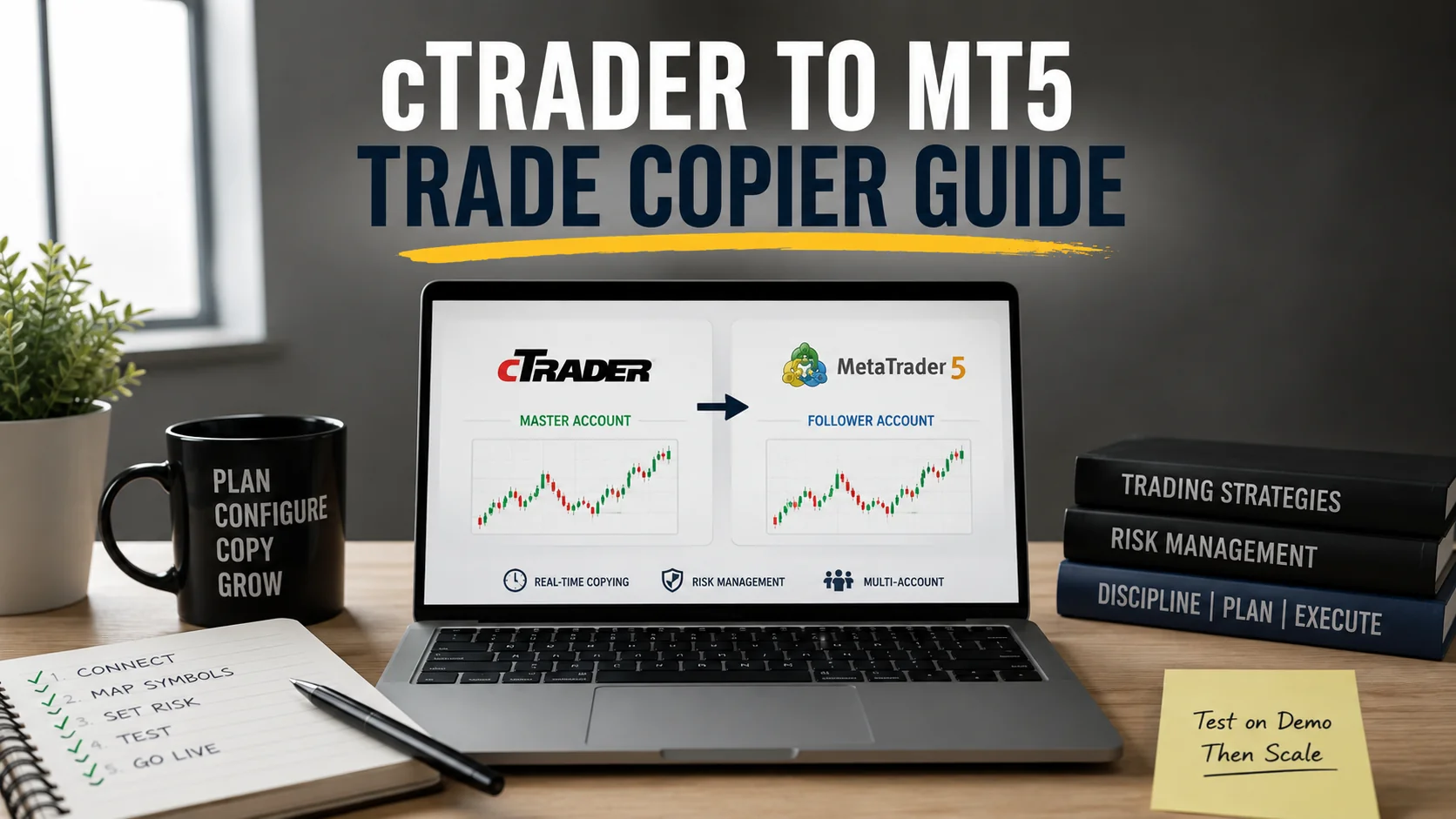
cTrader to MT5 Trade Copier:
Setup Guide and Common Pitfalls
cTrader to MT5 Trade Copier: Full Setup Guide and the Mistake That Breaks Most Setups
The most common reason a cTrader-to-MT5 copier setup "isn't working" isn't a bug — it's a symbol mismatch. Your master account fires a trade on EURUSD, and your MT5 follower broker lists the same pair as EURUSD.r or EURUSDm. With no mapping rule in place, the order gets silently rejected before it reaches the book — no error message, no obvious sign anything went wrong, just a trade that simply never arrives. This guide walks through the full setup correctly the first time, so you don't hit that wall.
Why cTrader to MT5 Isn't a Native, Plug-and-Play Bridge
cTrader and MetaTrader 5 are built on different architectures — different programming languages, order management systems, and APIs. There's no built-in way for one to talk directly to the other. A trade copier acts as the bridge: it reads trade events from the source platform's API and translates them into equivalent orders on the destination platform.
Step-by-Step Setup
- Connect your cTrader master account to the copier's dashboard via API credentials (not your raw login/password in most modern copiers, which is a better security practice).
- Connect your MT5 follower account(s). Note whether each MT5 account is a hedging or netting account type — this matters for how partial closes and multiple positions on the same symbol behave. Netting accounts can only hold one net position per symbol, which changes how a copier should handle multiple same-symbol trades from the master.
- Set up symbol mapping before you place a single live trade. Check your MT5 broker's exact symbol naming (including suffixes like
.r,m, orpro) and map each one explicitly to the corresponding cTrader symbol. Don't assume identical naming — verify it directly in both platforms' symbol lists. - Configure your lot-sizing method — proportional (scaled to account equity), fixed lot, or a custom multiplier — based on how different your master and follower account sizes are.
- Run a single small test trade on a common, simple pair (e.g., EURUSD) before connecting anything live. Confirm it arrives on the MT5 follower with the correct symbol and lot size.
- Test an edge case deliberately — a partial close, or a second trade on a symbol you already have open — since this is where hedging/netting differences most often cause unexpected behavior.
The Symbol Mapping Problem, in Detail
This is worth its own section because it's the actual root cause behind most "my copier isn't working" support tickets in this specific setup. Brokers append different suffixes to the same underlying instrument for internal accounting reasons — GOLD vs. XAUUSD, EURUSD vs. EURUSD.r. If your copier doesn't have an explicit mapping rule for a given symbol pair, the order to the follower account can fail silently rather than throwing a visible error, because as far as the platform's API is concerned, the mapped symbol simply doesn't exist on that broker.
Fix: Before going live, list out every symbol your master account trades, check the exact ticker on your MT5 follower broker, and set up an explicit mapping for each one — don't rely on automatic matching for anything beyond the most common major pairs.
Order Labeling Note (cTrader Specifics)
When trades are placed via API rather than manually, cTrader requires clear order labeling for transparency reasons — copied trades may show a label identifying the source (e.g., the copier's name) rather than appearing identical to a manually placed order. This is expected platform behavior, not a bug, and worth knowing in advance so it doesn't look like something went wrong.
Common Troubleshooting Checklist
- Trade doesn't appear on the follower at all → check symbol mapping first; this is the most common cause.
- Trade appears with the wrong lot size → check your lot-sizing method and account equity ratio.
- Multiple trades on the same symbol behave unexpectedly on MT5 → check whether the MT5 account is hedging or netting type.
- Trade arrives with an unfamiliar label → expected cTrader API behavior, not an error.
How TradeCopier Handles This
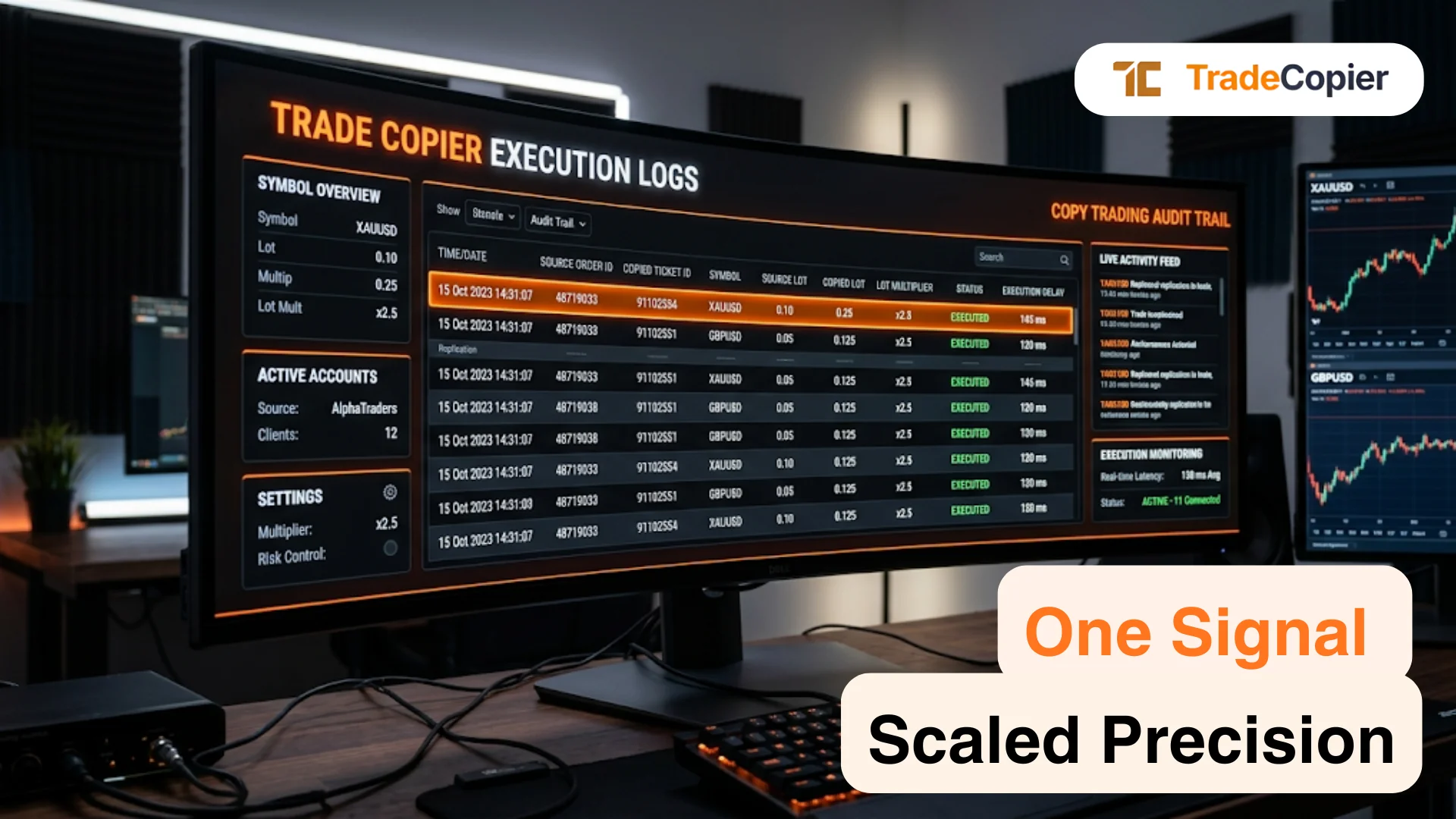
TradeCopier bridges cTrader and MT5/MT4 in both directions — MT4 to MT5, MT5 to MT4, and either to/from cTrader — with automatic symbol mapping that handles broker-specific naming differences like GOLD vs. XAUUSD out of the box, and manual override for anything the auto-mapping doesn't catch. Equity protection and activity logs apply the same way across the cross-platform bridge as they do for same-platform copying, so you can verify exactly what happened on any given trade.
Quick answers
Frequently Asked Questions
Find answers to the most common questions about this topic.
Why isn't my cTrader trade showing up on my MT5 follower account?
The most common cause is a symbol mapping mismatch — check that the exact ticker (including suffix) matches between platforms before assuming the copier itself is broken.
Does account type (hedging vs. netting) matter for cTrader to MT5 copying?
Yes. MT5 netting accounts can only hold one net position per symbol, which affects how multiple same-symbol trades from the master are handled. Confirm your MT5 account type before setting up copying.
Will copied trades on cTrader look identical to manually placed ones?
Not necessarily — cTrader may label API-placed orders for transparency. This is expected behavior, not an error.
Can I copy in both directions — cTrader to MT5 and MT5 to cTrader?
Yes, with TradeCopier and most modern cross-platform copiers — confirm bidirectional support with your specific provider if this matters for your setup.