Glossary · Prop trading · Last updated: 9 November 2026 · By TradeCopier Editorial Team
Eval Account Trading: What an Evaluation Account Is
Eval account trading means trading inside an evaluation account, a trial phase with set profit targets and loss limits that a firm runs before any funded account. You must meet the written targets without breaching the limits. Evaluation fees can be lost, and passing does not guarantee a funded account.
This entry covers the evaluation stage only: what the trial measures, how a breach ends an attempt, and what to record before you trade. It does not describe any named firm’s current rules. The firm’s own rules page decides them. For the wider model, read What Is a Prop Firm?.
This page is educational. It is not advice on any firm, program or trading strategy.
Key takeaways
- An evaluation account is a trial stage. You must reach the firm’s written profit target while staying inside its loss limits.
- Each limit has its own terms: how it is measured, which reference level it uses, and when a breach is judged. Those terms decide the outcome, not the profit figure alone.
- Under a program’s terms, a breach can end an attempt even on a day when the profit target has been reached.
- Evaluation fees can be lost, depending on the program’s terms. Passing an evaluation does not guarantee a funded account.
- Save a dated copy of the program rules before you start, because rules can change.
How Eval Account Trading Works
Eval account trading is trading in the test account that a prop firm may open before it considers a funded account. The test is set by written terms: a profit target the trader must reach, and loss limits the trader must stay inside. Programs use different names for this stage, so read the terms of the program you join rather than its label.
An evaluation is judged against the whole rulebook, not against the profit figure alone. A trader can reach the target and still fail if a loss limit is breached first. The profit is one line of the test. The limits are the other lines, and each one is checked on its own terms.
Copying on an evaluation account is a permission question for the firm, not a feature of the copier. The copier sends orders, but the program decides whether that copying is allowed. For that question, see where copying fits and the prop firm trade copier guide.
From trial to funded decision
The diagram shows the order of decisions. The rule check happens before any copying, and the trial can end on a breach even when the profit target has been reached.
Swipe the diagram sideways to read it at full size.
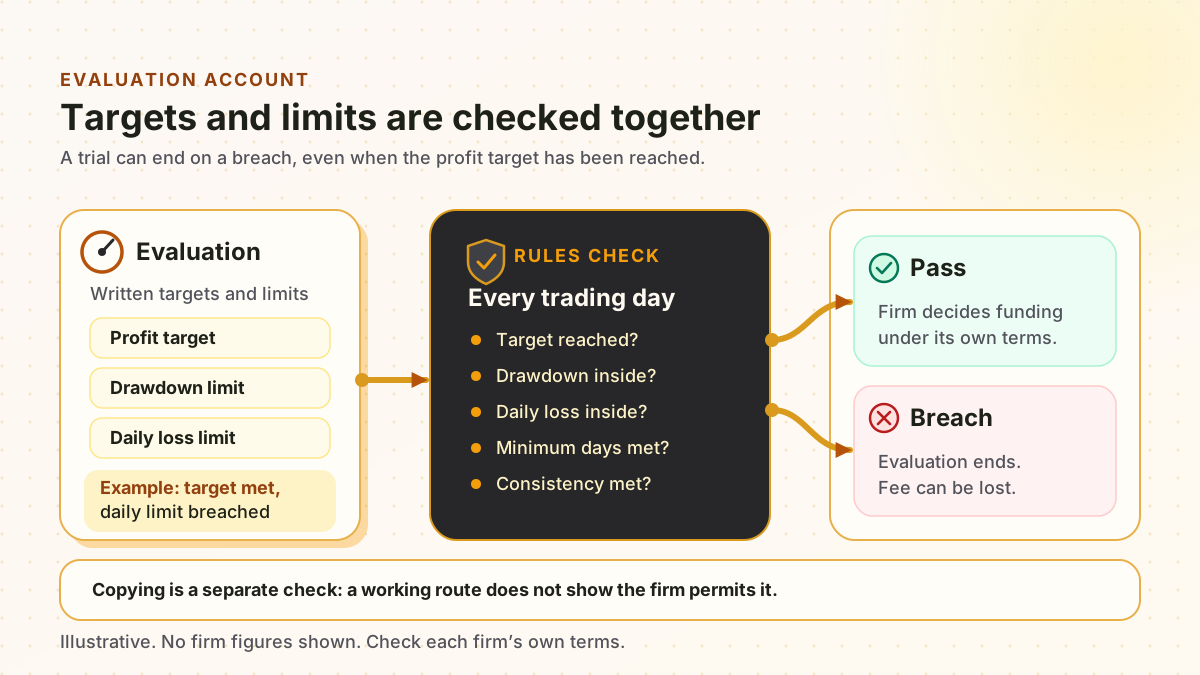
Evaluation Rule Points That Decide a Breach
These are the points that decide whether an attempt is still live. The table names what each point decides and what to confirm in the program’s written terms. It contains no figures.
Profit target
- What it decides
- Whether the trial has been passed.
- What to confirm in the program terms
- Whether the target is measured on balance or equity, and whether it has a time limit.
Loss limit reference
- What it decides
- The level the account is measured against when a limit is tested.
- What to confirm in the program terms
- Whether the reference is fixed or trails the account’s high point, and whether it uses balance or equity.
Trading-day definition
- What it decides
- When a daily loss limit starts and resets.
- What to confirm in the program terms
- The server time zone used, and whether open profit or loss counts at the reset.
Timing of the check
- What it decides
- When a breach is judged: during the session, or only at the close.
- What to confirm in the program terms
- Whether limits are checked continuously, per trade or at the end of the day.
Minimum activity
- What it decides
- Whether the attempt can pass with only a few trading days.
- What to confirm in the program terms
- What counts as a trading day, and whether very small trades qualify.
Consistency
- What it decides
- Whether one day or one trade can carry too much of the profit.
- What to confirm in the program terms
- The exact formula, and whether it applies to the target, to payouts or to both.
Read each row against the program’s own wording. A breach in one row can end the attempt if the terms say so.
A Worked Example of a Breach
The example is illustrative. It uses no firm’s figures or terms.
Suppose a program has a profit target, a trailing loss reference and a daily loss limit. A trader reaches the profit target within a few trading days. On one day, a single position is sized too large for the account. The daily loss limit is breached during that session, and the attempt ends under the program’s terms even though the target was met.
The lesson is that the target and the limits are checked together. A check during the session and a check at the close can give different answers, so the timing rule matters as much as the number. Track the room left under every limit each day, not only the distance to the target.
What to Record Each Trading Day
Keep this record for each evaluation account. It is a working habit, not a rule of any firm.
- The room left under each limit, measured the way the program measures it.
- The distance to the profit target, and the number of trading days counted so far.
- Any breach warning the platform or the firm shows, with the time it appeared.
- Any copied order that did not match the source, with the reason it differed.
- The dated copy of the program rules you are trading under.
Common Misreadings of Eval Accounts
The profit target is the only test
The loss limits, the timing rules and the consistency rule can end an attempt that has met the target. The target is one line of the rules, not the whole test.
An eval is the same as a funded account
An evaluation tests a trader against written terms. A funded account follows under its own terms, which may differ. Read what changes after a pass before you pay for an attempt.
Rules are the same across firms
Programs differ in names, values and definitions. A rule that appears in one firm’s terms may be defined differently in another’s. Compare the exact wording, not the category name.
Fees, Breaches and What Passing Does Not Promise
Check whether the program charges a fee to start an attempt, and whether that fee comes back after a pass or after a breach. Refund and reset terms are set by each firm, so read them before you pay.
Regulator warnings are another check. The Financial Conduct Authority (FCA) published a warning on 12 August 2025 about Funded Trader. The FCA states that the firm is not authorised by it. The warning says the firm may be targeting people in the UK and may be providing or promoting financial services or products without FCA permission, and it does not specify which services. Read it as a reason to check a firm’s status before paying, not as a finding about every prop firm. Source: FCA warning on Funded Trader.
Passing an evaluation does not guarantee a funded account, a payout or continued access. TradeCopier does not promise any evaluation result. A trade copier repeats orders from a source account. It does not change the program’s rules.
Risk note
Trading and evaluation programs carry risk. Evaluation fees can be lost, including after a breach, depending on the program’s terms. Passing an evaluation does not guarantee a funded account, a payout or continued access. A trade copier repeats orders and does not change a program’s rules. This page is educational and is not advice on any firm, program or strategy.
Eval Account Trading FAQ
It means trading inside an evaluation account, a trial stage that a prop firm sets up with written profit targets and loss limits. Passing the trial is one step a firm may consider before a funded account. Terms differ by firm.
No. An evaluation tests a trader against written rules. A funded account is the allocation that may follow, under the firm’s own terms. Check the firm’s rules for what changes after a pass.
A breach is going past one of the limits in the program’s terms, measured the way those terms define it. The reference level and the timing of the check both matter. Read the exact wording and save a copy.
It depends on the program’s terms. Evaluation fees can be lost, and refund or reset terms are set by each firm, so read them before you pay.
No. Passing meets the stated test, but the firm still applies its own conditions for funding and payouts. Neither this page nor TradeCopier offers a pass guarantee.
In the firm’s own rules, help center or program terms. Save a dated copy, because rules can change and the version you signed up under is the one that matters.
External source cited: FCA warning on Funded Trader, first published 12 August 2025, checked 9 November 2026 (https://www.fca.org.uk/news/warnings/funded-trader). Other statements describe this page’s checklist or depend on each program’s own terms. No firm figures are shown.