Glossary · Last updated: 9 November 2026 · By TradeCopier Editorial Team
What Is a Prop Firm? Definition and Where Copying Fits
A prop firm, short for proprietary trading firm, provides trading capital to traders under written risk rules. Most futures prop firms, according to Topstep's guide, require a paid evaluation first, a test phase with loss limits and a profit target, before a funded stage. Rules, fees and payout terms differ by firm, and no pass or payout is guaranteed.
TradeCopier is not affiliated with any prop firm named on this page and does not endorse one. Firm examples come from that firm's own published pages, checked 9 November 2026.
Key takeaways
- A prop firm, or proprietary trading firm, funds trading under written rules. Each firm sets its own rules, fees and payout terms.
- Most futures prop firms, according to Topstep's guide, require a paid evaluation before a funded stage. Topstep runs its evaluation in a simulated account, where only the evaluation fee is at risk.
- Read the rule categories before paying: loss limits, profit targets, consistency, news, automation and copying, account ownership, fees and payouts.
- Copying is governed by the firm's rules. A copier does not change those rules, and permission has to be checked for each program and stage.
- Nothing on this page, and nothing a copier does, guarantees a pass, a funded account or a payout.
What is a prop firm, step by step
The model is simple to describe and easy to misread. Most of the risk sits in the rules and the fees, not in the label.
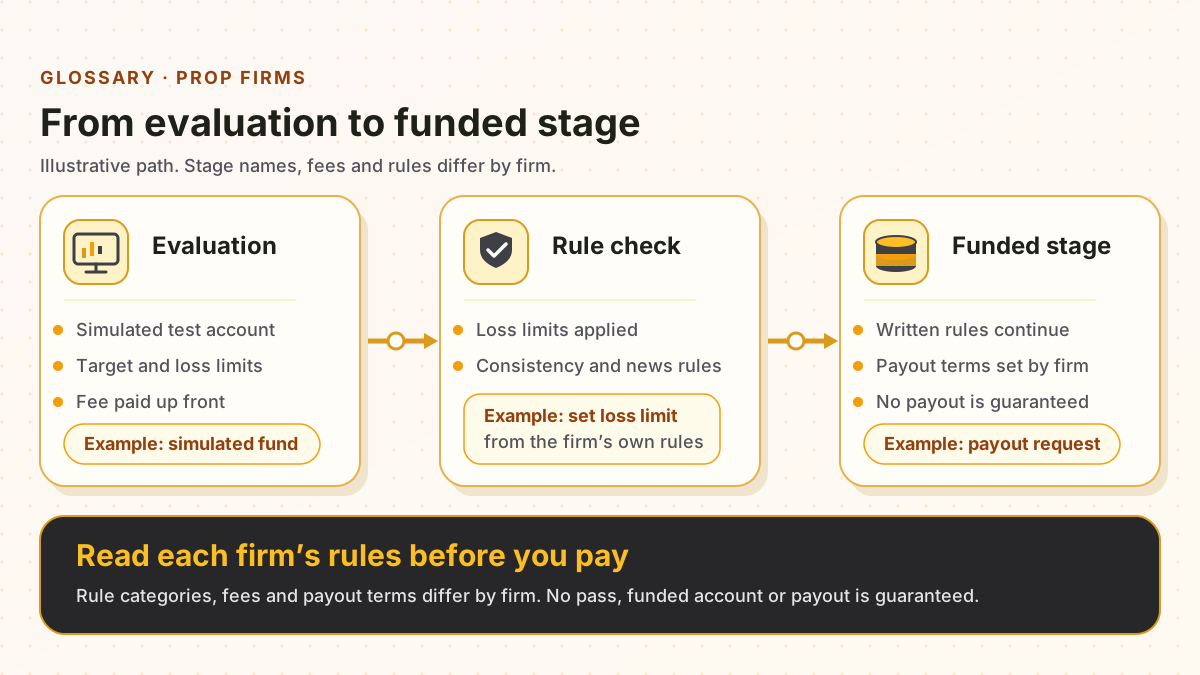
Topstep's guide describes a prop firm as a three-step path: pass an evaluation, trade a funded account under risk rules, then request payouts under a profit split. First, the trader pays for access to a test phase. Names differ by brand; Topstep calls its test phase the Trading Combine. Second, the trader has to reach a profit target without breaching the firm's loss limits. Third, if the rules are met, the firm offers a funded stage, and the trader may keep a share of profits under the firm's payout terms.
Topstep says its evaluation runs in a simulated account, and that during that phase only the evaluation fee is at risk. Its guide also says most futures prop firms, including Topstep, require a paid evaluation in a simulated account before a funded account. Names and structures can differ between firms, so read each firm's own terms rather than relying on the label "prop firm" to tell you how the account works.
Topstep's guide also describes evaluation-based retail prop firms as the model that describes most futures prop firms today. That is one firm's description of the market, not an independent count, so use it as a reason to check the program you are considering, not as a statistic.
Fees are the part of the model you pay directly. Topstep's guide lists three fee types: a monthly subscription for access to the test phase, an activation fee when a funded account opens, and a reset fee to restart after a rule is broken. Other firms charge differently. Ask which fees you pay, when you pay them, and whether any of them come back.
How the evaluation path works
An illustrative path, not a firm's actual terms. Stage names, fees and rules vary by firm, so use the diagram only as a map of the questions to ask.
Swipe the diagram sideways to read it at full size.
Rule categories to check before you buy an evaluation
A checklist, not a summary of any firm's rules. The loss, profit target, consistency, fee and payout rows follow the rule types in Topstep's guide. The news, copying and ownership rows are questions that guide does not answer, so take them from each firm's own terms.
Maximum loss limit
- What it means
- The lowest balance the account can fall to before it fails. Topstep's guide says its limit trails the highest end-of-day balance and locks once it reaches the starting balance.
- Why it matters when copying
- A copied account can reach the limit faster if its size or risk differs from the source account.
Daily loss limit
- What it means
- The most an account can lose in one trading day before trading stops for that day, as Topstep's guide describes it.
- Why it matters when copying
- Copied orders from one source can add up quickly in a single day. Check whether the limit applies automatically or only in some stages.
Profit target
- What it means
- The profit an evaluation has to reach to pass that phase.
- Why it matters when copying
- Passing is measured on the account's own results under that firm's terms. A copier does not change what counts toward the target.
Consistency rules
- What it means
- A limit on how much of the total profit can come from a single trading day, as Topstep's guide describes it.
- Why it matters when copying
- One large copied day can break a consistency rule even when the total result looks fine. Check the rule before setting copy sizes.
News trading restrictions
- What it means
- Whether the firm's terms restrict opening or holding trades around scheduled economic releases. The Topstep guide does not cover this, so answer it from the firm's own rules.
- Why it matters when copying
- A news filter in a copier is a separate setting. It does not replace the firm's own news rule.
Copying, signals and automation
- What it means
- Whether copying between accounts, signal services and expert advisors are allowed, and in which stage.
- Why it matters when copying
- This decides whether a copier can be used on the account at all. The firm sets that permission, not the copier.
Account ownership and transfer
- What it means
- Who may hold, use or transfer an account, and whether trading on behalf of others is permitted. Answer this from the firm's terms.
- Why it matters when copying
- Copying from a master account owned by someone else may need explicit permission in the firm's terms.
Fees and refunds
- What it means
- Evaluation, activation, reset and subscription fees, and whether they can be refunded. Topstep's guide says its evaluation and activation fees are not refundable.
- Why it matters when copying
- A failed evaluation can mean losing the fee. Check the reset terms before you start a second attempt.
Payout terms
- What it means
- How and when profits can be withdrawn, the profit split and any minimum withdrawal. Topstep's guide gives a $125 minimum payout for its own program.
- Why it matters when copying
- Payouts depend on the firm's program rules. A copier does not decide payout eligibility.
Where copying fits
A trade copier and a prop firm solve different problems. The copier moves orders between accounts. The firm decides which accounts may be used and how.
A trade copier sends orders from one account to another. In a prop firm setting, the question is not whether the software can copy trades. The question is whether the firm's rules allow copying on that account, in that program and stage, between those owners.
Permission depends on the firm's rules. Ask the firm whether copying between your own accounts is allowed, whether signal services, team trading or account management are treated differently, and whether the answer changes between the challenge, evaluation, funded and live stages. Check each stage before connecting an account, and keep a record of the answer.
TradeCopier's prop firm page lists the questions to answer before connecting a funded account: which program and stage apply, who owns each account, and which connection method is allowed. Start with the prop firm trade copier guide. For the test phase itself, read eval account trading.
Before you connect a copier to a prop firm account
These definition-level questions are neutral. Each one needs an answer from the firm's current rules, not from a blog post or a forum. The full preflight checklist for a funded account is in the prop firm trade copier guide.
- Who owns the source account and the destination account, and does the firm's rulebook allow copying between them?
- Which program and stage apply, and do the same rules hold once the account moves to a funded or live stage?
- Which connection method does the firm permit for that account?
- Are evaluation, activation and reset fees refundable under the firm's terms?
Common misreadings
The term sounds like a finance product, but the business and its rules are specific. These four points come up often.
A funded stage is not guaranteed income
Passing an evaluation does not guarantee a funded account, a profit split or a withdrawal. Topstep's guide says most Trading Combines are not completed.
Simulated does not mean risk free
A test phase in a simulated account can still cost a fee that is not refundable. Topstep's guide states that its evaluation and activation fees are not refundable.
The label does not approve the firm
Prop firm and proprietary trading firm are descriptions, not licences. Check the firm's terms and your regulator's warning list before you pay anyone.
A copier does not set the rules
The firm's rulebook decides what is permitted. A copier cannot change a firm's rules or make an account compliant with them.
Risk note
Prop firm programs carry fee loss and rule-breach risk. No firm, copier or guide can guarantee that you will pass an evaluation, receive a funded account or withdraw a payout, and past results do not predict future results. Copying trades can increase losses as well as gains. The UK Financial Conduct Authority publishes warnings about firms that may be providing financial services without its permission. It published a standalone warning about one funded-trader firm on 12 August 2025, saying that firm may be operating without its permission (FCA warning). Check your own regulator's warning list before you pay any firm. This page is general education, not financial advice.
Related pages
Prop Firm Trade Copier
Check rules and connection method before connecting a funded account.
Eval Account Trading
What an evaluation account is, and the rule checks that come before a funded stage.
News Filter
How a copier pauses around scheduled releases, separate from any firm news rule.
Equity Protection
Drawdown triggers on connected accounts, and why outcomes depend on the broker response.
TradeCopier Pricing
Plan limits and billed amounts for TradeCopier, shown before you connect anything.
Prop firm questions
A prop firm, or proprietary trading firm, provides trading capital to traders under written risk rules. Traders may keep a share of profits under the firm's payout terms. The firm's rules, fees and stages decide what is allowed.
Not necessarily. [Topstep's guide](https://www.topstep.com/blog/what-is-futures-prop-firm-beginners-guide) describes a broker as the firm that executes trades in an account holding your own money, and a prop firm as one that gives access to its capital under its rules, usually after an evaluation. Check each firm's terms for the execution route it uses.
No. [Topstep's guide](https://www.topstep.com/blog/what-is-futures-prop-firm-beginners-guide) describes its evaluation as a simulated account in which only the evaluation fee is at risk, and says evaluation and activation fees are not refundable. That fee can be lost even though no live capital is at risk in that phase.
It depends on the firm, the program and the stage. The firm's rulebook decides whether copying, signals or expert advisors are allowed. A copier does not make that decision, so check the rules before you connect an account.
No. Payouts depend on meeting the firm's program rules and payout policy. No firm, copier or guide can promise a withdrawal.
Firm statements are from Topstep's guide, dated 1 November 2026 and checked 9 November 2026. The FCA warning was checked on fca.org.uk on 9 November 2026. TradeCopier product statements come from TradeCopier's own prop firm and pricing pages.