Glossary · Last updated: 9 November 2026 · By TradeCopier Editorial Team
Is Copy Trading Profitable? What Copying Does and Does Not Guarantee
No. Copy trading does not promise a profit. A copied account repeats the master's orders at its own size, so results depend on the strategy, spreads and commissions, lot sizing, slippage and fills, drawdowns and timing. A profitable master can produce a losing copy.
This page is a definition and a risk guide. It does not rank providers or forecast returns. For the difference between copy trading and a trade copier, read the copy trading beginner guide.
Key takeaways
- Copy trading repeats orders. It does not promise that the copied account will profit.
- A copied account trades at its own size, so the same percentage return can produce different money results.
- Spreads, commissions, swaps, subscription fees and slippage all reduce what a copied account keeps.
- A strong past record for a master account is not a forecast. Drawdown history matters as much as the best period.
- Leveraged products can lose more than a small account can absorb. Only risk money you can afford to lose.
Is copy trading profitable?
Possibly for a period. No result is promised.
Copy trading means one account automatically places the same trades as another account, called the master or lead trader. The copied account does not choose the strategy. It receives the master's entries, exits and sometimes stop-loss and take-profit levels, then places its own orders with its own balance.
That structure explains why profit cannot be promised. The master may have a good strategy with a long, verified history. The copied account still faces different conditions: it may be smaller or larger, it may pay different costs, it may fill at worse prices, and it may join after the master has already moved. Each of these can change the final result even when the copied orders match.
A profitable master can therefore produce a losing copy, and a copy can lose money while the master ends the same month ahead. Neither outcome means the system is broken. It means the copied result depends on more than the master's trade list.
What decides a copied account's result
The same order can land very differently on two accounts. Each card shows one example value; none is a result from a real account.
Swipe the diagram sideways to read it at full size.
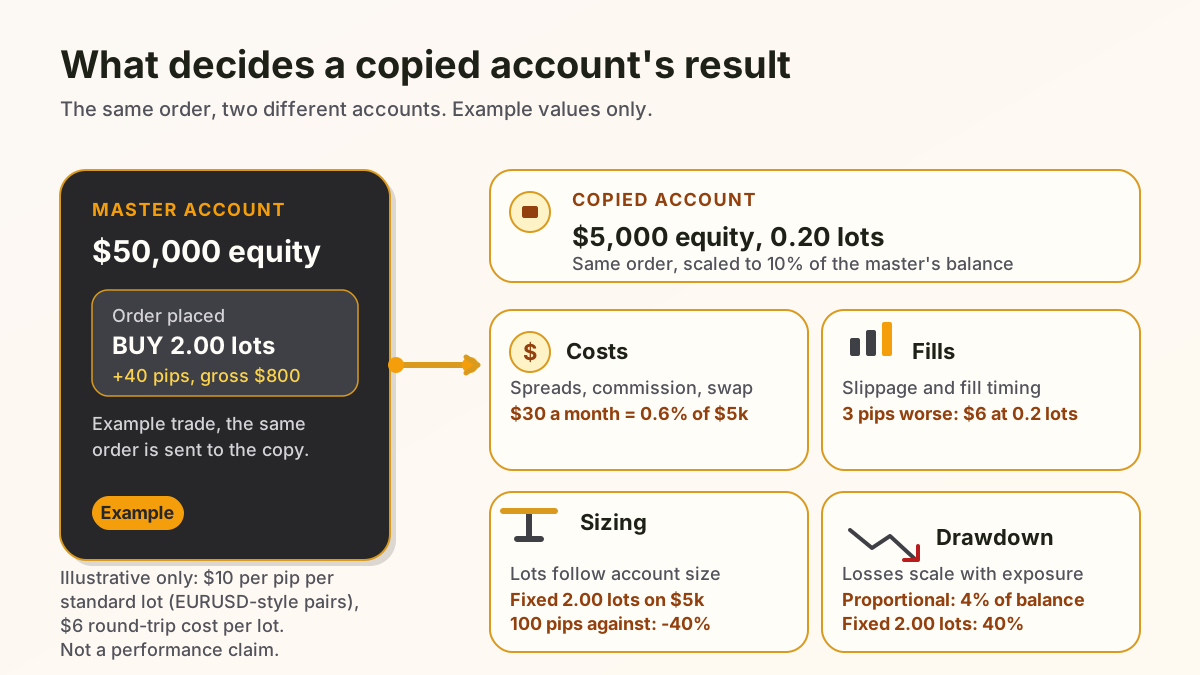
What drives a copied account's result
Six factors separate a copied result from the master's result. Check each one before you judge whether copying is worth the risk.
Strategy
- What it is
- The rules that open and close positions, including how often it trades and how much leverage it uses.
- How a copied account can differ
- The copier repeats the rules but not the judgement behind them. A change in the master's approach may pass through without notice.
Fees and spreads
- What it is
- Spreads, commissions, swaps (overnight financing) and any subscription fee.
- How a copied account can differ
- Costs are charged per trade or per account. A small account pays a larger share of any fixed fee.
Lot sizing
- What it is
- The number of lots placed for each trade.
- How a copied account can differ
- A copier may scale lots to account size, copy the master's lot count, or use a fixed size. The same trade can carry very different risk.
Slippage and fills
- What it is
- The gap between the price the master saw and the price the copied order filled at.
- How a copied account can differ
- Fast markets, news and delays can give the copy a worse entry or exit. Small gaps add up over many trades.
Drawdown
- What it is
- The fall from a peak balance to a later low.
- How a copied account can differ
- A copied account with larger exposure relative to its balance feels a drawdown more sharply and may close positions at a loss.
Timing
- What it is
- When the copy starts and stops relative to the master.
- How a copied account can differ
- Joining after a move, or pausing during a recovery, changes the outcome even when the trade list is the same.
These are general categories, not a claim about any specific master, platform or copier.
Worked example: same trade, two account sizes
The numbers below are illustrative. They show the arithmetic, not a result that any account has achieved.
Account equity
- Master account (example)
- $50,000
- Copied account (example)
- $5,000
Position size
- Master account (example)
- 2.00 lots
- Copied account (example)
- 0.20 lots (10% of the master's lot count; 0.04 lots per $1,000 of equity, the same as the master)
Gross profit on a 40-pip winner
- Master account (example)
- $800 (40 pips x $20)
- Copied account (example)
- $80 (40 pips x $2)
Spread and commission
- Master account (example)
- $12 (2.00 lots x $6)
- Copied account (example)
- $1.20 (0.20 lots x $6)
Slippage, 3 pips adverse in total
- Master account (example)
- Not assumed
- Copied account (example)
- $6 (3 pips x $2 per pip at 0.20 lots)
Net result
- Master account (example)
- $788, or 1.58%
- Copied account (example)
- $72.80, or 1.46%
Loss on a 100-pip adverse move, same sizing ratio
- Master account (example)
- $2,000, or 4.0%
- Copied account (example)
- $200, or 4.0%
Loss if the copier uses a fixed 2.00 lots
- Master account (example)
- Not applicable
- Copied account (example)
- $2,000, or 40% of equity
Assumes $10 per pip per standard lot (the value for EURUSD-style pairs; other instruments differ), a $6 round-trip cost per lot and 3 pips of adverse slippage in total on the copy. Not a quote from any broker and not a performance claim. The $30 monthly fee is an example number, not a TradeCopier price; a fixed $30 fee on the $5,000 account would be 0.6% of equity each month, before any trading result. TradeCopier's own plans are on the pricing page.
How to read the example
The same winning trade produced almost the same percentage on both accounts before costs. The gap came from per-lot costs and slippage. The bigger issue is sizing: a copier that keeps 2.00 lots on a $5,000 account turns a 100-pip move into a 40% loss, while the master lost 4%.
Lot sizing is the factor most often misunderstood. Copying the master's lot count is only safe when the copied balance is similar to the master's balance. Scaling lots to equity keeps exposure proportional. A fixed lot size can make the same market move far more dangerous on a small account.
Costs are the second factor. Spreads and commissions look small on one trade and add up over hundreds of trades. A fixed monthly fee matters most on small balances, because it is a larger percentage of the account.
Checks before you copy anyone
These checks do not guarantee a good result. They reduce the chance of copying a risk you did not understand.
- Ask how the master's results would have looked on a copied account, not only on the master's own account.
- Confirm the master's account size and how their lots compare with the size of the account you would copy into.
- Ask whether the record is shown after costs and slippage, and at what account size.
- Check how your copier sizes trades. Scaling to equity and a fixed lot count give very different risk.
- Add up the costs: spreads, commissions, swaps and any subscription. Compare them with the strategy's typical gain per trade.
- Ask how the master can change the strategy, and whether you will be told before a change takes effect.
- Set the loss you can accept before you start, and keep money you cannot afford to lose out of the account.
What regulators say about leveraged trading
The two official sources checked on 9 November 2026 are a definition and a CFD risk figure. Neither measures the results of copied accounts.
Investor.gov, the SEC's investor education site, describes copy trading as digital platforms that let investors copy other investors' trades in certain types of investments. That is a definition, not a statement about results. Read the Investor.gov copy trading entry.
In a press release dated 27/03/2018, the European Securities and Markets Authority (ESMA) said that analyses by national competent authorities on CFD trading across EU jurisdictions show that "74-89% of retail accounts typically lose money on their investments". The release concerns CFDs, a leveraged product, and does not mention copy trading. Read the ESMA press release for the full context.
The point for copy trading is narrow but important. A copied account can use leveraged products, and then the leverage risk is the same whether the trade was chosen by you or copied from someone else. Check the product, leverage and margin rules before you copy.
Risk note
Copy trading can lose money, including the full balance of the copied account. A master's past results are not a forecast, and leverage magnifies gains and losses in both directions. The examples on this page are illustrative and are not performance claims. This page is general education, not personal financial advice. TradeCopier is software that copies orders between accounts. It does not choose a strategy or a provider, and it does not promise results. Only use money you can afford to lose.
Frequently asked questions
No. Copy trading does not guarantee a profit or a particular return. A copied account repeats orders, and its result depends on the strategy, costs, sizing, fills and drawdowns. Losses are possible, including the full balance of the copied account.
The copied account can differ from the master in size, lot sizing, spreads and commissions, slippage, and timing. A larger position relative to the balance can turn a small master loss into a large copied loss.
No. A past record is not a forecast. Check the worst drawdown, how long recovery took, and whether the strategy has changed. A short winning run can hide large risk.
No. A trade copier repeats the orders from the account you choose to follow. It does not pick the strategy or the provider, and it does not decide whether a strategy is suitable for you.
Check the full record, the drawdown history, the costs, how your copier sizes trades, and whether the master can change the approach without notice. Set the loss you can accept before you start.