What a Free Trade Copier Trial Checklist Should Let You Test
Introduction
A trade copier trial should do more than demonstrate how trades move between accounts. It should help traders assess whether copied orders behave as expected during regular sessions, extended trading hours, scheduled breaks and unexpected market closures.
A practical trade copier trial checklist should therefore include market availability, time-zone accuracy, daylight saving adjustments and order handling when a market pauses. These checks matter because trading schedules vary by exchange, product and broker.
For traders asking, “Is there any free trade copier?”, a free trial or demo can provide an opportunity to evaluate these operational details before committing to a solution.
1. Test Regular Versus Extended Trading Sessions
Start by identifying the regular trading hours (RTH) and extended sessions supported by the relevant instrument and broker.
Regular sessions often coincide with the main underlying market's activity. Extended sessions may offer additional trading opportunities, but liquidity, spreads and execution conditions can differ.
During the trial, verify:
Whether the master account can open trades during each supported session.
Whether follower accounts receive the corresponding orders.
Whether session restrictions prevent new trades or affect existing positions.
Whether pending orders remain active, expire or trigger according to their configured conditions.
Do not assume that every futures contract follows the same schedule. A copier's behaviour must be tested against the actual instruments and broker connections being used.
2. Check the Exchange Schedule, Time Zone and Daylight Saving Rules
A reliable trial checklist should include a product-specific schedule rather than a generic market-hours reference.
The following table illustrates the information traders should record. CME Globex examples are indicative of common schedules, not a substitute for checking individual contracts. CME Group's official schedule provides product and holiday information.
| Product or schedule | Reference timing | What to verify |
|---|---|---|
| CME equity index futures, such as E-mini S&P 500 | Commonly Sunday–Friday, 6:00 p.m.–5:00 p.m. Eastern Time (ET), with a daily break | Confirm the exact contract's opening, closing and maintenance times |
| CME interest-rate and currency futures | Product-specific Globex schedules | Check the individual contract specifications |
| Indian commodity derivatives | Generally 9:00 a.m. onward, with closing times varying by commodity and season | Verify the latest NSE schedule and applicable contract |
| Holiday sessions | May include early closes, delayed openings or full closures | Check the exchange's official calendar for each date |
Time-zone and daylight saving checks: Record the exchange's stated time zone and confirm whether the platform displays exchange time, broker-server time or local time. US and European daylight saving changes occur on different dates, potentially shifting session overlaps temporarily. India does not observe daylight saving time.
Test whether session indicators and scheduled restrictions remain accurate after a clock change. Recheck schedules whenever an exchange publishes a revision.
3. Verify Daily Maintenance Breaks and Sunday Reopening
Many electronic futures markets have a daily maintenance window. Some contracts also pause over the weekend before reopening on Sunday evening in the exchange's local reference time.
During these periods, a copier should not be assumed to execute orders that the underlying market cannot accept.
Test whether the platform:
Identifies the market as closed or unavailable.
Handles new master orders without creating misleading execution confirmations.
Preserves pending orders according to the broker's rules.
Resumes copying correctly when the market reopens.
Reports rejected, delayed or missed orders clearly.
The objective is to establish what happens before, during and after a scheduled pause, rather than assuming that continuous software connectivity means continuous market access.
4. Check Official Holiday Exceptions
Exchange holidays can introduce shortened sessions, early closes and altered reopening times. The final schedule may also be updated close to the holiday.
Before testing a holiday scenario, consult the relevant exchange's official calendar. For example, CME Group publishes holiday and trading-hour schedules, while India's NSE publishes market timings and holidays.
Record the applicable product, date, time zone, opening time, closing time and any special break. Revisit this information regularly; a static schedule should not be treated as permanently accurate.
5. Understand What Scheduled Pauses Mean for Copied Orders
A scheduled market pause does not automatically cancel every existing order or close every open position. The outcome depends on the instrument, order type, broker and copier configuration.
A trial should test whether the system distinguishes between an order submitted, an order accepted and an order actually executed. It should also identify how failed orders, delayed responses and reopening gaps are reported.
Where supported, check whether the copier logs errors and allows the user to reconcile the master and follower accounts after trading resumes. Never assume that a missed order will automatically be copied later.
Conclusion
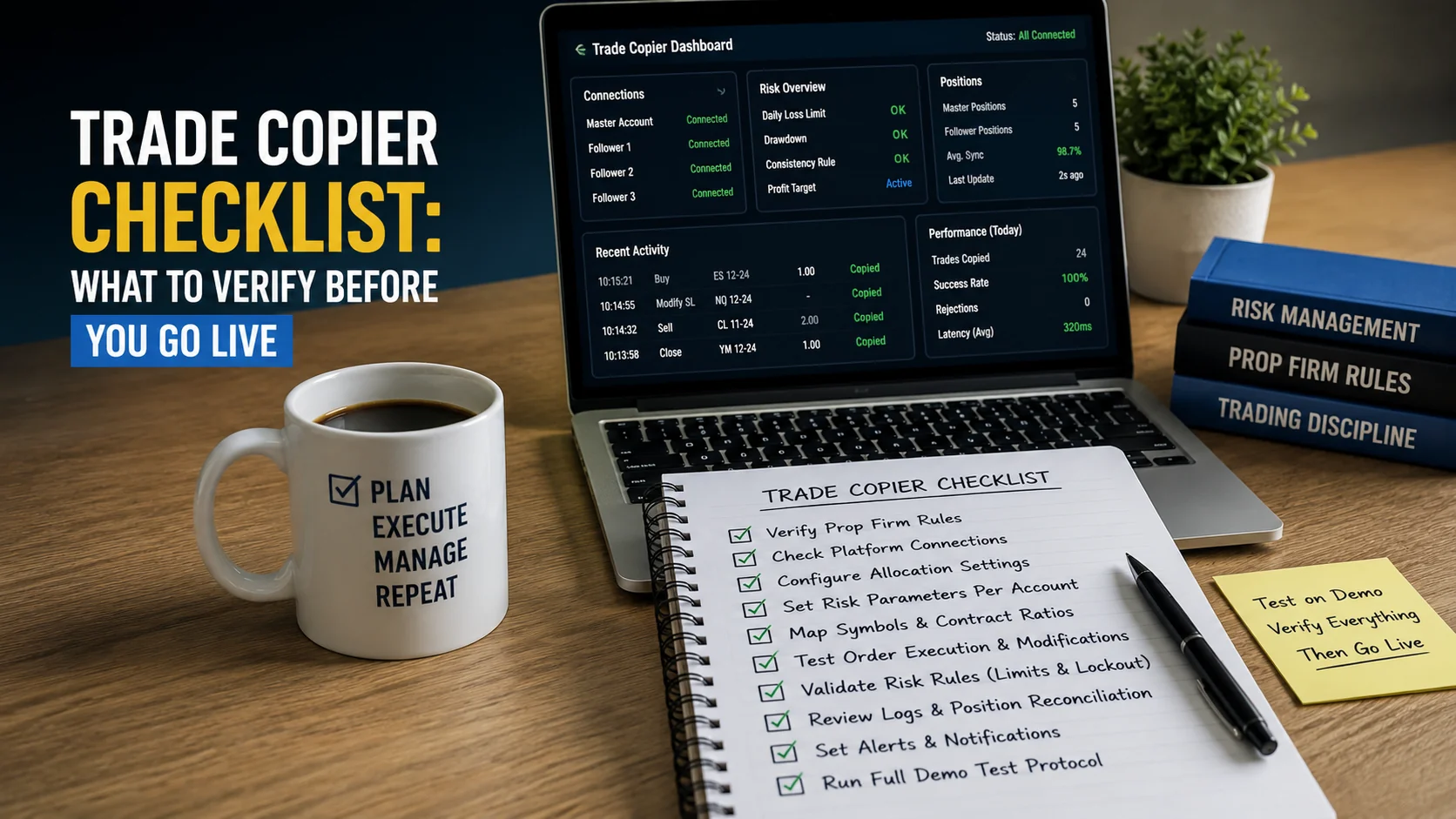
A thorough trade copier trial checklist evaluates the entire copying workflow, including market schedules, daylight saving changes, holiday exceptions and order behaviour around pauses. Because schedules can change, traders should verify official exchange information and maintain their checks over time.
Start your copy trading journey at tradecopier.org.
Quick answers
Frequently Asked Questions
Find answers to the most common questions about this topic.
Where can I copy trades for free?
Traders can investigate free trials, demo accounts or free-tier copy trading tools. Availability, supported brokers and feature restrictions vary, so the trial terms should be checked before use.
Is there any free trade copier?
Yes, some providers offer free access or trial periods. However, a free option may have limits on accounts, instruments, execution features or usage duration.
What are some good trading checklists?
Useful checklists cover account connectivity, market hours, order types, risk settings, execution reports, scheduled breaks and holiday exceptions. A trial checklist should also include recovery and error-handling tests.