cTrader to MT4 or MT5 Trade Copier:
Two Route Checklists
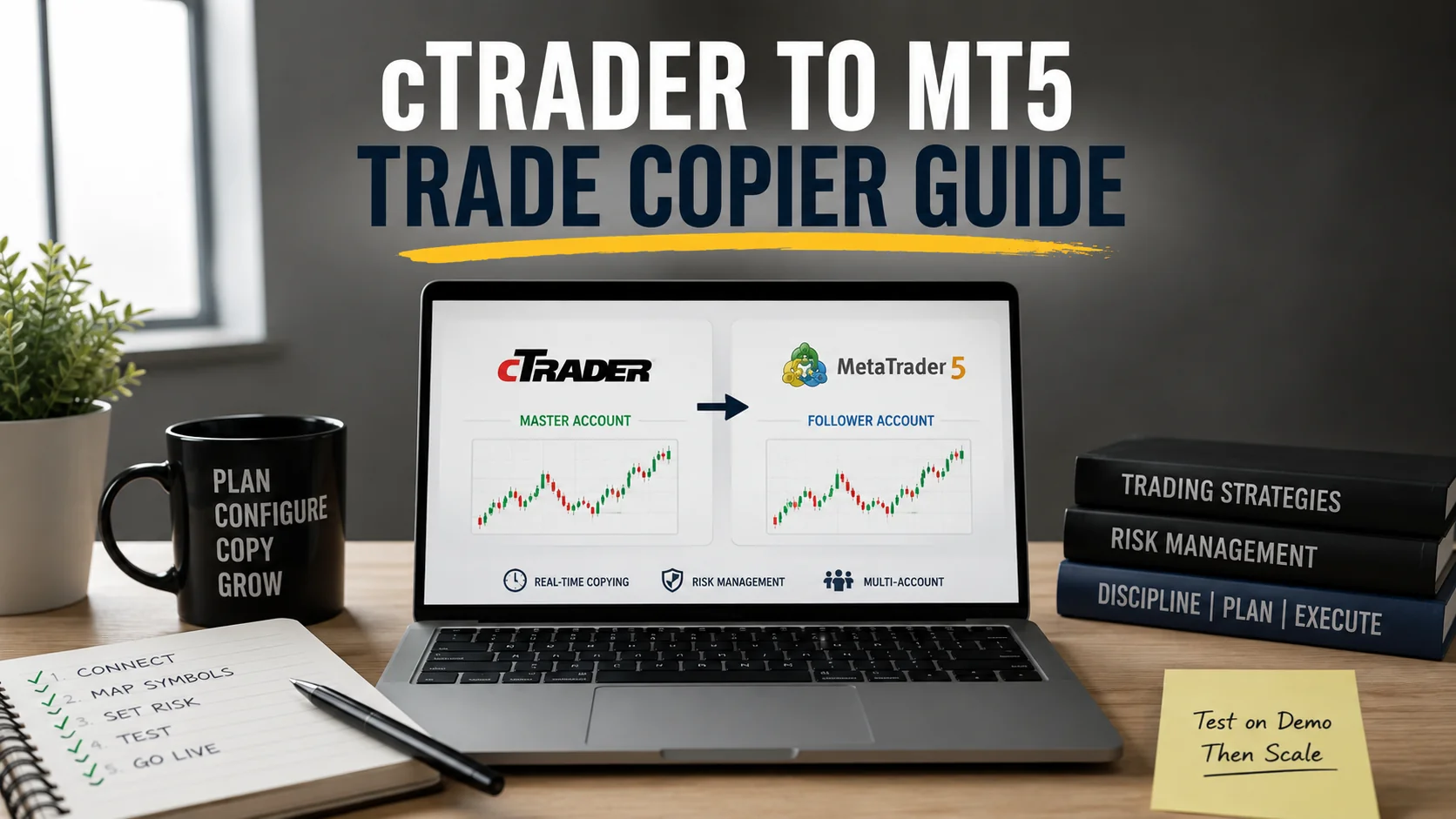
cTrader to MT4 and cTrader to MT5 are two different copying routes. TradeCopier supports cTrader, MT4 and MT5 as platforms, but a platform listing does not establish that your particular source account can copy to a particular follower broker in either direction. Confirm each route's current setup instructions, account mode, instrument and order actions, then compare the follower broker's actual orders and positions with the intended result.
Publisher disclosure: TradeCopier publishes this guide about its own product. Its platform catalog also lists NinjaTrader 8, DXTrade, TradeLocker, MatchTrader and VertexFX. The self-service account menu inspected September 24, 2026 showed MT5, TradeLocker and cTrader; ask support for current MT4 setup instructions. This article is an editorial test plan, not a report of a completed cTrader-to-MT4 or cTrader-to-MT5 broker order, latency benchmark or customer outcome.
Confirm the direction before connecting accounts
A cTrader source and an MT4 follower are not interchangeable with an MT4 source and a cTrader follower. The same is true of the two cTrader/MT5 directions. For each proposed route, record the source and follower account aliases, brokers, servers, live or demo modes, product permissions and required online components. Obtain the current connection steps through your dashboard or TradeCopier support. Do not install a third-party EA, cBot or DLL based solely on a generic platform tutorial.
| Proposed direction | Confirm before setup | Observe in a controlled test |
|---|---|---|
| cTrader source to MT4 follower | Current MT4 setup path, broker server, account permissions, source event scope and destination symbol rules | MT4 broker order, requested and filled lots, stop and target state, close behavior and final position |
| cTrader source to MT5 follower | MT5 broker server, hedging or netting mode, source event scope and destination symbol rules | MT5 order, deals, resulting position, protection changes and any rejection or unresolved event |
The cTrader-to-MT5 guide examines the second direction in more detail. An observed result on either route does not certify the other route, another broker, a live account or every order type.
Map the destination instrument and quantity
A similar symbol label is not enough. The source might display EUR/USD while the follower broker exposes EURUSD or a suffix such as EURUSD.pro. Confirm that both instruments represent the intended market, then record each broker's contract size, minimum volume, volume step, trading session and permitted order types. TradeCopier's symbol-mapping overview explains the product control; the MQL4 symbol reference and MQL5 symbol properties describe fields to inspect on the actual account. None supplies universal values for every broker.
For a fictional illustration, suppose a cTrader source event refers to 10,000 currency units. If the destination broker defines one full lot as 100,000 units for the mapped instrument, a 0.10-lot request would represent 10,000 units before any separate follower sizing rule. A different contract definition or permitted lot step changes the calculation. These numbers are arithmetic examples, not TradeCopier execution data or a recommended trade size. Check the destination account's live specification and risk limit before submitting a test request.
Test the full order lifecycle
An opening request is only the first case. List the actions your strategy actually uses: market or pending entry, modification, stop-loss and take-profit changes, partial close, full close, cancellation and reconnect behavior. Record the expected follower state before each permitted demo or small controlled test. If an action is unsupported or its outcome is unavailable, label it that way rather than assuming it synchronized.
Spotware's Open API model documentation distinguishes account rights, orders, deals and positions. MetaQuotes likewise explains that an accepted MT5 OrderSend request does not itself prove completed execution. These platform concepts help design the check; they do not establish which fields or actions every TradeCopier connector exposes. Compare source and copier activity with the destination broker's order, fills or deals, working orders and final position.
Do not retry an uncertain request just because the copier or broker connection timed out. First inspect the destination account. A delayed acknowledgement can coexist with a filled order, and an unexamined retry could create duplicate exposure.
Separate cloud routing from connector uptime
TradeCopier hosts its routing layer, so you do not need a personal VPS to run that layer. A selected broker or platform connection may still need an authenticated session, terminal or other component to remain available. Ask where that component runs and what happens after a disconnect. A VPS can be useful for a separately confirmed local dependency, but no blanket speed or reliability advantage follows from the word “VPS.” Measure the actual route and include broker outcomes before making a performance claim.
For prop-firm accounts, technical connectivity and firm permission are separate. Check the current firm's rules for the exact account owner, program, stage, platform and copying arrangement. A copier cannot grant contractual permission or guarantee that an equity rule will prevent a breach.
Keep one acceptance record per route
- Write down the source and follower aliases, broker servers, account modes, connection method and direction.
- Save the actual destination symbol, contract size, volume step, order permissions and intended sizing rule.
- Define expected opening, modification, protection, closing and recovery results for the actions you need.
- In an approved test environment, compare source events and copier decisions with broker orders, fills and final positions.
- Mark missing evidence or an unresolved request as unknown. Retest after a broker, account mode, connector, instrument or rule change.
The MT4-to-MT5 guide addresses another direction, and the cross-platform feature page explains general connection checks. Neither substitutes for a dated test of your cTrader source and chosen MT4 or MT5 follower.
Quick answers
Frequently Asked Questions
Find answers to the most common questions about this topic.
Does TradeCopier support cTrader, MT4 and MT5?
Yes. All three are in TradeCopier’s supported platform catalog. The inspected self-service account menu showed cTrader and MT5 but did not show an MT4 setup choice; ask support for current MT4 instructions. Platform support does not certify your exact broker pair, direction or order actions.
Can I copy cTrader trades to both MT4 and MT5 followers?
Plan cTrader-to-MT4 and cTrader-to-MT5 as separate routes. Confirm current setup instructions, broker servers, account modes, instruments and supported actions for each follower, then test and reconcile each broker result. This guide does not report a completed two-follower product test.
Will stop-loss changes and partial closes always synchronize?
Do not assume so. Confirm that the exact route supports each required action, test it where permitted and inspect the destination order and position. A source change or copier event alone does not prove a broker accepted or filled it.
Is a personal VPS required for cTrader to MT4 or MT5 copying?
TradeCopier hosts its routing layer. A specific source or follower connection may still need an online terminal, authenticated session or connector. Confirm that dependency and its location before turning off a computer or renting a VPS.
Does a faster copier guarantee matching fills?
No. Router timing is separate from broker execution. Quotes, liquidity, account permissions, instrument specifications, order size and network conditions can change the follower result.
Can I use this route with a funded account?
Only if the firm’s current rules permit the exact account ownership, software and copying arrangement. Confirm provider permission separately from technical setup and verify the destination account’s actual orders, positions and limits.